

Laminated Core: What the Definition Actually Requires
A laminated core is a magnetic circuit built from many insulated sheets. The sheets are stacked in order and clamped, so eddy current stays inside each one. That definition rests on four numbers. Jiangsu Zhongtong Weiye Special Steel Co., Ltd. walks them below, using a non-oriented electrical steel sheet as the example.
The Four Numbers
Thickness, shape, build height, and pattern decide what a stack becomes. Change one, and the loss, the labour, and the noise all move. Hence a lamination drawing carries all four, so a quotation follows them. A comparison note covers the rival build.
One — Sheet Thickness
Thickness sets how much eddy current each sheet traps, because a thin sheet holds less area for a loop. A 0.23 mm sheet traps far less than a 0.65 mm one, at the same frequency. A thin sheet also means more pieces per build, so labour rises as gauge falls. Hence thickness trades loss against handling. The thickness note covers the range.
Two — Sheet Shape
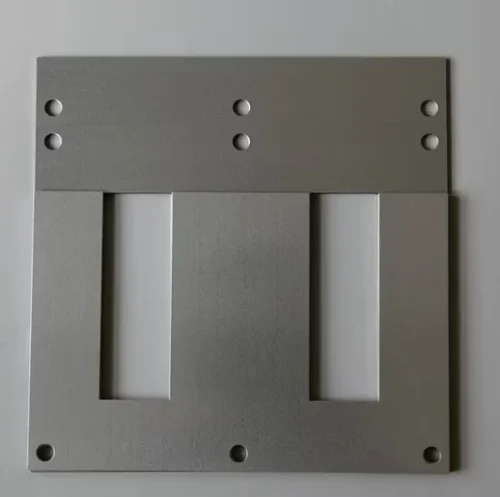
Shape follows the magnetic path, so a lamination carries the outline of a device. An EI set serves a small transformer, while a full ring serves a toroid, and a sheet note lists both. A step-lap design uses four distinct shapes, so each one sits at a corner. Hence shape count decides die cost, and die cost decides batch size.
Three — Build Height
Build height converts into piece count, although the stacking factor sits inside that sum. A 50 mm nominal build at 96 percent holds 48 mm of steel. A 0.35 mm sheet then needs about 137 pieces, rather than the 143 a nominal divide gives. Hence the factor changes the count, and the count changes press hours. The factor note covers that ratio.
Four — Joint Pattern
Joint pattern decides how much reluctance the corners add, so three patterns dominate. A single overlap puts every seam in one place, so it runs fast and lossy. A step-lap staggers the seams across two or three positions, so loss falls. Full interleaving rotates each layer, so the seams spread across the whole stack. Hence pattern is the cheapest magnetic upgrade in a stack, and a noise note covers its side effect. The loss note covers the accounting.
Who Owns Which Number
Three people touch a stack, although each owns one number. The tool engineer owns shape, because the die follows the outline. Height belongs to the builder, since piece count sets the table time. Thickness and pattern belong to the test engineer, because those two move the loss reading. Hence a change needs three signatures, while a verbal change needs none. That gap causes most disputes, and it costs the least to close.
Clamping and Bonding
Four methods hold a stack together, although each leaves a mark. Interleaving needs no fastener, because the pieces lock themselves. Through bolts need holes, so they remove magnetic area. Rivets need space, so they remove area at the corner. A bond needs adhesive, which survives only below a rated temperature, as the heat note explains. Hence the method trades assembly cost against area. The coating note covers the adhesive side.
The Order of Assembly
Assembly follows the pattern, so the pattern decides the table layout. A single overlap builds from one side, and a worker keeps one seam line in view. A step-lap builds in layers, so the table carries four piles at once. Full interleaving rotates every layer, so the worker turns the stack each pass. Hence labour rises with magnetic quality, and the quote should say so. A table note covers a motor case.
What the Drawing Must Show
Five items on a drawing prevent a wrong build. Thickness, outline, build height, pattern, and clamping method. A drawing that omits the pattern leaves the builder free to choose, so the choice becomes a loss dispute. Hence a stack order starts with a pattern code, rather than a grade alone. A burr note covers the edge.
What Goes Wrong
One buyer specifies a single overlap, then wonders why loss runs high. Another builds to nominal height, so the piece count runs short. A third bolts through the limb, and that removes area where flux runs. Those three errors arrive monthly, and a pattern code prevents the first.
What We Do Not Do
We do not melt or roll steel. We do not stamp or stack a customer’s core, because those steps belong to the builder. Nor do we quote a stack loss figure without a pattern.
Those limits keep the answer honest, and they keep a definition exact.
Specify Your Order
Give the thickness, the outline, the build height, and the pattern. Those four fields then price a stack. Add the clamping method, because bolts and bonds differ in area. A grain oriented sheet covers an oriented duty. A cut core covers a wound alternative. That reply usually takes a day.
Related Reading
The build note covers the rival design. The texture note explains how flux crosses a corner. A hub page answers six basic questions.
Frequently Asked Questions
Many insulated sheets, stacked in order and clamped.
To stop eddy current crossing from one sheet to the next.
About 137 at 0.35 mm, with a 96 percent stacking factor.
A step-lap, since seams never sit in one line.
Yes, since pressure adds stress to the sheets.
- Email: vera.liang@ztwysteel.com
- Location: Xishan District, Wuxi, Jiangsu, China
- Supply range: CRGO and CRNGO 0.20–0.65 mm, four coating classes
- Slitting: 20–1,250 mm, ±0.05 mm, burr under 0.02 mm
- Documentation: MTC EN 10204 3.1 with grade, thickness and loss basis, 3.2 on request







 English