

CRNGO Thickness Range: Which Gauge Survives Each Filter?
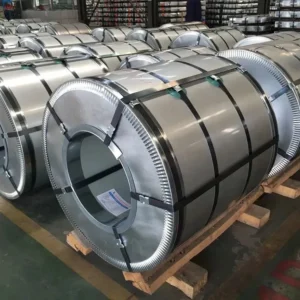
A motor designer rarely picks a gauge from a page, since three conditions filter the list first. The CRNGO thickness range in normal supply runs 0.35 to 0.65 mm, and 0.50 mm survives most screens. Jiangsu Zhongtong Weiye Special Steel Co., Ltd. applies the three filters in order below, using a non-oriented electrical steel sheet as the example.
The Short Answer
Three gauges cover the trade, since 0.35, 0.50, and 0.65 mm answer nearly every order. Frequency removes one, core size removes another, and stamping cost settles the rest. Hence a 50 Hz motor usually lands on 0.50 mm. An inverter-fed machine at 400 Hz instead leaves for 0.20 to 0.27 mm.
Filter One — What Frequency?
Eddy loss grows with the square of gauge, so frequency decides how heavily that term weighs. At 50 Hz a 0.65 mm sheet carries 3.45 times the eddy loss of a 0.35 mm sheet. At 400 Hz the gap widens further, since the term itself grows with frequency squared. Hence a high-speed machine cannot carry a thick sheet, whatever its price. A thin gauge note covers the far end of that curve.
Filter Two — How Big Is the Core?
Frame size filters next, because a large core tolerates a thick sheet better than a compact one does. A 0.65 mm sheet suits a large rotating machine, since the core is tall and the tooth stays wide. A 0.35 mm sheet suits a compact or high-speed rotor, since the flux path turns sharply there. Therefore, the gauge follows the geometry rather than the power rating alone.
Filter Three — What Does Stamping Cost?
The third filter is the press, since a thin sheet costs more strokes and a thick sheet costs more force. Cutting force follows shear strength, perimeter, and thickness. A 100 mm profile therefore needs 13 kN at 0.50 mm, against 9.1 kN at 0.35 mm. The thin sheet saves no labour, since it needs 43 percent more pieces for the same stack. Each piece still needs a stroke. Hence a stamper weighs die life against press time.
The Survivor — 0.50 mm
The 0.50 mm gauge survives all three filters in most 50 Hz work, since it balances three competing costs. It also stamps with familiar tooling, so a change of supplier disturbs no die. That is why 50W470 anchors many quotations, since the code names this gauge. Therefore, a first sample usually arrives at half a millimetre.
What a Tonne Buys
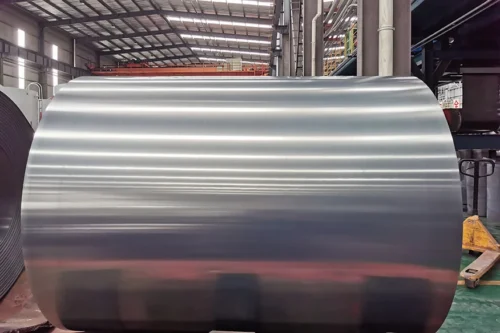
Gauge changes the length inside a tonne, and the swing between stops is wide. At 0.35 mm a square metre weighs 2.748 kg. The 0.50 mm stop gives 3.925 kg, and 0.65 mm gives 5.103 kg. Slit to 1,000 mm, five tonnes therefore buys 1,820, 1,274, or 980 metres, since the mass per metre moves. Hence a price per tonne hides a large difference in usable metres.
Two Families, Two Ranges
The oriented family sits lower on the scale, because its thin gauges serve transformer cores. A CRGO coil runs 0.23 to 0.35 mm, while non-oriented stock runs 0.35 to 0.65 mm. Hence a buyer who moves between families also moves between ranges. A gauge from one rarely suits the other.
The Tolerance Band
Each gauge arrives as a band rather than a figure, since the mill works to plus or minus 5 percent. On 0.50 mm the band runs 0.475 to 0.525 mm, and on 0.35 mm it runs 0.3325 to 0.3675 mm. A stack of 1,000 sheets then varies by 50 mm across that band. A fixed build therefore needs the band in writing.
What Goes Wrong
One buyer keeps 0.65 mm for an inverter-fed machine, then pays in eddy loss. Another drops to 0.35 mm for a large 50 Hz stator, although the gain never arrives. A third orders a gauge no mill rolls, then accepts a substitute without checking its basis. Those three errors arrive monthly.
What We Do Not Do
We do not melt or roll steel. We do not substitute a gauge without written approval, since the drawing belongs to the customer. Nor do we quote a 0.20 mm non-oriented coil as routine stock, because that gauge sits near the rolling floor.
Those limits keep the answer honest, and they keep a stamping line predictable.
Specify Your Order
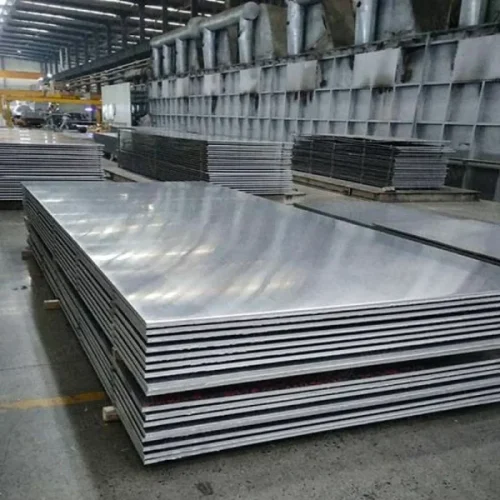
Give the frequency, the frame size, the gauge, and the stamping volume, since four fields pick the survivor. Add the tolerance band when the stack height is fixed. A silicon electrical steel sheet then ships with its gauge and band printed. A silicon steel sheet then arrives sheared to width. That reply usually takes a day.
Related Reading
Our CRGO range note covers the oriented side. The grade guide maps all four naming patterns. A hub page answers six basic questions.
Frequently Asked Questions
0.35 to 0.65 mm, in three steps.
0.50 mm, since 50 Hz work dominates.
Yes, when it runs at high frequency.
It needs more force, yet fewer strokes.
No, it arrives as a band of plus or minus 5 percent.
- Email: vera.liang@ztwysteel.com
- Location: Xishan District, Wuxi, Jiangsu, China
- Supply range: CRGO and CRNGO 0.20–0.65 mm, four coating classes
- Slitting: 20–1,250 mm, ±0.05 mm, burr under 0.02 mm
- Documentation: MTC EN 10204 3.1 with grade, thickness and loss basis, 3.2 on request




 English