

Stamped Laminations: What a Supply Order Actually Covers
A buyer asks for stamped laminations and receives four quotations that cannot be compared. Stamped laminations supply covers four distinct forms, so the form belongs in the enquiry. Jiangsu Zhongtong Weiye Special Steel Co., Ltd. sets the options out below, using a grain oriented electrical steel sheet for transformer cores as the example.
Stamped Laminations Supply in Brief
Name the form, the drawing, and the die owner, so that quotations become comparable. Loose sheets, an interleaved stack, a bonded block, and an annealed batch are four products. Hence a price without that form is a guess. A wound and laminated core comparison explains what the stack finally becomes.
Four Forms of Stamped Laminations Supply
Four forms cover most orders, and each one changes both price and labour. The list below runs from the cheapest sheet to the most finished block.
Loose Electrical Steel Stampings
Loose sheets arrive flat, counted, and crated, with nothing joined. No further stamping happens, so the buyer stacks in house. This form suits a builder that owns a stacking line, since freedom matters more than price. Hence it carries the lowest piece price, along with the highest customer labour.
Interleaved Stamped Laminations
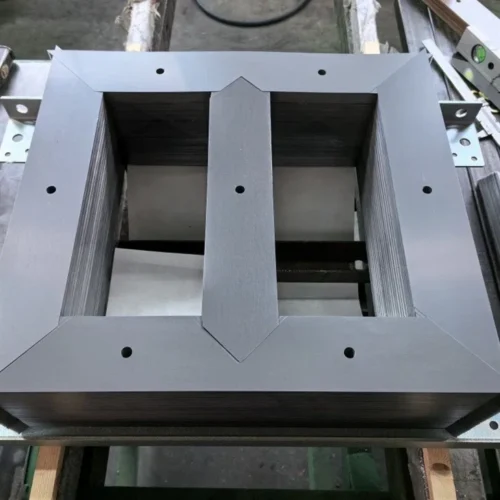
An interleaved stack arrives ready to wind, since each layer rotates to spread the seams. The builder saves table time and gains lower loss, because seams never line up. Hence this form suits a shop without a stacking table. The stacking factor of silicon steel explains the height effect.
Bonded Transformer Core Lamination
A bonded core arrives as one block, since adhesive joins the layers during build. That block resists vibration, so it suits a unit that must stay quiet. The bond also caps service temperature, because adhesive has a limit near 180 degrees. Hence this form suits a fixed duty, rather than a hot one. A heat resistant temperature of silicon steel covers that ceiling.
Annealed Stamped Laminations
An annealed batch leaves the furnace after stamping, so punching stress has relaxed in part. Loss recovers towards the parent figure, while the price carries the cycle. Hence this form suits a unit with a tight no-load guarantee. An annealing after stamping note covers the cost and benefit sum.
Custom Stamped Laminations: What the Drawing Must Carry
Five items make a drawing quotable, and each removes a question. Thickness, outline, build height, pattern, and clamping method. A drawing without a pattern leaves the choice open, so two suppliers quote two different products. Hence a pattern code saves a round of emails, and it saves a dispute later. A silicon steel burr limit covers the edge tolerance.
Transformer Core Stamping: Tolerances That Decide Fit
Three tolerances decide whether a stack fits, although each has a different source. One belongs to the stamper, and two belong to the steel supplier.
Outline Tolerance Follows the Die
An outline holds about plus or minus 0.10 mm on a fresh die. It tightens near 0.05 mm once the tool settles. The die sets that figure, rather than the steel, so a worn tool widens it. Hence a buyer should ask for the die history before accepting a tight callout.
Burr Stays Under 0.02 mm
Burr stays under 0.02 mm, because a taller burr bridges the coating and shorts the layers. A why silicon steel sheets need insulation page covers that failure. Hence the limit protects the magnetic result, rather than the appearance.
Slit Width Within 0.05 mm
Slit width runs within plus or minus 0.05 mm, since it comes off our slitting line. That tolerance sets the blanking allowance, so a narrow strip forces a tighter die. Hence width and die clearance should be agreed together. A custom size silicon steel coils and sheets note covers the width range.
Motor Lamination Stamping: Whose Die Runs
Three arrangements cover most orders, and each one moves the tooling cost to a different party.
A Customer Die Travels
A customer die may travel to a partner press, so the tool stays the buyer’s property. We book the run, hold the tolerance, and return the die after the batch. Hence the buyer keeps control of the geometry.
A Partner Die Already Exists
Where a partner die already exists for a common outline, no tooling charge applies. That saves money, although the outline must match the existing tool. Hence a standard frame often quotes faster than a custom one.
A New Die Lands on the First Batch
Should a new die be needed, the tool cost lands on the first batch. An electrical steel coil MOQ note covers the batch side. Hence a first order carries a burden that a repeat order does not.
Batch Size and Tooling Cost
Tooling cost divides by batch size, so a small batch carries a heavy share of it. An 8,000 dollar die spread over 10,000 pieces adds 0.80 dollars per piece. The same die over 1,000 pieces adds 8 dollars per piece, so it can double a quote. Hence batch size decides whether a new die makes sense. An electrical steel quotation speed note covers the reply time.
What Ships With a Stamped Lamination Order
Four documents travel with a stamped batch, and each one settles a later question. A mill certificate names the grade and the loss basis. Dimensional data covers slit width and burr. Pieces are counted by form on the packing list. A photo set records the stack as loaded, so a claim starts with paperwork rather than a phone call. A silicon steel standards note covers the certificate.
What Goes Wrong
One buyer compares a loose price with a bonded price, then rejects the sound one. Another omits the pattern, so two quotes describe two products. A third orders 1,000 pieces against a new die, then blames the piece price. Those three errors arrive monthly, and each starts with a missing field.
What We Do Not Do
We do not melt or roll steel. We do not run a press here, because stamping happens at a partner works under our order. Nor do we build a die, although we book the run and hold the tolerance.
Those limits keep the answer honest, because a supply chain should be described as it is.
Request a Quotation
Send four items, so that a reply carries a real price. Send the drawing, the gauge, the batch size, and the die owner. We answer a drawing enquiry within one working day, and a quotation stays valid for two weeks. Hence a decision can be planned, rather than rushed. The tonnage then comes from a silicon steel sheet weight calculation note.
A non oriented electrical steel for motor stampings suits a rotating duty. A cut core lamination for a 100 kVA transformer instead suits a wound design. Both ship with the same documents.
Related Reading
The laminated core definition covers the stack itself. A stamping stress and core loss note covers the punch penalty. A silicon steel hub page answers six basic questions.
Frequently Asked Questions
Loose sheets arrive separate, and bonded layers arrive as one block joined by adhesive.
About plus or minus 0.10 mm on a new die, and near 0.05 mm once the tool settles.
A partner works runs it, while we hold the order, the tolerance, and the report.
An 8,000 dollar die adds 0.80 dollars at 10,000 pieces, and 8 dollars at 1,000.
No, although we book the run and hold the tolerance on the outline.
One crate, which usually runs near 500 kg, so a drawing sets the exact figure.
Only as slit strip or cut sheets, since a stamped outline needs a tool.
- Email: vera.liang@ztwysteel.com
- Location: Xishan District, Wuxi, Jiangsu, China
- Supply range: CRGO and CRNGO 0.20–0.65 mm, four coating classes
- Slitting: 20–1,250 mm, ±0.05 mm, burr under 0.02 mm
- Documentation: MTC EN 10204 3.1 with grade, thickness and loss basis
- Response time: drawing enquiries answered within one working day, quotes valid two weeks




 English