

Custom Size Silicon Steel Coils & Sheets: Tailored Solutions for Electrical Manufacturers
Custom size silicon steel coil pricing depends on six lines in your request, and most buyers leave two of them blank. In practice, an incomplete RFQ forces assumptions, and assumptions then become disputes at the dock. Consequently, a clear template saves weeks. Jiangsu Zhongtong Weiye Special Steel Co., Ltd. quotes against exactly that template, so here it is.
Line 1 — Grade and Loss Limit
Name the grade, or state the loss you can accept at a defined induction. For instance, “P1.5/50 ≤ 4.0 W/kg” pins the material far better than “M19” alone. Therefore, give a number whenever you can.
Line 2 — Gauge With a Measurement Basis
Gauge requires a basis, since coating adds 1–3 µm to the measured figure. Hence write “0.35 mm before coating” or “0.35 mm after coating”, and never leave it open. Moreover, tolerance should be explicit, typically ±0.02 mm.
Line 3 — Slit Width and Tolerance
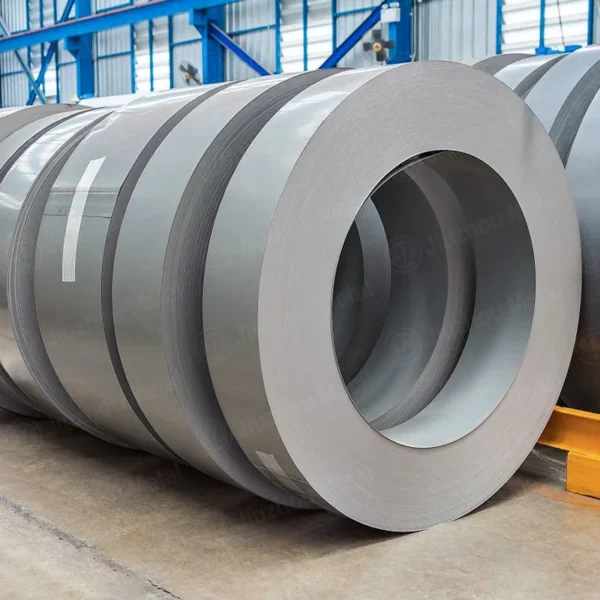
Width follows your nesting plan, not our stock list. Standard slit range runs 20–1250 mm, and tolerance holds ±0.05 mm. Furthermore, burr must stay under 0.02 mm, because burr damages coating at the edge.
Two practical limits matter. Edge trim consumes 1–2% of the master coil, and each additional width change adds setup scrap. Therefore, ordering several widths at once distributes that cost.
Line 4 — Coil Format
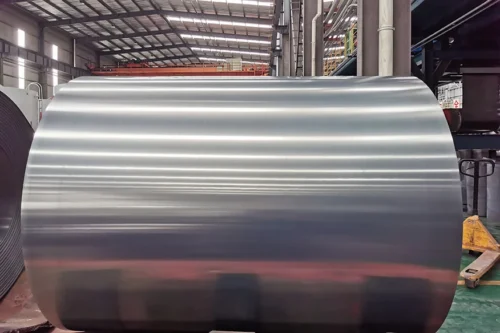
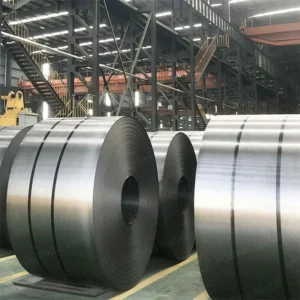
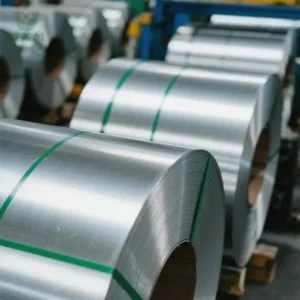
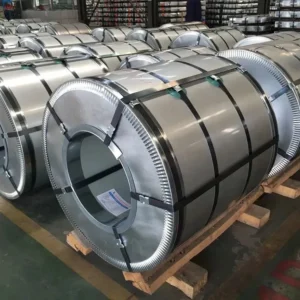
Coil weight and bore decide handling, so specify both. Standard bore is 508 mm, while coil weight usually sits between 3 and 8 tons. Subsequently, a 5-ton limit keeps forklift handling safe at most plants.
Outer diameter matters too, since a container door limits what fits through it. Hence mention the destination plant’s crane capacity when you order.
Line 5 — Coating Type
Coating choice follows your process, and the wrong film fails quietly. C-5 suits general impregnation, while C-6 handles heavier builds. In addition, self-bonding coatings eliminate clamping in some stacks.
Where varnish baking runs hot, adhesion becomes the deciding property. Consequently, state your cure temperature instead of just naming a coating code.
Line 6 — Cutting, Packing, and Paperwork
Sheets require cut-to-length service, with length tolerance normally ±1 mm. Coils require VCI paper, edge protectors, and desiccant. Furthermore, every shipment needs MTC EN 10204 3.1 plus a packing list with photographs.
Incoterm belongs here as well, because FOB and CIF change who absorbs transit damage. Therefore, agree it before the coil is slit.
What Custom Sizing Cannot Fix
- Gauge drift: comes from the mill, not from slitting.
- Loss shortfall: no width change recovers a wrong grade.
- Flatness defects: worsen slightly after slitting, never improve.
- Texture direction: oriented sheet stays directional regardless of width.
Hence custom sizing solves fit, and it cannot solve metallurgy.
Where It Pays
Narrow widths cut stamping skeleton waste, often by several points of utilisation. Moreover, exact widths reduce die wear, since alignment improves. Subsequently, scrap revenue rises while press downtime falls.
For a 620 mm stator, ordering 620 mm coil beats buying 1000 mm and trimming in-house. That margin alone frequently covers the slit charge.
Related Reading
Our existing custom coil and sheet overview covers formats in more depth. Programme-level planning appears in the batch lamination note.
Frequently Asked Questions
About 20 mm, although narrow slits raise burr risk and cost.
Yes, cut to length with ±1 mm tolerance.
Typically 5–7 days, since width changes run in sequence.
Slightly, because setup scrap and slitting labour enter the quote.
508 mm, with 610 mm available on request.
What We Do Not Do
- We do not roll or anneal steel.
- We do not stamp laminations.
- We do not hold width stock against future orders.
Consequently, we slit, pack, and document, while your engineers own the design.
Specify Your Order
- State grade and loss limit.
- Give gauge with its basis.
- Give width, coil weight, then tonnage and port.
M19 Non Oriented Electrical Steel and M36 Non Oriented Electrical Steel both ship to your width, and quotes return within one working day.
- Email: vera.liang@ztwysteel.com
- Location: Xishan District, Wuxi, Jiangsu, China
- Supply range: CRNGO M19–M47 at 0.35–0.65 mm, CRGO M4/M5 at 0.23–0.35 mm
- Slitting: 20–1250 mm, ±0.05 mm, burr under 0.02 mm
- Documentation: MTC EN 10204 3.1, core loss per ASTM A343 / IEC 60404-2




 English