
Silicon Steel Mill Grades: What a Buyer Can Actually Order
A mill code answers part of the buyer’s question before any price arrives. Silicon steel mill grades fix thickness and watt loss in their own letters. This page lists the mill systems we can source. It also states plainly what that sourcing does and does not cover. Jiangsu Zhongtong Weiye Special Steel Co., Ltd. supplies grain oriented electrical steel sheet for transformer cores from stock, and we slit it to your width.
Silicon Steel Mill Grades in Brief
Three mill systems cover most of what we ship. Baosteel, WISCO, and Ansteel. Each publishes its own grade code, and each code carries a thickness field and a loss field. Hence a buyer can compare two offers without a phone call, as long as both quotes name the mill code.
The Three Mill Systems We Can Source
Three systems cover the enquiries that reach us, although the paperwork differs for each one. The list below is ordered by order volume rather than by merit, since we do not compare mills.
Baosteel B Series
The B series carries a letter, a thickness, a letter, and a loss number. B35A300 then reads as 0.35 mm with 3.00 W/kg at 1.5 T. That series covers both grain oriented and non oriented duties, so it appears in transformer and motor orders alike. A Baosteel B series grade decoding page explains each field.
WISCO Grades
WISCO, now part of the Baowu group, publishes codes such as 23RK085 and 27RK095. The first two digits give thickness in hundredths of a millimetre, so 23 means 0.23 mm. The trailing number gives loss, so 085 means 0.85 W/kg at 1.7 T. Hence a buyer can rank two WISCO codes without opening a datasheet.
Ansteel Grades
Ansteel runs its own code system, which does not map field for field onto the other two. We quote it against the mill certificate, rather than against a guessed code. Hence an Ansteel enquiry should carry the certificate number, so the grade field stays traceable.
What Mill System Sourcing Means
Four statements define what we can offer, and each one keeps a claim honest. Read them before writing an order, since a wrong assumption here costs more than a price difference.
No Agency Appointment
We hold no agency appointment from any mill, so we never describe ourselves as an authorised distributor. What we hold is stock, a slitting line, and a document trail. Hence the mill brand on a coil reflects its origin, rather than a commercial tie.
The Mill Label Stays on the Coil
A coil keeps its mill label, so the brand, the code, and the heat number all remain readable. We do not re-label a coil under our own name. Hence the buyer receives the same identity the mill shipped.
We Slit, Store, and Document
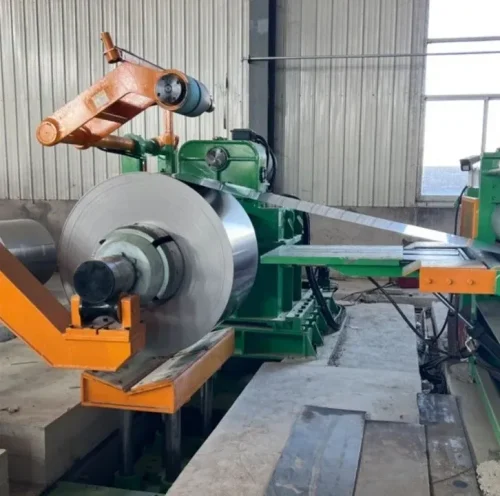
Our work starts after the mill gate, since we slit from 20 to 1,250 mm and hold stock in Wuxi. A custom size silicon steel coils and sheets page covers that range. Hence value comes from width and paperwork, rather than from melting.
No Relabelling, No Re-certifying
We do not change a label or reissue a certificate, because either act breaks the trail. A buyer who needs a different code should order that code, rather than ask for a conversion. Hence the document set stays as the mill issued it.
The Three-Place Check
Three places carry the same identity, so a mismatch exposes a substituted coil. The coil label, the mill certificate, and the heat number. Check the heat number across all three before accepting a delivery. Hence a substituted coil fails that check, while a genuine one passes it in a minute. A silicon steel standards four groups page covers the certificate side.

How a Mill Code Maps to a Quote
A mill code fixes thickness and loss, so a quote can stay short. Take B35A300 at 0.35 mm, which sits inside our 0.20 to 0.65 mm range. Take 23RK085 at 0.23 mm, which sits at the thin end. Hence a code plus a width plus a tonnage answers almost every enquiry we receive.
A silicon steel grade conversion page covers the national systems, since GB, EN, and ASTM name the same sheet differently. A what are the different grades of silicon steel page covers the field layout.
Stock Versus Mill Order
Two routes reach a buyer, and each one carries a different lead time. Stock ships from Wuxi in days, since the coil already sits on our floor. A mill order runs on the mill schedule, which usually means weeks. Hence a repair job takes stock, while a project takes a mill booking. An electrical steel coil MOQ page covers the minimum on each route.

What Ships With a Mill Grade Order
Four papers travel with the coil, and each one answers a later question. The mill certificate names the code and the loss basis, under EN 10204 3.1. Dimensional data covers the slit width and the burr. The packing list names the heat number and the coil weight. A photo set records the label as loaded. Hence a claim starts with paper, rather than with a phone call.
What Goes Wrong
One buyer orders by brand alone, then receives a code that misses the loss target. Another assumes an agency relationship, then asks us to press the mill for a concession. A third accepts a coil whose heat number differs from the certificate. Those three errors come up monthly, and the second one wastes the most time.
What We Do Not Do
We do not melt or roll steel. We do not claim an agency appointment, and we do not re-label a coil or reissue a certificate. Nor do we rank one mill against another, since each system fits a different duty.
These limits keep the answer honest: a brand name is a starting point, not a guarantee.
Request a Quotation
Send the desired mill code, the width, the tonnage, and the application. Those four fields then determine the coil price, and the fifth field sets the certificate type. A WISCO code and a Baosteel code can be compared side by side, since both carry a loss figure. We answer a grade enquiry within one working day, and a quotation stays valid for two weeks. The electrical steel quotation speed page explains that response time.
A non oriented electrical steel for motor stampings covers a rotating duty. A CRGO silicon steel coil covers a winder. Both arrive on the same document set.
Related Reading
The grain oriented steel coil guide covers the coil basics. A silicon steel hub page answers six basic questions. A custom stamped laminations page covers the next step down the chain.
Frequently Asked Questions
No, we hold stock and slit to order, so we claim no agency appointment.
0.35 mm thickness with 3.00 W/kg loss at 1.5 T, read from four fields.
0.23 mm thickness with 0.85 W/kg loss at 1.7 T, in the WISCO code.
Match the heat number across the coil label, the certificate, and the packing list.
No, since relabelling breaks the identity trail.
0.20 mm, while 0.23 mm and 0.27 mm are the common oriented picks.
Stock moves in days from Wuxi, while a mill booking usually runs in weeks.
- Email: vera.liang@ztwysteel.com
- Location: Xishan District, Wuxi, Jiangsu, China
- Supply range: CRGO and CRNGO 0.20–0.65 mm, four coating classes
- Slitting: 20–1,250 mm, ±0.05 mm, burr under 0.02 mm
- Documentation: MTC EN 10204 3.1 with grade, thickness and loss basis, 3.2 on request
- Response time: grade enquiries answered within one working day, quotes valid two weeks




 English