

Where Does Transformer Core Noise Come From?
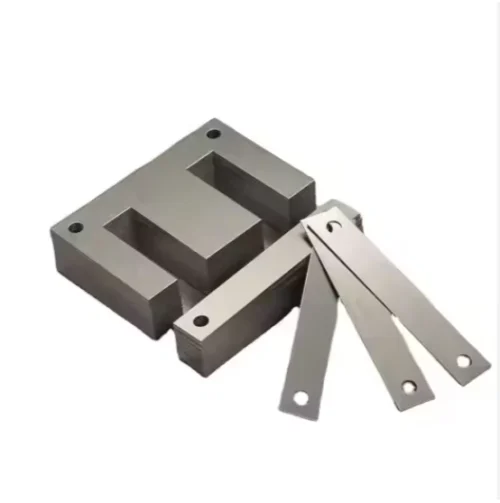
A strained sheet moves less than a hair’s width, and the room still hums. Transformer core noise therefore needs a scale chain, since four stages sit between a strain figure and a sound level. Jiangsu Zhongtong Weiye Special Steel Co., Ltd. walks that chain below, using a grain oriented electrical steel sheet as the example.
The Short Answer
A 3 percent silicon sheet strains about 1 to 3 parts per million at 1.5 T. A 500 mm limb therefore moves 0.5 to 1.5 micrometres, which is roughly fifty times finer than a hair. Sound still leaves the core, because the tank and the room amplify that motion. Hence a grading upgrade rarely fixes a noise complaint.
Stage One — The Strain
Magnetostriction is the source, and it stays small on oriented strip. At 1.5 T the strain reaches 1 to 3 ppm, which makes an invisible change in length. That figure grows fourfold as flux doubles, since the effect follows the square of flux density. Therefore, running a core at a lower peak buys quiet more reliably than any grade change does. The core material note explains the mechanism.
Stage Two — The Motion
Strain becomes motion once a length is attached to it, so limb size enters next. A 500 mm limb at 1.5 ppm moves 0.75 micrometres, while a hair measures about 70. Hence displacement stays below the eye, although a fingertip on a vibrating tank feels it at once. That step is pure arithmetic, since strain times length gives the movement.
Stage Three — The Amplification
The tank and the core respond as structures, and every structure carries modes. When a driving frequency lands near a mode, the motion multiplies, even though the source never moved. A 100 Hz hum from a 50 Hz supply arrives at the second harmonic, because strain repeats twice per cycle. Harmonics at 200 and 300 Hz then land on further modes. Hence two identical cores can differ by several decibels, once two different tanks hold them. The Hi-B note covers the harmonic pattern.
Stage Four — The Meter Reading
Sound reaches a meter as pressure after travelling through air, so distance sets the final stage. A doubling of distance drops about 6 dB, although doubling the sound power lifts 3 dB. At 100 Hz the wavelength runs 3.43 metres, which exceeds most tanks. The core therefore radiates almost evenly in every direction. Hence a reading at one metre is the usual convention, taken with A-weighting on the meter. The thickness note rules out gauge as a fix.
Which Stage to Attack
Stage one responds to flux density, and that field belongs to the designer. Limb length rules stage two, since transport and loss both constrain it. Structure decides stage three, and there the cheapest win sits. Distance fixes stage four, so the site owns it. Therefore, a noise clause should name the stage before it names a material, and the stage list is short.
What the Gauge Does Not Do
A thinner sheet cuts eddy loss, yet it leaves strain almost untouched, since the effect belongs to the crystal. A buyer who swaps 0.27 mm for 0.23 mm to cure hum will measure much the same sound. That outcome surprises buyers, although the physics stays plain. Hence a noise target and a loss target are two briefs, rather than one.
When Load Enters
A core measured at no load carries the magnetostriction source alone. Under load the windings add their own force, since current in a field pushes the conductor. That contribution rises with the square of current, so a heavily loaded unit hums above its no-load figure. Hence a noise clause should name the load condition as well as the distance. The loss note keeps the same habit on watts.
Modes Move With Temperature
A tank warms as the unit runs, and mild steel softens slightly as it does. That shift drags a mode away from the driving frequency, so the hum can settle lower within an hour. It can also climb, since the shift follows the mode’s starting point. Therefore, a single cold reading misleads, and a short soak helps. The thermal note covers the heat path.
What Goes Wrong
One buyer asks for a quieter grade, then receives a louder tank, since the mode moved. Another measures at 2 m, then compares that figure with a 1 m limit. A third tests at no load only, so the loaded unit later surprises them. Those three errors arrive monthly.
What We Do Not Do
We do not melt or roll steel. We do not measure sound, because that test needs the assembled unit. Nor do we promise a decibel figure from a certificate alone.
Those limits keep the answer honest, and they keep a noise clause enforceable.
Specify Your Order
Give the peak flux, the limb length, the tank type, and the limit distance. Four fields then locate the stage still open to you. Add the harmonic content when an inverter drives the core. A CRGO coil then ships with its strain class noted. A cut core arrives when the stack is built elsewhere. That reply usually takes a day.
Related Reading
Our magnetostriction note covers the material side. The large unit note sets the 65 to 75 dB site limit. A hub page answers six basic questions.
Frequently Asked Questions
Under a micrometre on a half metre limb.
Because strain repeats twice per cycle.
No, since strain belongs to the crystal and not to the gauge.
Lower peak flux, or a stiffer tank.
At one metre, with A-weighting.
- Email: vera.liang@ztwysteel.com
- Location: Xishan District, Wuxi, Jiangsu, China
- Supply range: CRGO and CRNGO 0.20–0.65 mm, four coating classes
- Slitting: 20–1,250 mm, ±0.05 mm, burr under 0.02 mm
- Documentation: MTC EN 10204 3.1 with grade, thickness and loss basis, 3.2 on request





 English