
What Is Hi-B Grain Oriented Steel?
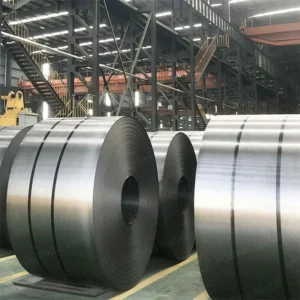
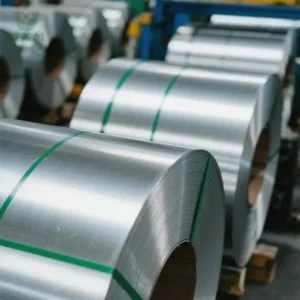
Two coils can carry the same loss figure and behave differently at the corner of a core. Hi-B grain oriented steel holds permeability where a conventional grade bends. That nerve shows at high induction, because the field pushes hardest there. Jiangsu Zhongtong Weiye Special Steel Co., Ltd. sets the two curves side by side below, using a grain oriented electrical steel sheet as the reference.
The Short Answer
Hi-B means high permeability, and the letter pair marks a sharper texture rather than a thinner strip. Both families carry a Goss alignment, so both point the easy axis down the rolling line. Neither guarantees it in every grain, though. The difference sits in how well they hold that alignment under a strong field, since a weak texture slips first. Hence Hi-B buys headroom, rather than a smaller watt figure, though the label rarely says so.
Two Ways to Grow the Same Grain
Conventional CRGO grows its Goss grains with a manganese sulphide inhibitor, while the mill usually cold rolls in two passes. Hi-B leans on aluminium nitride instead, so it often needs one cold rolling pass. The chemistry differs, so the anneal window differs as well. A CRGO coil then carries the result rather than the recipe. Therefore, the two families are cousins rather than neighbours, although both end at 1,200 °C.
Why the Quoted Point Looks Similar
A loss figure such as 0.85 W/kg is quoted at 1.7 T, and both families can hit it. That is why the sheets look interchangeable. Buyers then compare those numbers and conclude the premium buys nothing, because the basis stays invisible. That reading misses the field at which the figure was earned, since a number without a basis says little. Hence the label hides the curve behind it.
Where the Curves Fork
Above 1.7 T the conventional grade saturates sooner, so its loss climbs faster than Hi-B’s. A corner at 1.85 T can therefore cost a tenth more in watts on the cheaper sheet. The saving then moves to the wrong column. That gap widens as the design pushes harder, so a crowded corner pays twice. Therefore, headroom matters most where flux crowds. A silicon electrical steel sheet shows the same effect on a small test core.
Where They Converge
Below 1.5 T the two curves nearly meet, because neither grade fights the field there. A core held at 1.4 T gains almost nothing from the premium, although the invoice still rises. Hence a conservative design wastes the upgrade. The flux density note explains why the basis travels with every figure.
The Cost Side
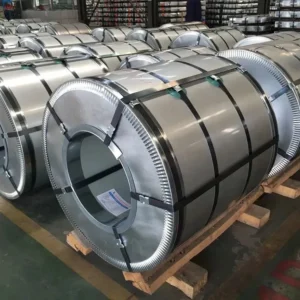
A Hi-B coil carries a premium over conventional CRGO, and a thin gauge adds another step. A 0.23 mm coil often costs near twice a 0.50 mm one, since rolling thinner takes more passes. More scrap follows too. CRGO in general sits near 1,700 to 2,400 USD per tonne FOB. A silicon steel sheet of plain CRNGO stays well below that band. Therefore, the upgrade has a price that a headroom gain must beat.
The Gauge That Comes Along
Hi-B grades commonly arrive at 0.23 to 0.30 mm. A sharp texture pays best when the eddy term stays small. A thick Hi-B sheet loses part of its advantage, since eddy grows with the square of gauge. Hence the family and the gauge travel together, so a buyer rarely picks one without the other.
Two Questions That Decide It
Ask what peak induction the design runs, and ask what the corner reaches. A design at 1.6 T with corners near 1.7 T gains little, so the cheaper grade wins there. A design at 1.75 T with corners near 1.9 T gains a measurable margin, so the premium pays. Therefore, the operating point decides the purchase, since the datasheet cannot read a drawing.
What Goes Wrong
One buyer orders Hi-B for a 1.5 T core and finds no change. The curves met there. Another compares a 1.7 T figure with a 1.8 T figure and therefore ranks them wrongly. A third mixes a Hi-B limb with a conventional yoke, so the corner still saturates despite the premium. Those three errors arrive monthly.
What We Do Not Do
We do not melt or roll steel. We do not redesign a customer’s core, since the drawing belongs to the builder. Nor do we claim a curve that no mill certificate plots, since a drawn curve needs test data behind it.
Those limits keep the answer honest, and they keep the premium arguable.
Specify Your Order
Give the peak induction, the corner induction, and the gauge, since the three decide the family. Add the loss basis when the figure arrives without one, since a bare number cannot be ranked. A CRGO coil then ships with its curve, while a cut core arrives already built from one family. That reply usually takes a day.
Related Reading
The grade note explains how a name such as 23P85 encodes its basis. Our hysteresis note covers the loop that a sharper texture narrows. A hub page answers six basic questions.
Frequently Asked Questions
No, it means a sharper texture.
Aluminium nitride rather than manganese sulphide.
No, since the premium covers the extra process.
Barely, because the curves nearly meet there.
Better not, since the corner takes the weaker one.
- Email: vera.liang@ztwysteel.com
- Location: Xishan District, Wuxi, Jiangsu, China
- Supply range: CRGO and CRNGO 0.20–0.65 mm, four coating classes
- Slitting: 20–1,250 mm, ±0.05 mm, burr under 0.02 mm
- Documentation: MTC EN 10204 3.1 with grade, thickness and loss basis, 3.2 on request



 English