

Which Grade Suits a Large Power Transformer?
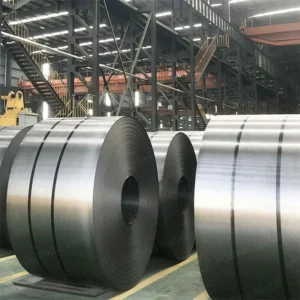
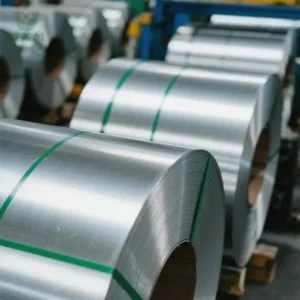
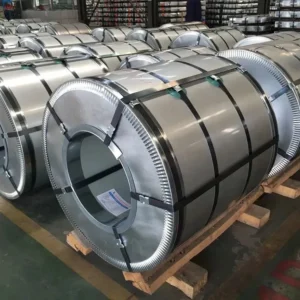
A 300 MVA unit answers to three masters at once, so a grade that pleases one can fail another. A large power transformer grade is therefore a compromise, since loss, noise, and transport weight pull in different directions. Jiangsu Zhongtong Weiye Special Steel Co., Ltd. sets out the three corners below, using a CRGO sheet as the example.
The Short Answer
Units above roughly 100 MVA usually take 0.23 to 0.27 mm strip in high-induction grades. A 27RK095 grade clears most loss guarantees, while 23RK085 answers the tightest ones. Above 0.27 mm the eddy term grows faster than the price falls, so the thick stops drop out. Hence the band is narrow, and the arguments inside it are commercial.
Corner One — Loss
Start with the guarantee, since a large unit capitalises every watt. A 300 MVA transformer might allow 130 kW of no-load loss over a core of 100 tonnes. That works out at 1.30 W/kg across the core. A building factor of 1.25 then lifts the demand to 1.04 W/kg on strip. Hence the strip must test below 1.04, and the catalogue narrows quickly.

Corner Two — Noise
Sound follows flux density first, since magnetostriction grows with induction squared. A core pushed to 1.9 T therefore hums more than one at 1.7 T, since the strain rises with induction. Gauge alone barely changes the sound level. Site limits near housing often sit at 65 to 75 dB at one metre. A tender rarely moves that number, and the site test follows it. Therefore, a designer who buys silence pays in core size rather than in strip grade. The magnetostriction note explains the mechanism.
Corner Three — Weight and Size
Transport sets a hard ceiling, since a completed unit may weigh 300 to 400 tonnes. A road route then caps the core mass, whatever the loss target asks. A core of 100 tonnes is therefore a large share of the budget, and a smaller core saves steel twice. Higher induction shrinks the core, which is why a Hi-B grade earns its premium at this scale. Hence weight, not loss, often decides the flux level, and a designer who ignores it ships nothing.
The Grade That Survives All Three
A 27RK095 strip answers the loss corner at 0.95 W/kg, while it keeps the build inside a normal window. A 23RK085 strip answers a tight guarantee at 0.85 W/kg, although it adds laminations. Either choice leaves the noise corner to the designer, since sound depends on flux and clamping. Therefore, the grade narrows to two, and the rest is core geometry.
Why Thinner Is Not Automatically Better
Each step down the gauge adds sheets, and every sheet adds a joint face at the mitre. A core of 100 tonnes at 0.23 mm needs 44,307 metres, against 37,750 metres at 0.27 mm. Cutting and stacking that extra length costs labour, because the press runs slower on thin stock. Hence a thin gauge can win on watts and lose on build. The range note covers that trade at each stop.
The Price of a Watt at This Scale
A step from 1.20 to 0.85 W/kg frees 0.35 W/kg, so 35 kW disappears from a 100 tonne core. Capitalised near €14 per watt, that gain carries about €490,000 of value. Against that figure, a premium of a few hundred dollars per tonne is almost invisible. Hence large units almost always buy the better strip, while small units often do not.

One Step That Beats a Gauge Change
Joint quality can outweigh a grade step, since a large core carries hundreds of joints. A step-lap joint reduces the loss at each corner, although it costs nothing in material. A laser-scribed strip of the same gauge lowers loss further, though it carries a premium. Therefore, a designer should price the joint before the gauge. The core note shows the finished article.
What Goes Wrong
One buyer holds 0.27 mm for a tight guarantee, then misses that target by a third. Another pushes flux to 1.9 T to shrink the core, although the noise test then fails. A third counts metres from a nominal gauge, so the order arrives one coil short. Those three errors arrive monthly.
What We Do Not Do
We do not melt or roll steel. We do not design the magnetic circuit, because that work belongs to the customer’s engineer. Nor do we promise a laser-scribed gain the mill has not tested.
Those limits keep the answer honest, and they keep a tender defensible.
Specify Your Order
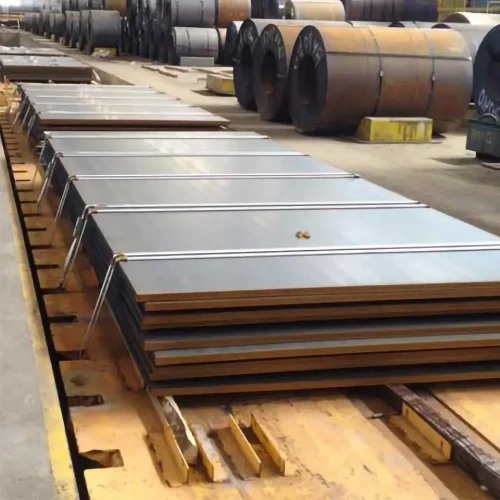
Give the MVA, the voltage class, the guaranteed no-load loss, and the core mass, since four fields frame the triangle. Add the noise limit when the site is sensitive. A grain oriented coil then ships with its basis printed. A silicon steel sheet ships when the core is built on site. That reply usually takes a day.
Related Reading
Our distribution note runs the same logic at a smaller scale. The grade guide maps every naming pattern. A hub page answers six basic questions.
Frequently Asked Questions
0.23 to 0.27 mm, in high-induction grades.
No, since sound follows flux density first, and the gauge barely moves it.
Because transport caps the finished unit, and a heavy core leaves no margin.
Rarely, since the eddy term grows too fast.
A step-lap joint, since it costs no material and cuts corner loss.
- Email: vera.liang@ztwysteel.com
- Location: Xishan District, Wuxi, Jiangsu, China
- Supply range: CRGO and CRNGO 0.20–0.65 mm, four coating classes
- Slitting: 20–1,250 mm, ±0.05 mm, burr under 0.02 mm
- Documentation: MTC EN 10204 3.1 with grade, thickness and loss basis, 3.2 on request




 English