
Does Grain Oriented Steel Belong in a Motor Core?
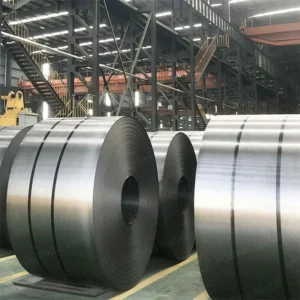
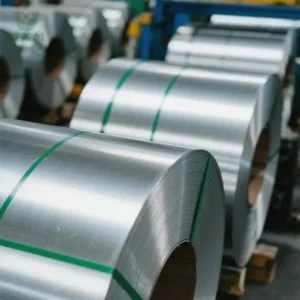
A sales engineer sometimes asks for the transformer sheet, on the theory that a lower watt figure must help somewhere. Asking for grain oriented steel for motors usually costs money. The flux in most machines turns rather than runs straight, and that turn erases the benefit. Jiangsu Zhongtong Weiye Special Steel Co., Ltd. explains the mismatch below, then names three exceptions, using a CRGO sheet as the example.
The Short Answer
Oriented strip suits a fixed flux direction, although a rotating machine offers none. A stator tooth sees flux swing through a full cycle. The easy axis is then crossed at right angles, once per turn. Hence the premium buys a property the machine cannot use, and the exceptions are narrow.
Why Rotation Punishes Oriented Strip
An oriented sheet carries its grains along one rolling direction, and that line becomes the easy axis. Turn the flux 90 degrees, and the same sheet acts like a poorer grade. Loss then climbs sharply, since the crystal orientation no longer helps. Transverse loss often runs three to five times the rolling figure. A motor holds flux at every angle, so part of every tooth sits in that bad direction. The texture note explains the geometry.
The Cost of Asking It Backwards
Oriented strip trades near 1,700 to 2,400 USD per tonne FOB, while non-oriented strip trades near 850 to 1,200. That is roughly twice the price, for a sheet used sideways. So a motor on oriented strip pays a premium, then collects a penalty. Both bills land on one buyer. Therefore, the choice costs twice, once at the invoice and once at the loss test. The price note compares families on that basis.
Exception One — A Linear Motor
A linear motor moves along a track, and its flux runs one way across the plate. That path never turns, so the easy axis can be aligned with it. Hence the full benefit arrives on every stroke. A buyer who slits along the travel direction gains that benefit, while a crosswise slit loses it. Hence this is the cleanest case for the transformer grade.
Exception Two — A Tooth-Only Path
Some small machines route flux through a single tooth, which keeps the direction fixed inside the part. An oriented lamination cut so that the grain follows that line can beat non-oriented stock at the same induction. The gain is real yet modest, because joints and fringes still cost loss. Therefore, this case needs a drawing review before an order.
Exception Three — A High-Flux Small Core
A compact machine that must reach 1.8 T in a narrow tooth can use oriented strip for that headroom. A Hi-B grade holds a low loss at that induction, while non-oriented stock climbs. Hence the gain appears in torque density, not in watts. A designer accepts the anisotropy there, since the alternative is a larger frame.
What Non-Oriented Does Better
Non-oriented strip wins the ordinary case on four counts, and each one is practical. Such a sheet behaves alike in every direction, so a lamination can be rotated at no cost. Stamping comes easier too, since oriented sheet cracks at tight radii. Thin gauges near 0.20 mm also arrive for high-speed rotors, and the price runs near half per tonne. The NGO note covers those gauges.
The Test That Settles It
A coupon test settles an argument faster than a catalogue, and it needs two cuts. Cut one Epstein strip along the rolling direction and one across it, then measure both at that induction. The transverse figure shows what half of each tooth will do. Hence a buyer can price the anisotropy before committing. The standard note lists the items to report.
What Goes Wrong
One buyer substitutes oriented strip for non-oriented, then finds the loss higher. Another rotates an oriented lamination 90 degrees to save scrap, although the core then runs hot. A third orders the transformer grade for a high-speed rotor, when a thin non-oriented sheet would serve. Those three errors arrive monthly.
What We Do Not Do
We do not melt or roll steel. We do not promise a motor gain from a sheet chosen for transformers, because the flux path decides. Nor do we slit oriented strip across its rolling direction without saying so.
Those limits keep the answer honest, and they keep a motor test predictable.
Specify Your Order
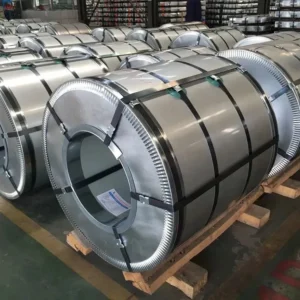
Give the flux path, the design induction, the frequency, and the volume, since four fields settle the family. Add the direction of slit when the part is directional. A grain oriented coil then ships with its rolling direction marked on the label. That reply usually takes a day.
Related Reading
Our Hi-B note covers the high-induction end. The grade guide maps every naming pattern. A hub page answers six basic questions.
Frequently Asked Questions
Only when the flux path stays fixed, as in a linear machine.
Because the grains help along one axis alone, and a motor crosses that axis.
Roughly twice the price of non-oriented strip, at 1,700 to 2,400 USD per tonne.
Not an oriented one, since the axis then crosses the flux path.
An Epstein cut in both directions, compared at one induction.
- Email: vera.liang@ztwysteel.com
- Location: Xishan District, Wuxi, Jiangsu, China
- Supply range: CRGO and CRNGO 0.20–0.65 mm, four coating classes
- Slitting: 20–1,250 mm, ±0.05 mm, burr under 0.02 mm
- Documentation: MTC EN 10204 3.1 with grade, thickness and loss basis, 3.2 on request



 English