
What Is RGO (Regular Grain Oriented) Steel?
Most distribution transformers still run on the ordinary oriented grade, and buyers keep asking whether that choice is outdated. Regular grain oriented steel is the volume grade, since it carries a Goss texture without the high-permeability process behind Hi-B. Jiangsu Zhongtong Weiye Special Steel Co., Ltd. tests six common claims against what a coil actually does. A grain oriented electrical steel sheet serves as the reference.
The Short Answer
RGO means regular grain oriented, and the name marks a family rather than a quality tier. It still holds a Goss alignment, so the easy axis follows the rolling direction. What it lacks is the induction headroom that the Hi-B process adds. Hence RGO suits a design that runs at a modest flux, not one that crowds a corner.
Six Claims, Six Verdicts
The six claims below arrive in most enquiries, and each one needs a short answer.
Claim One — RGO Is Obsolete
False, since a 1,000 kVA distribution unit can still be built on it. Those units ship by the thousand each year, because the 10 to 35 kV class sets the volume. A grade that class trusts is not obsolete. Therefore, the claim confuses fashion with service, rather than reporting a real shift in demand.
Claim Two — Only the Price Differs
False, because the two families use different inhibitors and different rolling routes. RGO grows its grains on a manganese sulphide inhibitor, while the high-permeability family leans on aluminium nitride. The Hi-B note follows that second route in detail. Hence the gap sits in the process, not in the invoice alone.
Claim Three — The Letter Tells You the Family
True, since Chinese designations carry a marker after the Q. A name such as 30Q120 means a regular oriented grade at 0.30 mm and 1.20 W/kg. A name such as 27QG120 adds a G, which flags the high-induction family. Therefore, one letter separates two different products.
Claim Four — RGO Cannot Be Rated at 1.7 T
False, because the standard quote point is exactly 1.7 T for both families. A regular grade therefore carries a 1.20 W/kg label at that field, since every GO sheet shares one basis. The difference shows above that point rather than at it. Hence the label already tells you the basis.
Claim Five — RGO Is Always the Cheaper Choice
Half true, since the premium per tonne runs a few hundred dollars rather than a rounding error. A core that saves 0.35 kW repays that premium many times over across thirty years. Therefore, the cheaper invoice often loses to the cheaper lifetime.
Claim Six — RGO Needs a Different Anneal
False, since both families share one stress relief window. RGO and Hi-B both sit near 750 to 800 °C for stress relief, while a higher hold coarsens the grain. Therefore, a shop can run one furnace recipe for both, provided it stays inside that band.
The Arithmetic Behind Claim Five
Take a one tonne core of 30Q120 at 1.20 W/kg, so the no-load loss lands near 1.2 kW. A high-permeability core of the same mass at 0.85 W/kg lands near 0.85 kW. The saving reaches 0.35 kW, which capitalises near 4,900 EUR at 14 EUR per watt. The flux density note explains why the comparison needs one basis. Hence a few hundred dollars per tonne rarely survives that comparison.
Where RGO Actually Wins
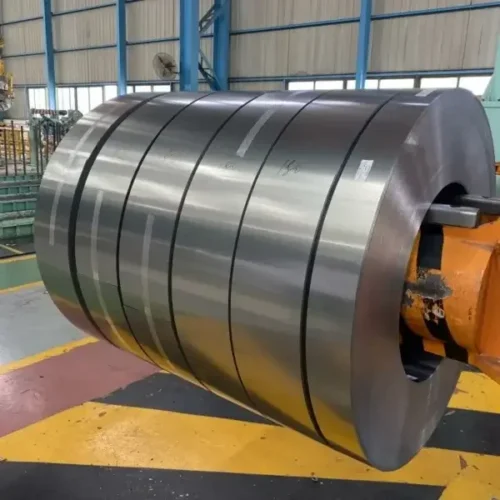
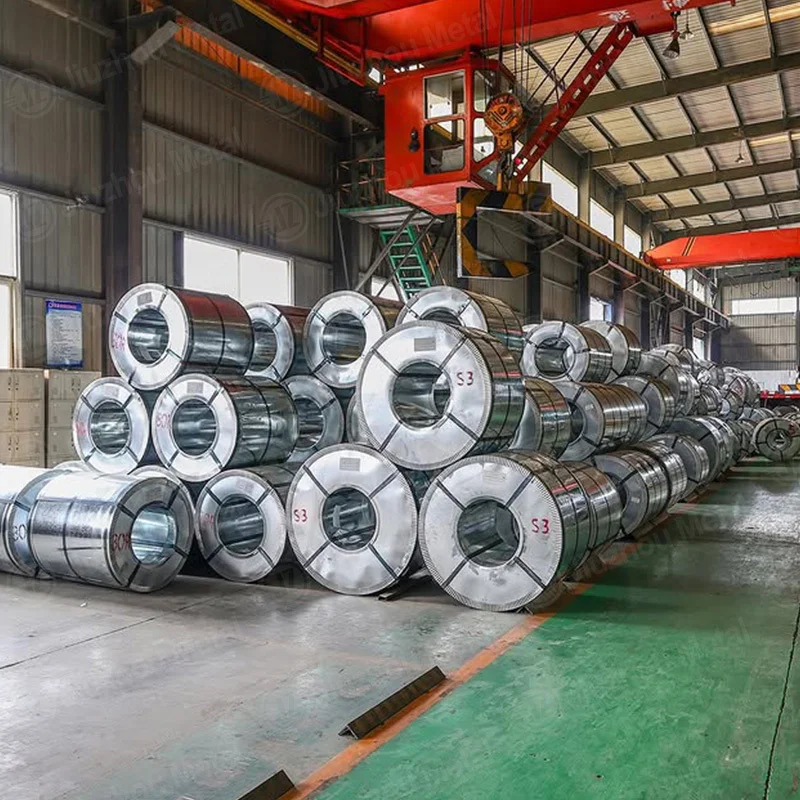
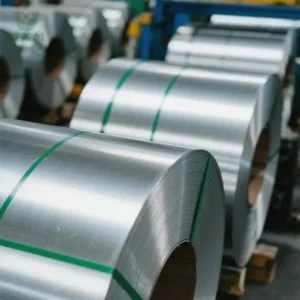
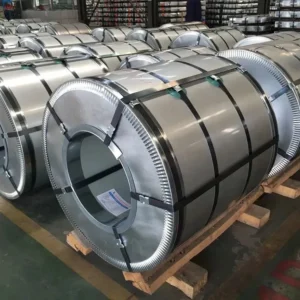
RGO wins on availability, since the grade sits in stock at every slit width. Common gauges run 0.27 to 0.35 mm. A CRGO coil then ships without a long lead time. It also wins where capital budget rules the project, because the premium must be found up front. A modest design at 1.5 T then extracts little from the upgrade, since the curves nearly meet there. Therefore, the grade serves a schedule as much as a specification. A silicon steel sheet of the regular family is also far easier to source in odd widths.
What Goes Wrong
One buyer treats a Q name as a QG name and prices the wrong core. Another runs a regular grade at 1.9 T at the corner and blames the mill. A third compares two tonnes of core without matching the loss basis. Those three errors arrive monthly.
What We Do Not Do
We do not melt or roll steel. We do not run a lifetime study for a customer, since the tariff belongs to the utility. Nor do we sell a regular grade as equivalent to a high-induction one.
Those limits keep the answer honest, and they keep the six verdicts checkable.
Specify Your Order
Give the grade name, the gauge, and the peak induction, since the three settle the family question. Add the corner induction and the tariff when a payback argument is needed. A CRGO coil then ships with its basis printed, while a cut core arrives already built. That reply usually takes a day.
Related Reading
The grade note decodes the whole naming pattern. Our hysteresis note covers the loop both families narrow. A hub page answers six basic questions.
Frequently Asked Questions
Yes, though the alignment is less sharp.
A G after the Q.
No, both families quote at 1.7 T.
Yes, since the window overlaps.
Yes, by a few hundred dollars.
- Email: vera.liang@ztwysteel.com
- Location: Xishan District, Wuxi, Jiangsu, China
- Supply range: CRGO and CRNGO 0.20–0.65 mm, four coating classes
- Slitting: 20–1,250 mm, ±0.05 mm, burr under 0.02 mm
- Documentation: MTC EN 10204 3.1 with grade, thickness and loss basis, 3.2 on request




 English