

Does the Coating Survive Stamping?
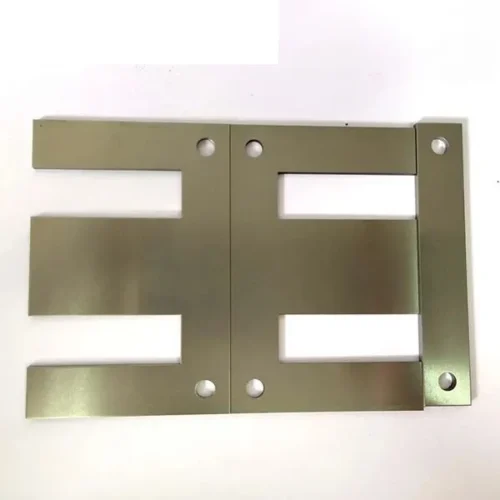
A film a few micrometres thick meets a punch that travels a million times, so survival turns mechanical. Coating for stamping meets four contacts in one stroke. The film survives most of them, while it fails at the shear edge. Jiangsu Zhongtong Weiye Special Steel Co., Ltd. walks that stroke below, using a crgo sheet as the example.
The Short Answer
The film survives the presser and the stripper, although it loses at the shearing edge. A cut edge always exposes bare metal, because the shear runs through the film. Hence a stamper should expect a clean face beside a bare edge, and judge the film by the face. The coating note covers which film to pick.
Contact One — The Presser
A presser ring bears down on the sheet before the punch moves. That load spreads across a wide area. A film of a few micrometres carries that pressure without crushing, while the load per square metre stays moderate. The risk appears when grit sits on the ring, since one particle concentrates the load. Hence housekeeping protects a film more than film choice does.

Contact Two — The Shear
The punch enters and the shear runs across the thickness, so no coating survives that cut. The cut face shows bare metal by design, while a film above it simply ends. What matters is whether the film peels back from the edge, because peeling widens the bare zone. A hard oxide tends to crack rather than peel, while a soft resin tends to smear. Therefore, edge condition separates the two families better than a lab report does.
Contact Three — The Stripper
On the return stroke the stripper pulls the sheet off the punch, so that motion rubs the film sideways. A film with poor adhesion lifts at that moment, and a lifted patch becomes a bridge later. Hence adhesion matters as much as hardness, because both decide survival. The burr note follows that bridge.
Contact Four — The Stack
Finished pieces slide against each other as they fall into a bin, so friction scratches the face. A scratched face loses insulation along a line, while a low resistance path appears later. Hard films resist that scratch, although resin films scuff readily. Therefore, handling after the press belongs in the coating discussion.
The Clearance Numbers
Die clearance usually runs near 5 percent of thickness, so 0.50 mm gives 25 micrometres of gap. That clearance exceeds a 20 micrometre burr, since a compliant edge must still fit the die. At 0.27 mm the clearance falls to 13.5 micrometres, while thin gauge leaves less room for error. Hence thin gauge punishes a worn die sooner, and the tool card should say so. The range note sets those gauges.
How to Judge a Film
Three checks settle the question in a shop. The tape test measures adhesion, because a lifted patch shows there. A bend test follows, since a film that cracks will not survive a corner. Cut face inspection finishes, because the bare zone width reads directly. Hence three cheap checks replace a long argument.
Where the Bare Edge Matters
Every cut face is bare, and that is normal. Trouble starts when bare faces line up, since a stack of aligned edges forms a conducting column. A core rotated by half a pitch breaks that column, because each bare face meets a coated face instead. Hence stacking practice protects insulation better than a thicker film does. The stacking note covers that practice.
What Goes Wrong
One buyer judges a film at the cut edge, then rejects a good coil. Another accepts a coil with a lifted patch, so a bridge turns up weeks later. A third runs a worn die on thin gauge, and the burr passes its limit before the tool change. Those three errors arrive monthly.
What We Do Not Do
We do not melt or roll steel. We do not run a customer’s press, because the die belongs to the stamper. Nor do we promise tool life from a film description.
Those limits keep the answer honest, and they keep a die budget honest too.
Specify Your Order
Give the thickness, the hit count, the die clearance, and the film family. Those four fields then set an expectation for the edge. Add the handling method when pieces travel far after the press, since scratches follow transport. A grain oriented sheet then ships with its film named. A silicon steel sheet covers a thicker duty. That reply usually takes a day.
Related Reading
Our sheet type note lists the films by duty. The burr limit note derives the 0.02 mm ceiling. A hub page answers six basic questions.
Frequently Asked Questions
No, since the cut face ends up bare by design.
The stripper, through rubbing and lift, since it pulls sideways.
Yes, since thin gauge leaves only 13.5 micrometres of gap.
With a tape test first, then a bend.
Yes, since a scuff becomes a short across two sheets.
- Email: vera.liang@ztwysteel.com
- Location: Xishan District, Wuxi, Jiangsu, China
- Supply range: CRGO and CRNGO 0.20–0.65 mm, four coating classes
- Slitting: 20–1,250 mm, ±0.05 mm, burr under 0.02 mm
- Documentation: MTC EN 10204 3.1 with grade, thickness and loss basis, 3.2 on request






 English