

Why Is the Burr Limit 0.02 mm?
Every slitting order carries the same small ceiling, although few buyers ask where it began. Silicon steel burr has a 0.02 mm limit, and that figure comes from coating thickness rather than from a table. Jiangsu Zhongtong Weiye Special Steel Co., Ltd. derives it below, using a silicon steel sheet as the example.
The Short Answer
A burr of 0.02 mm runs roughly four times the coating on one face. That film measures a few micrometres. Two faces stacked therefore keep a compliant burr inside the insulation budget. Once the burr passes that, metal touches metal, so a conductive bridge forms across sheets. Hence the ceiling is a physical consequence, rather than a convention. The coating note covers that budget.
Where the Number Comes From
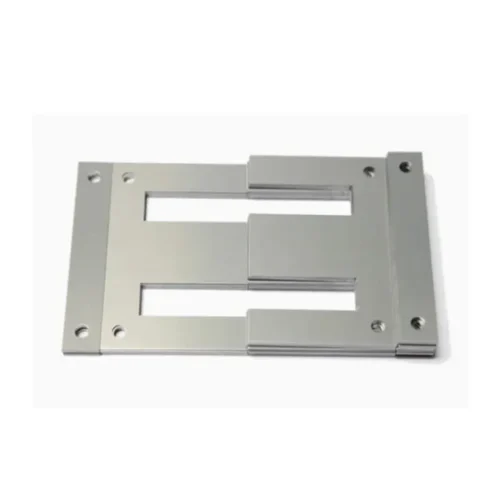
A C5 or C6 coating runs a few micrometres on each face, which means 0.003 to 0.006 mm per side. Two faces in contact then total 0.006 to 0.012 mm of insulation, while a third face adds little. A burr of 0.02 mm exceeds that sum, so an unguarded edge will push through the film. Therefore, the limit sits near the point where a bridge becomes likely, and buyers keep it just under. That derivation is an order of magnitude argument, while the standards still state the number directly.
The Stack Effect
A core carries hundreds of sheets, so each burr adds a local step. A thousand pieces at the ceiling would sum to 20 mm, if every burr landed on the same spot. Real stacks never sum that way, because burrs fall in different places. Yet pressure still bends a wave into the block, so stacking factor error rises. Hence flatness and loss both suffer, even when no short appears.
What the Burr Costs in Watts
A bridge lets eddy current run along the sheet rather than across it, and that path runs long. Loss therefore climbs inside a small area, while a hot spot forms near the edge. A single bridged pair matters little, although a continuous burr line matters a lot. Therefore, edge quality shows up as a loss signal on a bad coil. The loss note splits the terms.
How It Is Measured
A burr reading starts with a straight edge and a dial gauge, or else a profile trace across the cut. The operator reads the tallest projection rather than the average, since one spike does enough damage. Sampling follows the coil length, because a worn slitter degrades as the run continues. Some specs state a share of thickness instead. On 0.50 mm that figure equals 4 percent, while on 0.20 mm it equals 10. Hence a single reading near the head proves nothing, and a thin gauge needs its own ceiling. The slitting note covers that routine.
Who Owns the Limit
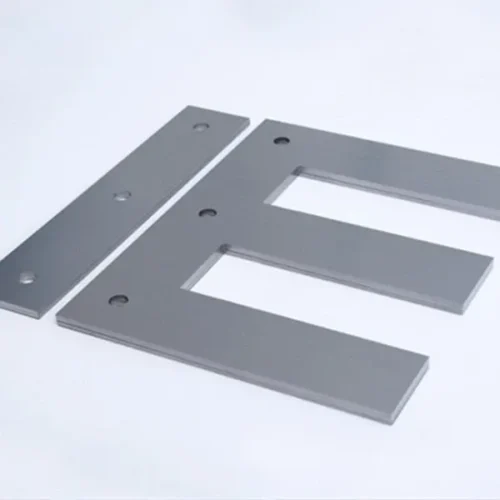
The service centre owns the slit edge, where knife clearance and knife wear set the burr. A stamper owns the punched edge, where die clearance near 5 percent sets it. A worn punch raises that burr quietly, so the second owner often misses it. Therefore, a claim should name the edge before it names the coil. The grade note keeps the fields aligned.
When the Limit Is Waived
A buyer may accept a heavier burr for a core that is potted or glued, because resin fills the gap. That waiver should be written, and it should name the process beside it. Without that note, a later claim has no defence, since acceptance turned informal. Hence a waiver belongs in the purchase order, and not in a phone call. The composition note lists the films available.
What Goes Wrong
One buyer inspects the head of a coil, then passes a worn tail. Another blames the mill for a burr that a dull punch raised. A third accepts a verbal waiver, so an argument follows a year later. Those three errors arrive monthly.
What We Do Not Do
We do not melt or roll steel. We do not measure a customer’s punched edge, because that die belongs to the stamper. Nor do we certify an edge that we never cut.
Those limits keep the answer honest, and they keep a burr claim clean.
Specify Your Order
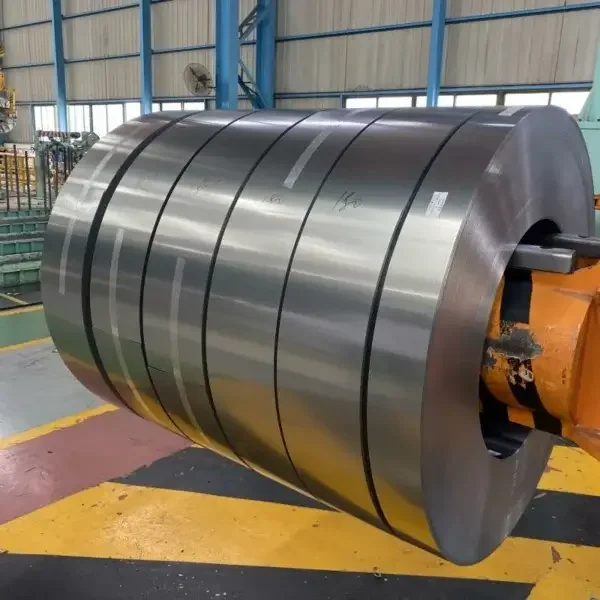
Give the thickness, the width, the coating class, and the burr ceiling. Those four fields then set the slitting plan. Add the process when the edge gets punched later, since die clearance enters at that step. A CRGO coil then ships with its edge condition recorded. A non-oriented sheet covers the thicker gauges. That reply usually takes a day.
Related Reading
Our burr effect note follows the bridge into loss. The stacking note explains the area correction. A hub page answers six basic questions.
Frequently Asked Questions
It appears in many purchase specs, since it follows from coating thickness.
Sheets touch, so eddy current bridges across them.
No, although a continuous line does, and that line is common.
The stamper, through die clearance and tool wear.
Yes, in writing, when resin fills the gap.
- Email: vera.liang@ztwysteel.com
- Location: Xishan District, Wuxi, Jiangsu, China
- Supply range: CRGO and CRNGO 0.20–0.65 mm, four coating classes
- Slitting: 20–1,250 mm, ±0.05 mm, burr under 0.02 mm
- Documentation: MTC EN 10204 3.1 with grade, thickness and loss basis, 3.2 on request





 English