

What Is Hysteresis Loss?
Every core loss figure hides two bills, and the first one repeats fifty times a second. Hysteresis loss is that recurring half, since the loop traced by the magnetic field pays out on every cycle. Jiangsu Zhongtong Weiye Special Steel Co., Ltd. splits the account below, using silicon steel sheet as the example.
The Short Answer
Core loss splits into hysteresis and eddy current, and the two behave nothing alike. A silicon electrical steel sheet carries both terms in one figure. Hysteresis rises with frequency in a straight line, while eddy rises with frequency squared. Thickness therefore moves one half and leaves the other alone. Hence a grade name states a total, and the split stays hidden, which is why buyers misread a thin grade.
Where the Loop Comes From
A magnetic field pushes domain walls through the grain, and each wall sticks at a defect before it jumps. That stick and jump traces a loop rather than a line, so energy leaves as heat. A wider loop means a bigger bill per cycle. Therefore, anything that pins a wall widens the loop, so a clean melt pays less.
Why Frequency Enters in a Straight Line
One loop closes per cycle, so a 50 Hz core pays that area fifty times a second. Over thirty years the count reaches about 47 billion reversals. Double the frequency and the hysteresis bill doubles with it, since the loop area stays put. That linearity separates it from the eddy half, since the squared term climbs far faster.
Why Thickness Does Not Enter
Eddy current runs across the strip, so a thinner sheet shortens the path and cuts that loss sharply. Hysteresis runs within the grain instead, and the strip thickness never enters its arithmetic. A 0.23 mm CRGO sheet therefore pays the same hysteresis per kilo as a 0.50 mm sheet. Hence thinning attacks one half only, though buyers often assume it cuts both.
The Split at Fifty Hertz
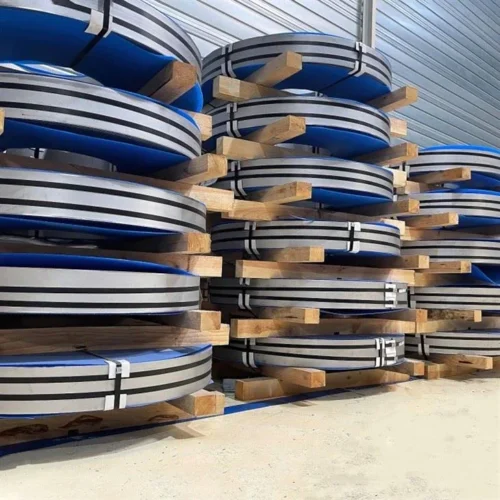
A 0.50 mm non-oriented grade rated 4.70 W/kg carries roughly 2.6 W/kg of hysteresis. The eddy term then takes the remaining 2.1 W/kg at 1.5 T. Those two figures are typical rather than fixed, since alloy and grain shift the ratio. Still, the order of magnitude holds across the family. Therefore, the total hides a near-even split, and a label alone cannot reveal it.
What Thinning Can and Cannot Do
Thinning the same grade to 0.27 mm cuts the eddy term by a factor of 3.43. That takes 2.1 down to about 0.62. The hysteresis term stays near 2.6, so the total lands near 3.20 rather than 1.37. That is a 32 percent saving, not the 71 percent a squared-law guess would promise. Hence a thinner strip cannot fix a hysteresis problem, since the loop area never moved.

The Five Things That Widen the Loop
Carbon, sulphur, nitrogen, and oxygen each pin a domain wall, so a clean steel pays less. The composition note tracks where each element enters. Grain size matters too, since a 150 μm grain carries fewer boundaries than a 40 μm one. Stress from stamping adds pinning sites, and a texture that aligns the easy axis narrows the loop. Higher induction widens it as well, because the loop opens as the field pushes harder. Therefore, chemistry and anneal decide this half.
The Dominance Map
At 50 Hz the two halves stay comparable, which is why a 0.50 mm sheet still sells. At 400 Hz the eddy term grows 64 times against 8 for hysteresis, so eddy takes most of the bill. That map explains the thin gauges used in fast machines. Hence frequency picks the gauge, not the grade alone, while the alloy decides the floor.
Why a Grade Name Hides the Split
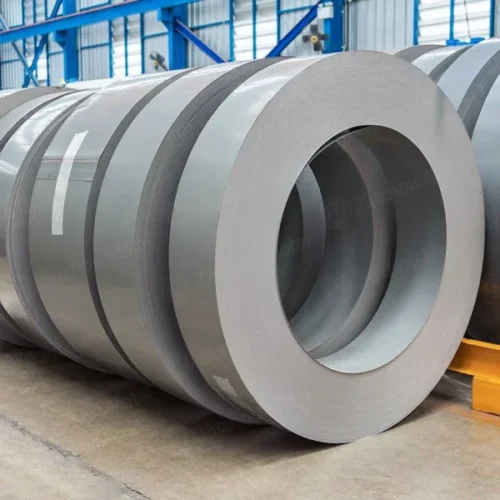
A label such as 50W470 states a total at one induction, and no mill prints the two halves beside it. A buyer comparing two grades then sees totals and guesses at the split. Ask for the loss curve instead, since a curve separates the terms. The grade note explains what a label such as 50W470 leaves out. Therefore, one curve beats ten labels, since it separates what a name merges.
What Goes Wrong
One buyer thins a strip to chase a loss target and finds a third of the saving missing. Another blames thickness for a hot core that a stress anneal would have fixed. A third compares a 1.7 T figure with a 1.5 T figure and misranks both. Those three errors arrive monthly.
What We Do Not Do
We do not melt or roll steel. We do not measure a customer’s core for them. Nor do we print a split that no test supports.
Those limits keep the answer honest.
Specify Your Order
Give the frequency, the induction, the grade, and the gauge. Add the anneal route when one applies, since stress relief changes the hysteresis term. A loss curve then follows with both halves separated. A cut core travels with the same curve when you need assembled parts. That reply usually takes a day.
Related Reading
The resistivity note explains the eddy half in detail. Our insulation note covers the coating that keeps the two apart. A hub page answers six basic questions.
Frequently Asked Questions
No, it is one of two parts.
No, since thickness stays outside the arithmetic.
Carbon, at the parts-per-million level.
Yes, by removing stress pinning.
No, only a loss curve shows it.
- Email: vera.liang@ztwysteel.com
- Location: Xishan District, Wuxi, Jiangsu, China
- Supply range: CRGO and CRNGO 0.20–0.65 mm, four coating classes
- Slitting: 20–1,250 mm, ±0.05 mm, burr under 0.02 mm
- Documentation: MTC EN 10204 3.1 with grade, thickness and loss basis, 3.2 on request




 English