

CRGO Thickness Range: Which Gauge Fits Your Core?
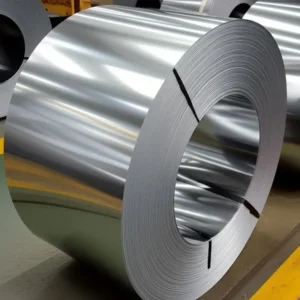
A catalogue page can list four gauges side by side, and the differences look tiny on paper. The CRGO thickness range in normal supply runs 0.23 to 0.35 mm, with 0.27 mm carrying most of the volume. Jiangsu Zhongtong Weiye Special Steel Co., Ltd. walks the stops in order below, using a grain oriented electrical steel sheet as the example.
The Short Answer
Four gauges cover almost every order: 0.23, 0.27, 0.30, and 0.35 mm. A fifth stop, near 0.18 mm, belongs to thin high-permeability stock and stays special. Hence the choice is a trade between watts, price, and build height, and no single gauge wins everywhere.
Why the Range Stops Where It Does
Three forces set the ends, and each one pulls in the same direction. A standard grid fixes the recognised gauges, since a buyer cannot order a size no standard lists. A rolling floor comes from the mill, because thinner strip breaks in the tandem mill. The designer then sets the ceiling, since a thick sheet raises eddy loss. Therefore, the four stops are an agreement rather than a preference.
Stop One — 0.23 mm
The thinnest common gauge serves large power transformers, since no-load loss is capitalised over decades. A 0.23 mm coil costs more per tonne, although it saves watts in a core that runs for thirty years. That arithmetic favours the thin stop on big units. Hence this gauge rarely appears in small distribution work, since the premium outruns the saving there.
Stop Two — 0.27 mm
This gauge carries the volume, because distribution transformers sit at the point where price and loss balance. A 0.27 mm sheet also stacks well, since the coating share stays modest, so the build remains manageable. That is why 27QG120 appears in many enquiries, since the code names this gauge. Therefore, a first quotation usually lands here unless the design says otherwise.

Stop Three — 0.30 mm
The 0.30 mm stop trades watts for price, and it suits cost-led distribution work, where duty cycles run light. Each square metre weighs 2.355 kg, so a tonne buys fewer metres than at 0.27 mm. A designer accepts that loss because the core is priced against first cost. Hence this gauge serves markets that compete on first cost.
Stop Four — 0.35 mm
The thickest common stop fits large cores with a generous window, since build height is rarely the binding limit there. It costs less per tonne and stamps with less trouble, since a heavier sheet resists buckling. A buyer accepts more eddy loss in exchange, and the trade is often sound at low duty. Therefore, this gauge appears where the design has room to trade.
What Thinner Actually Buys
Eddy loss falls with the square of gauge. A step from 0.27 to 0.23 therefore leaves 72 percent of it, since the ratio squares to 1.38. The whole core loss falls by less, since hysteresis does not care about thickness at all. That split is the reason a thin coil never delivers the full square-law gain. The hysteresis note works that arithmetic through.
What Thinner Charges
Three bills arrive with the thin stop, and each one hides behind the energy saving. Price per tonne rises, since a thinner strip needs more rolling passes and more scrap. Sheet count rises too, since a 0.27 mm build needs 17 percent more sheets for equal height. Stacking factor also drops, since coating takes a larger share of a thin sheet. Hence the gain in watts is partly returned in labour.
What a Tonne Buys at Each Stop
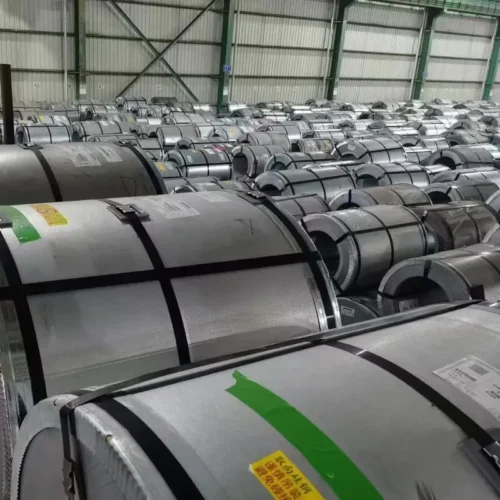
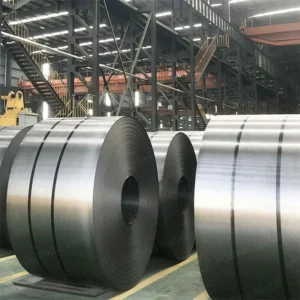
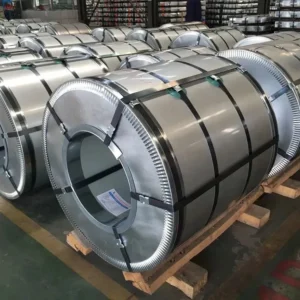
Weight per square metre follows density, and the numbers diverge far more than buyers expect. At 0.23 mm a square metre weighs 1.806 kg, while 0.35 mm gives 2.748 kg. Slit to 1,250 mm, a running metre weighs 2.257 kg at the thin stop. The thick stop reaches 3.434 kg. Five tonnes therefore buys 2,215 metres at 0.23 mm, against 1,456 metres at 0.35 mm. Hence a tonne is not a fixed quantity of core, and a quotation must state the gauge.
The Tolerance Band
Each gauge arrives as a band rather than a point, since the mill works to plus or minus 5 percent. On 0.27 mm that band runs 0.256 to 0.284 mm. The spread then matters when a core has a fixed build. A stack of 1,000 sheets at the low end stands 28 mm shorter than one at the high end. Therefore, a designer who counts sheets should ask for the band. One who counts height should weigh the stack instead.
Below and Above the Range
Thin high-permeability stock near 0.18 mm exists, although it sits outside routine supply and carries a premium. A silicon electrical steel sheet of that gauge answers a specialist design. A CRGO sheet at 0.35 mm still covers large cores, since the thick stop stays inside normal supply. Above that the family loses its purpose, because eddy loss grows faster than price falls. A 0.50 mm oriented sheet exists in some catalogues, although it serves rare large cores only. Hence the four stops describe the working range rather than a limit.
What Goes Wrong
One buyer orders 0.23 mm for a small core, then finds the premium unpaid by the saving. Another counts laminations from a nominal gauge and builds a core 28 mm off. A third mixes two gauges in one stack and creates a step that hums. Those three errors arrive monthly.
What We Do Not Do
We do not melt or roll steel. We do not promise a gauge outside the mill’s rolling floor, since a promise cannot make strip. Nor do we mix gauges inside one coil to hit a nominal weight.
Those limits keep the answer honest, and they keep a build predictable.
Specify Your Order
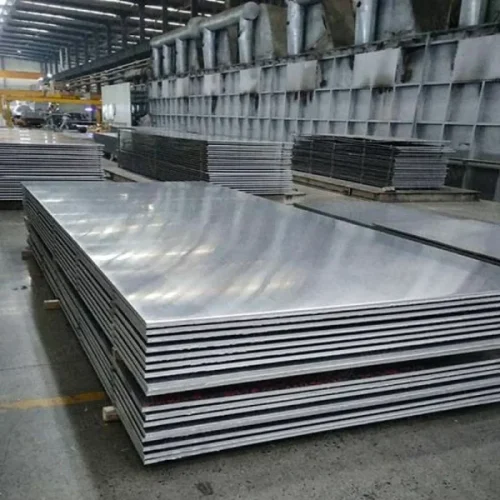
Give the gauge, the width, the core class, and the design induction, since four fields pick the stop. Add the tolerance band when a drawing fixes the build height. A CRGO coil then ships with its gauge printed on the label. A cut core arrives already stacked. That reply usually takes a day.
Related Reading
The coil guide covers width, mass, and packing. Our conversion note matches a grade across standards. A hub page answers six basic questions.
Frequently Asked Questions
0.23 to 0.35 mm, in four steps.
0.27 mm, since distribution work dominates.
Only on the eddy half of the loss.
Rarely, since it sits near the rolling floor.
Rarely, since it sits near the rolling floor.
- Email: vera.liang@ztwysteel.com
- Location: Xishan District, Wuxi, Jiangsu, China
- Supply range: CRGO and CRNGO 0.20–0.65 mm, four coating classes
- Slitting: 20–1,250 mm, ±0.05 mm, burr under 0.02 mm
- Documentation: MTC EN 10204 3.1 with grade, thickness and loss basis, 3.2 on request





 English