

Ultra Thin Silicon Steel: Five Uses That Justify the Price
Ultra thin silicon steel earns its place only when frequency runs high. Eddy loss grows with the square of both frequency and gauge, because both enter the same term. A 0.50 mm grade suits 50 Hz mains work, while a 0.20 mm grade suits 400 Hz and above. Pay the thin gauge premium at 50 Hz and you buy cost rather than performance. Choose it at 1 kHz and the loss falls faster than the price rises.
This guide sets the frequency where thin gauges pay, then names five uses that justify the order.
What Makes a Silicon Steel Grade Ultra Thin
The industry treats 0.20 to 0.27 mm as ultra thin, while 0.35 mm marks the common middle. Standard non-oriented stock runs 0.50 mm, while a grain oriented electrical steel sheet runs 0.23 to 0.35 mm. Two production routes reach the thin band, namely heavy cold reduction and a second cold pass with an intermediate anneal.
Thin strip costs more for three reasons, because each extra pass adds roll time, annealing time and yield loss. A 0.20 mm coil therefore carries a premium over 0.50 mm rather than a discount. It weighs less per square metre, yet the route costs more.
Why Frequency Sets the Thickness
Loss splits into hysteresis and eddy components, and only the eddy part scales with gauge. Eddy loss follows the square of thickness, so halving the gauge cuts that component to one quarter. Frequency enters the same square, so the two effects multiply.
Eddy Loss Falls With the Square
At 50 Hz a 0.50 mm sheet carries a modest eddy share, so the hysteresis term dominates. That balance suits non oriented electrical steel used on mains supply. Raise the frequency to 1 kHz and the eddy term grows 400 times. That ratio follows the square, since 1,000 Hz sits 20 times above 50 Hz. Thin the sheet from 0.35 mm to 0.20 mm and the eddy term falls to about one third. The gauge ratio is 1.75, so its square reaches 3.06.
The 400 Hz Crossover
Around 400 Hz the thin grades start to win on total loss. So aircraft and machine tool work sits near that line. Below 400 Hz a 0.35 mm grade often costs less per unit of loss. Above that line a 0.20 mm grade pulls ahead, because the eddy share grows. The crossover moves with flux density, so check the actual duty point rather than the catalogue.
Ultra Thin Silicon Steel: Five Real Uses
Five applications justify the premium, and each runs above the 400 Hz line or close to it. Read the frequency first, because the use follows the hertz.
High Speed Motors
A four pole motor at 15,000 rpm runs 500 Hz, since frequency equals speed times pole pairs. A spindle at 30,000 rpm doubles that figure, so the eddy term climbs four times. Ultra thin grades from 0.20 to 0.27 mm suit those drives. Both rotor and stator see the high frequency, so both need the thin strip.
EV Traction
A traction inverter switches near 8 to 10 kHz, so the current carries a ripple far above the base frequency. That ripple adds harmonic loss, and the thin gauge trims it. Most traction motors run 0.20 to 0.25 mm grades, since the duty cycle rewards every watt saved. Silicon steel for EV motors follows that rule across the industry.
Aircraft 400 Hz Systems
Aircraft generators run at 400 Hz to save weight. At the same flux the core sees eight times the loss, since 400 Hz sits eight times above 50 Hz. Ultra thin grades keep that loss inside the thermal budget, since the cooling air carries a fixed capacity. A 0.20 mm grade often decides whether the generator fits its nacelle.
High Frequency Inductors
Inductors in a switch mode supply run from 1 to 20 kHz, so the core loss climbs sharply with frequency. Thin grades from 0.10 to 0.20 mm suit those parts. Above 20 kHz a ferrite or an amorphous core takes over, since silicon steel loss climbs too far. Silicon steel keeps the advantage of high saturation, since it reaches 2.0 T against 0.5 T for ferrite. That margin explains why silicon steel sheets still hold high frequency slots below 20 kHz.
Miniature Motors
A dental handpiece or a drone motor runs at high speed inside a small frame. So the core needs thin strip to fit the slot. A 0.20 mm grade packs more laminations into the same tooth, so the designer gains flux without gaining bulk. That trade explains why miniature motors pay the premium without argument.
What Ultra Thin Costs
Two cost effects follow the thin gauge, and both belong in the quote. One is the price per tonne, while the other is the stacking factor.
Price per Tonne
A 0.20 mm grade often costs 1.5 to 2 times the 0.50 mm price of the same family. The rolling and annealing routes run longer, because two passes replace one. On a 30 kg order the gap reads small, while on a 30 t order it decides the project. Ask for the quotation speed before you commit, since thin stock turns slower.
Stacking Factor Penalty
The coating keeps a fixed thickness near 0.003 to 0.006 mm per side. So it takes a larger share of a thin sheet. A 0.50 mm stack reaches a stacking factor near 0.98, while a 0.20 mm stack falls near 0.95. That gap traces back to the stacking factor definition, since the film keeps a fixed thickness. That 3 point drop raises the flux density by about 3 percent for the same core. So the design must account for it.
How to Specify an Ultra Thin Grade
Four fields settle the order, so write them down before you ask for a quote. Frequency, flux density, gauge and coating class make the list.
Start with the frequency, because it decides whether the thin gauge pays. Next comes the flux density, since the crossover moves with it. Third is the gauge, because 0.20 and 0.25 mm behave differently near the limit. Compare both against the silicon steel grades list before you fix the pick. Finally, name the coating class, since a thin sheet needs a thin film rather than a heavy one.
Ultra Thin Silicon Steel: A Fit Table
The table pairs five uses with the gauge that usually fits. Treat it as a starting point rather than a rule, because the duty point decides the final pick.
| Use | Frequency | Usual gauge |
|---|---|---|
| High speed spindle | 500–1,000 Hz | 0.20–0.27 mm |
| EV traction motor | 8–10 kHz ripple | 0.20–0.25 mm |
| Aircraft generator | 400 Hz | 0.20 mm |
| Switch mode inductor | 1–20 kHz | 0.10–0.20 mm |
| Miniature motor | 1 kHz and above | 0.20 mm |
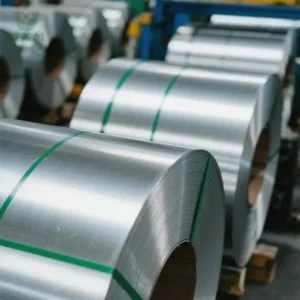
A 0.20 mm sheet weighs 1.57 kg per square metre, so a 1 t coil covers about 637 m². Check the thickness range before you size a core, because thin stock changes the piece count fast. Use the silicon steel sheet weight calculation to confirm the figure.
What We Do Not Do
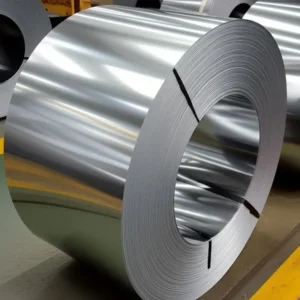
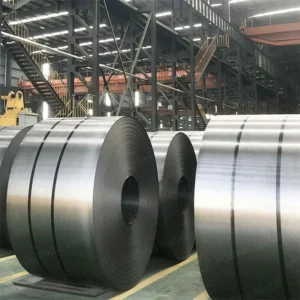
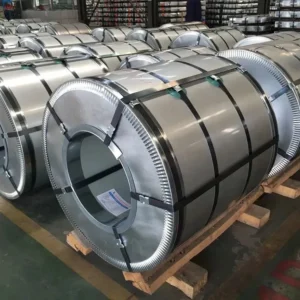
We do not recommend a thin gauge for a 50 Hz core, because the premium buys nothing there. We keep CRGO silicon steel coils for the gauges that suit low frequency work. Nor do we quote a 0.10 mm grade we cannot roll. Nor do we promise a stacking factor without a stack test. Thin gauge non oriented silicon steel leaves Wuxi with the mill label intact. Every coil ships from Jiangsu Zhongtong Weiye Special Steel Co., Ltd.
FAQ
Near 400 Hz on total loss, because the eddy term then dominates. Below that line the thicker gauge often costs less per unit of loss, since the hysteresis term rules.
No, because the thin gauge adds cost without adding benefit. A 0.23 to 0.30 mm grain oriented grade suits that duty, since the frequency stays low.
Usually 1.5 to 2 times per tonne, because extra passes add roll time and annealing time. The gap often narrows on a large order, since the mill spreads the setup.
Yes, because the coating keeps its thickness while the steel thins. A 0.20 mm stack lands near 0.95 against 0.98 for 0.50 mm, so the design loses about 3 points.
Technically yes, but the cost rarely pays. A 0.35 mm grade delivers the same loss at lower cost, since the frequency stays low.
Request a Quotation
Send the frequency, the flux density, the gauge and the coating class. Then we can check whether a thin grade pays. Gauge questions are answered within one working day, while quotes stay valid for two weeks. Write to vera.liang@ztwysteel.com.
- Email: vera.liang@ztwysteel.com
- Location: Xishan District, Wuxi, Jiangsu, China
- Thin gauge range: 0.10–0.27 mm non-oriented, 0.20–0.35 mm oriented
- Checks: frequency, flux density, stacking factor and coating class
- Documentation: MTC EN 10204 3.1 with loss basis and stacking factor
- Response time: gauge questions answered within one working day, quotes valid two weeks




 English