Silicon Steel Properties: The Numbers Behind Grade Choice
Silicon steel properties come from one alloy decision and one process decision: how much silicon sits in the iron, and how the sheet is rolled and annealed afterwards. Everything a buyer reads on a certificate, from density to core loss at a stated induction, traces back to those two.
This page collects the physical figures that matter in selection, with the basis each one is measured on. The basis matters as much as the number, because two identical-looking loss figures can sit on different inductions and never be compared.
Silicon Content Sets the Baseline
Silicon raises electrical resistivity, and resistivity is what suppresses eddy current loss. Adding silicon also hardens the alloy and lowers saturation induction.
| Property | Effect of adding silicon |
| Resistivity | Rises sharply, roughly a factor of five against pure iron at 3% Si |
| Eddy current loss | Falls, which is why silicon steel replaced plain steel in cores |
| Saturation induction | Falls slightly |
| Hardness and brittleness | Rise; above roughly 3.5% cold rolling becomes difficult |
Most commercial grain-oriented material sits near 3% silicon. Non-oriented grades spread from about 1% to 3.5%, and that spread explains why two 0.50 mm non-oriented grades can differ so much in loss.
Density and Resistivity
Density drives the weight calculation, and resistivity explains the frequency behaviour.
| Property | Typical value (3% Si) | Why it matters |
| Density | 7.65 kg/dm³ | Converts coil weight to core weight and to loss per core |
| Resistivity | about 47 μΩ·cm, in a 40 to 50 μΩ·cm band | Higher resistivity pushes the eddy current ceiling upward in frequency |
| Saturation induction | roughly 2.0 T | Sets the absolute flux ceiling no grade can exceed |
Two traps live here. First, density is not a constant across all grades: lower-silicon non-oriented stock runs slightly denser than 3% oriented stock, so a weight calculated from 7.65 kg/dm³ on a low-silicon grade will be a little light. Second, resistivity is not a design input on its own. It only becomes useful when you combine it with thickness and frequency.
Induction, Permeability and Direction
Induction tells you how much flux the sheet carries at a given field; permeability tells you how much field it takes to get there.
Grain-oriented steel reaches high induction along the rolling direction and much less across it. That anisotropy is the whole point of the material, and it is why orientation matters more than grade number in a transformer core.
Non-oriented steel deliberately gives up peak induction to keep properties similar in every direction, which is what a rotating flux needs. The non-oriented range covers that trade, and the oriented grade ladder shows how much induction the oriented side gains.
Read the induction with its field. A figure quoted as B at 800 A/m is not the same as saturation induction, and the two get mixed up constantly in enquiries.
Core Loss and the Basis Behind It
Core loss is the one property every buyer checks, and it is the one most often compared wrongly.
- Grain-oriented grades quote loss at 7 T and 50 Hz
- Non-oriented grades quote loss at 5 T and 50 Hz
The two numbers live on different inductions, so a 3.00 W/kg oriented figure and a 4.70 W/kg non-oriented figure do not describe the same operating point. Convert both to one induction before ranking them.
Inside the total sit two components. Hysteresis loss depends on the alloy and the domain structure; eddy current loss depends on thickness and resistivity. At line frequency hysteresis dominates, and reversing the standard’s 50 Hz and 60 Hz figures for a typical non-oriented grade puts it near three quarters of the total. Raise frequency and the eddy share climbs quickly. The two components in detail works through the split.
Stacking Factor
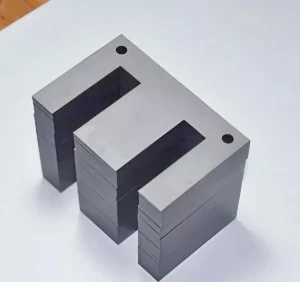
A stack never reaches the sum of its sheet thicknesses, because coating and surface roughness take space.
| Grade family | Typical stacking factor |
| Oriented, 0.23 to 0.30 mm | 0.95 to 0.97 |
| Non-oriented, 0.35 to 0.50 mm | 0.95 to 0.97 |
A 100 mm stack of 0.35 mm material therefore carries rather less than 100 mm of iron, and every loss and flux calculation has to use the effective section. How stacking factor is calculated runs the arithmetic.
Mechanical Properties
Magnetics decide whether the grade works; mechanics decide whether it survives the line.
The Chinese standard lists tensile strength and elongation as informative values in an annex, not as guaranteed figures:
| Grade | Tensile strength Rm | Elongation A |
| 50W470 | about 380 MPa | about 16% |
| 35W300 | about 420 MPa | about 11% |
Thinner and higher-silicon material is both stronger and less ductile, which shows up as edge cracking on a tight die and as sensitivity to burr. The full grade sheet for 50W470 carries these values beside the magnetic ones, and the M-series comparison shows how the American bands line up.
What to Check on the Certificate
- Loss with its induction and frequency.A bare number is not a specification.
- Induction with its field strength.B at 800 A/m is not saturation.
- Density as assumed, not measured.Mill certificates quote the assumed value used to convert weight.
- Stacking factor, if the core design depends on it.
- Test method.Epstein and single sheet figures differ by several percent, so the method belongs in the comparison.
FAQ
What is the density of silicon steel? About 7.65 kg/dm³ for 3% silicon grades. Lower-silicon non-oriented grades run slightly denser, so treat the figure as grade-specific rather than universal.
Why does silicon steel have higher resistivity than plain steel? Silicon dissolved in iron scatters electrons and raises resistivity roughly fivefold at 3%. Higher resistivity suppresses eddy currents, which is the main reason silicon steel exists.
Is higher permeability always better? Not by itself. Permeability at low field and induction at high field are different properties, and a grade can win on one while losing on the other. Match the property to the flux level the design actually runs at.
Why is core loss quoted at 1.5 T for non-oriented and 1.7 T for oriented steel? Because the two families serve different duty. Oriented material works near its flux ceiling in transformer cores, so the standard checks it there; non-oriented material in motors runs lower, and the standard follows the application.
Can I use the density to calculate core weight directly? Yes, with two corrections: multiply by stacking factor for the effective iron, and use the grade’s own assumed density rather than a generic figure.
Vera Liang
Senior Application Engineer | Electrical Steel & Specialty Alloys
With 8+ years of field experience in silicon steel and high-performance alloy specification, Vera supports industrial clients in grade selection, magnetic property validation and corrosion-resistant material matching for motor, transformer and chemical engineering applications.
Need the property figures for a specific grade rather than the general range? Send the grade name and the operating induction to vera.liang@ztwysteel.com, and Jiangsu Zhongtong Weiye Special Steel Co., Ltd. will return the certificate values for density, core loss, induction and stacking factor together. Wuxi, Jiangsu, China.