Silicon Steel Lamination: Types, Grades and Cut Quality
A silicon steel lamination is one punched or cut sheet that stacks with identical sheets to build a magnetic core, and the lamination rather than the coil decides most of the finished core loss. Buyers usually come to this question from one of two directions: they need finished EI or C cores and want to know which grade sits inside, or they already stamp in-house and want to know whether the cut quality they accept is normal.
This page covers both. It sets out the lamination families we supply, matches each one to a sensible grade, and lists the four tolerances that actually move loss.
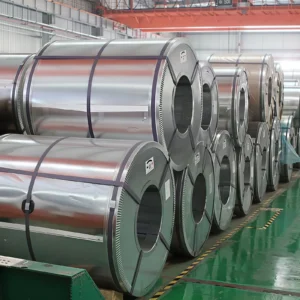
Lamination, Slit Strip and Coil
Three supply forms carry the same material, and the choice between them is a tooling question, not a metallurgical one.
| Form | What the buyer receives | Typical user |
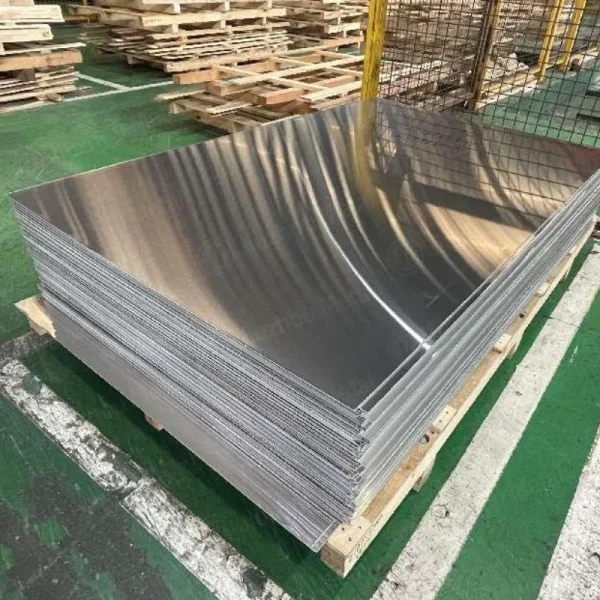
| Coil | Full-width coil, unprocessed | Large core builders with their own slitting and stacking line |
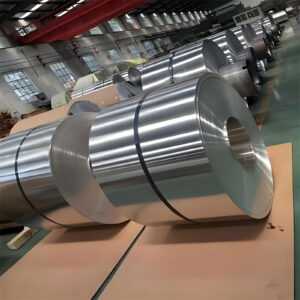
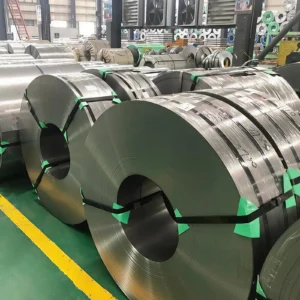
| Slit strip | Coil cut to the required width | Wind cores, C cores, toroidal cores |
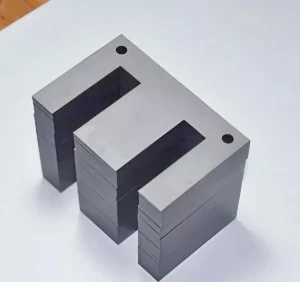
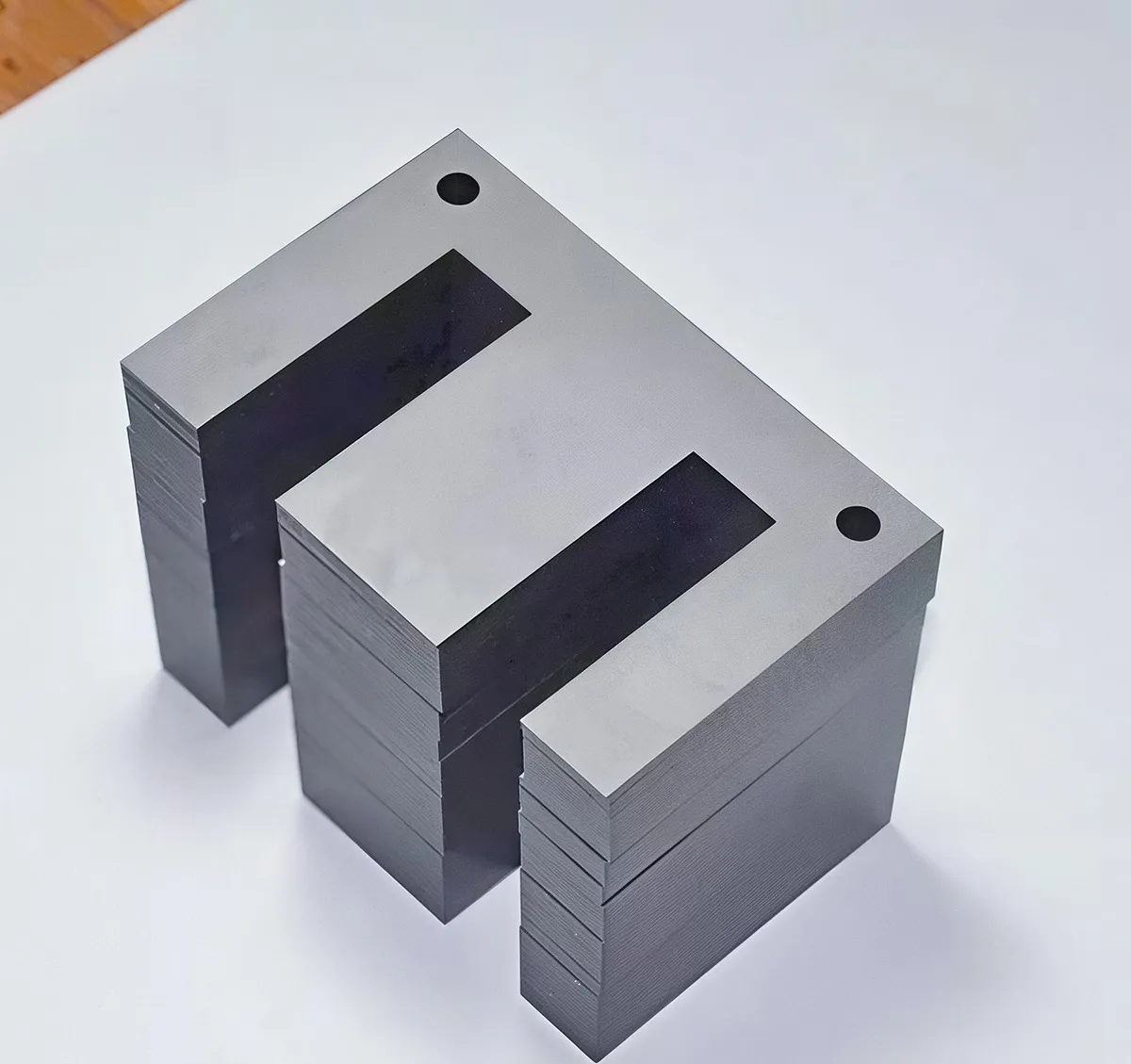
| Lamination | Individual punched or cut sheets, deburred | EI cores, UI cores, small transformer and motor cores |
A lamination is the only form where the supplier owns the cut quality. That matters because a bad edge costs loss twice: once through a short circuit between sheets, and again through the stress the punch leaves behind.
The Families We Supply
- EI laminations— the classic three-limb shape for small single-phase transformers, control transformers and chargers.
- UI and EE laminations— two-limb and shell types for instrument and small power transformers.
- C cores and cut cores— strip wound into a rectangle, then cut in half and lapped, used from distribution transformers up to medium power.
- Motor and generator laminations— stator and rotor packets, usually stamped from non-oriented grades.
Finished EI cores with hardware ship as assemblies; bare laminations ship as stacks for the customer to build. Our three-phase EI lamination core page shows the assembled form.
Which Grade Goes Inside
Grade choice follows the core type, not the customer’s habit.
| Lamination type | Usual grade family | Why |
| EI and UI small transformer cores | Non-oriented, 0.35 mm or 0.50 mm | Cheap, isotropic enough for the multi-directional flux in a small core |
| Motor and generator packets | Non-oriented, 0.35 mm and 0.50 mm | Rotating flux needs balanced properties in both directions |
| C cores and cut cores | Grain-oriented, 0.23 to 0.30 mm | Flux runs one way around the wound core |
| Loss-critical distribution cores | Grain-oriented, 0.23 and 0.27 mm | Lowest no-load loss per kilogram |
Two grades cover most EI work. 50W470 handles the mid-range where loss matters but cost still leads, and a 0.35 mm thin gauge takes the end where stack height is tight. For oriented work, the grain-oriented grade ladder covers the full spread from conventional to domain refined.
Four Tolerances That Move Loss
One: burr height. A punch leaves a burr on the shear face, and a tall burr bridges the insulation between two sheets. Practice holds oriented laminations under roughly 0.02 mm and re-checks it on a sample, because burr grows as a die wears. The shearing burr limit explains where the practical ceiling comes from.
Two: stacking factor. The stack never reaches the sum of the sheet thicknesses, because coating and surface roughness take space. Standard values run 0.95 to 0.97 depending on grade and coating, so a 100 mm stack of 0.35 mm material carries less iron than the arithmetic suggests. Stacking factor in numbers works through the calculation.
Three: cut edge stress. Shearing and punching deform the edge zone, and that deformation raises loss in the outer few millimetres. Oriented material suffers most, which is why punched oriented laminations normally go through a stress-relief anneal at 750 to 800 °C before stacking.
Four: coating choice. The insulation coating must survive the punch, the anneal and the impregnation. C5 and C6 coatings behave differently on all three counts, so the choice has to match the process rather than the price list.
When the Anneal Wipes Out the Grade
This is the trap that catches buyers moving from standard Hi-B to a domain refined grade. Laser-scribed material carries its gain as a stress pattern, and stress-relief annealing removes exactly that pattern. Punch a scribed lamination, anneal it, and the loss returns close to the unscribed level you paid less for.
So the order matters: decide the anneal route before choosing the grade. If the laminations will be annealed, specify a conventional or high-permeability oriented grade and design on its figures. If they stay unannealed, a domain refined grade keeps its advantage. What laser scribing actually buys covers the numbers.
Buy Laminations or Stamp In-House
Stamp in-house when annual volume justifies a die, when the design is stable for several years, and when you already run a slitting and annealing line. The die is the fixed cost, and everything after it is cheap.
Buy laminations when the volume is low or the design changes often, when the shape needs a die you will not amortise, or when you would rather not carry the deburring, annealing and inspection labour. For prototype and small-series work, buying also removes the risk of a die that never pays back.
Slit strip sits between the two: you keep the stacking and annealing, and the supplier keeps the slitting accuracy.
Buying Notes
- Send the drawing, not a grade name.Lamination cost depends on the shape, the die and the annual quantity far more than on the steel.
- State the anneal route up front.It changes the grade you can use and the coating that survives it.
- Agree the burr limit and the inspection method.A limit without a measuring method is not a limit.
- Ask for the stacking factor on the certificate.Magnetic values alone tell you nothing about how much iron fits the window.
FAQ
What is the difference between a lamination and a core? A lamination is one sheet. A core is the stack, usually clamped, sometimes impregnated, and often fitted with hardware. We supply both, and the price difference is mostly labour and hardware.
Which grade should I use for an EI lamination core? Non-oriented 0.35 mm or 0.50 mm covers most EI work. Choose 0.35 mm when stack height or loss is tight, and 0.50 mm when cost leads. Use oriented material only when the flux path is genuinely one-directional.
Can laser-cut laminations replace punched ones? For prototypes and small batches, yes. For volume, punching is cheaper per piece and gives a cleaner edge. Laser cutting leaves a heat-affected edge zone, and that zone costs loss on oriented material in particular.
Do all laminations need stress-relief annealing? No. Non-oriented laminations often run unannealed when the duty is light. Oriented laminations usually need it after punching, because the shear stress sits right where the flux turns.
What tolerance should I put on thickness? Follow the standard the grade comes from rather than inventing a number. Thickness tolerance and crown are specified there, and a tighter call-out raises the price without buying measurable loss.
Vera Liang
Senior Application Engineer | Electrical Steel & Specialty Alloys
With 8+ years of field experience in silicon steel and high-performance alloy specification, Vera supports industrial clients in grade selection, magnetic property validation and corrosion-resistant material matching for motor, transformer and chemical engineering applications.
Need laminations cut to a drawing, or the grade that goes inside them? Send the shape, thickness, annual quantity and annealing route to vera.liang@ztwysteel.com. Jiangsu Zhongtong Weiye Special Steel Co., Ltd. supplies lamination stock and finished cores from Wuxi, and will confirm the grade, coating and burr limit before quoting.