
What Is Goss Texture?
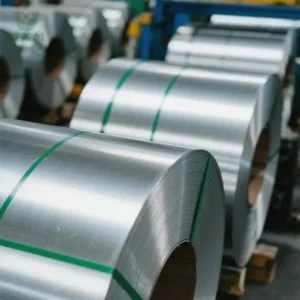
An oriented coil does one job that a non-oriented coil cannot do. Every grain points the same way to do it. Goss texture is that shared direction, named {110}<001>, since the easy axis lines up with the rolling direction. Jiangsu Zhongtong Weiye Special Steel Co., Ltd. reads the coordinate below, starting from a grain oriented electrical steel sheet as the reference.
The Short Answer
Goss texture means most grains sit with one crystal plane flat and one axis along the strip. The pair is written {110}<001>, and the second number carries the magnetism. That single alignment buys a high flux density along rolling and charges a penalty across it. Hence the texture sells a direction rather than a number.
Reading the Coordinate
Two brackets appear in every orientation notation, and each does a different job. The round bracket names the plane that lies parallel to the sheet surface. The angle bracket names the direction that points along the rolling line. So {110} describes a plane, while <001> describes a line. Therefore, a coil with Goss texture lies flat one way and points true the other. A single grain may still stray.
Why <001> Carries the Magnetism
Iron magnetises easily along its cube edge, and that edge is the <001> family. A domain wall then moves with little resistance, so a small field swings the flux a long way. That ease shows up as high permeability and low hysteresis, since the wall barely resists. Hence the texture is really a way to place the easy axis where the flux runs.
The One Process Step That Makes It
Goss grains do not appear by accident, and a normal anneal produces the wrong ones. The mill adds an inhibitor such as MnS or AlN. It then holds the coil near 1,200 °C in a final box anneal. Only the Goss grains survive that hold, so they grow at the expense of their neighbours. Therefore, the texture is a consequence of one deliberate step, not of rolling alone.
The Grain Size Consequence
That step leaves grains measured in millimetres, while a non-oriented sheet carries grains near 120 μm. The gap reaches roughly eight times in diameter, which is why an oriented sheet shows so few boundaries. A 0.27 mm CRGO coil then holds less than one grain through its thickness. Hence a thin oriented sheet behaves as a single crystal in the thickness direction.
What the Alignment Buys
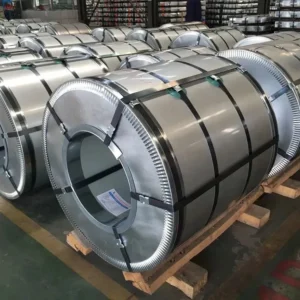
Flux along the rolling direction reaches a high density at modest field, and hysteresis stays low. Core loss follows, since a narrow loop wastes less per cycle, so the grade earns its name twice. That is why a transformer limb runs near 1.7 T without excessive heat. A CRGO coil therefore sells on a direction-specific guarantee, not on a single headline figure.
The Direction Tax
Turn ninety degrees and the same sheet fights the flux, because the easy axis now sits across the strip. Loss climbs, permeability drops, and the local core heats up. Corners and T-joints force exactly that turn, so a design pays a tax at every bend. A small corner detail then decides how much. Hence a lamination cannot simply be rotated for a better fit.
A Comparison That Fails
A 1.7 T figure and a 1.5 T figure cannot be set side by side, because the induction differs. Buyers still compare them, and the answer always flatters the lower induction. Our flux density note explains why the basis belongs beside the number. Therefore, insist on the induction before you compare any two grades.
How to Check a Coil
A pole figure test maps the grain directions, and it needs X-ray equipment rather than a hand tool. Simpler checks exist, since loss along rolling and loss across rolling can be measured apart. A sharp gap between the two confirms a strong texture, while a narrow gap suggests a weak one. Repeat on a second sample, because a coil end differs from the middle. A silicon electrical steel sheet drawn from one heat removes a chemistry variable.
What Goes Wrong
One buyer rotates a lamination for yield and finds a hot corner. Another compares two grades at different induction and picks the wrong one. A third assumes every grain in the coil points true, though a commercial sheet tolerates a spread. Those three errors arrive monthly.
What We Do Not Do
We do not melt or roll steel. We do not run a pole figure for a customer. Nor do we promise a texture figure that no mill certificate states.
Those limits keep the answer honest, and they keep the direction measurable.
Specify Your Order
Give the grade, the gauge, and the flux direction, since a corner detail decides the real loss. Add the rolling direction marking when the parts are large. A silicon steel sheet then ships with the arrow drawn on the coil, while a cut core arrives already oriented. That reply usually takes a day.
Related Reading
The grade note explains how a name such as 23P85 encodes the loss basis. Our hysteresis note covers the loop that a texture narrows. A hub page answers six basic questions.
Frequently Asked Questions
Closely related, since Goss is one specific orientation.
The <001> inside the angle bracket.
Rarely, since its grains point at random.
Not safely, because the tax follows the turn.
No, though the grain count does.
- Email: vera.liang@ztwysteel.com
- Location: Xishan District, Wuxi, Jiangsu, China
- Supply range: CRGO and CRNGO 0.20–0.65 mm, four coating classes
- Slitting: 20–1,250 mm, ±0.05 mm, burr under 0.02 mm
- Documentation: MTC EN 10204 3.1 with grade, thickness and loss basis, 3.2 on request




 English