Upgraded Silicon Steel Case for Industrial Air Compressor: High-Efficiency Motor and Loss Reduction
Silicon steel for air compressor motors improves one line of the loss account, and that line is smaller than most upgrade brochures imply. In practice, iron loss accounts for roughly a fifth of total motor loss at 55 kW. Consequently, a better grade moves overall efficiency by a fraction of a point, not by double digits. Jiangsu Zhongtong Weiye Special Steel Co., Ltd. supplies the coil behind that fraction.
The Ledger: Where a 55 kW Drive Actually Loses
Take a four-pole 55 kW motor at IE3, where efficiency sits near 95.4%. Total loss therefore reaches about 2.5 kW, and it splits roughly as follows:
- Stator copper: about 40%, or 1.0 kW.
- Rotor copper: about 25%, or 0.63 kW.
- Iron loss: about 20%, or 0.50 kW.
- Friction and windage: about 10%, or 0.25 kW.
- Stray load loss: about 5%, or 0.13 kW.
Only the iron line responds to steel grade, since the rest follows winding design, bearings, and cooling.
What a Grade Change Delivers
Moving from M36 to M19 typically cuts iron loss by 12–18% at 1.5 T. Consequently, the 0.50 kW iron line falls to about 0.43 kW. Total loss therefore drops from 2.50 kW to 2.43 kW, and efficiency rises roughly 0.12 points.
That gain is real, and it is modest. Hence treat the steel upgrade as one lever among several, not as the headline claim.
Annual Money, Checked Honestly
Assume 8000 running hours per year at €0.10 per kWh. Saving 70 W yields about 560 kWh annually, which is roughly €56. Over a ten-year life that reaches €560, and a 300 kg core makes the arithmetic easy.
Therefore, the grade premium must stay inside that envelope to pay back. If a supplier quotes a large premium for “high-efficiency steel”, ask for the loss curve rather than the adjective.
Where the Bigger Gains Sit
Variable speed drive control usually saves far more, since part-load running dominates compressor duty. Unloading losses, pipe pressure drop, and heat recovery each beat a steel swap too.
Therefore, sequence the upgrade properly: control first, then heat recovery, then motor core. Skipping that order wastes capital on the smallest lever.
What “Upgraded Case” Means in Steel Terms
- Lower loss grade: M19 instead of M36 at the same induction.
- Thinner gauge: 0.35 mm instead of 0.50 mm, which cuts eddy loss.
- Stress-relief annealing: recovers 5–10% of loss lost during stamping.
- Better slot fill: raises copper area, which cuts copper loss per ampere.
- Tighter gauge tolerance: stabilises stack height and air gap.
Only the first three touch steel supply directly, yet all five affect the number on the nameplate.
Slit Width Quietly Decides Cost
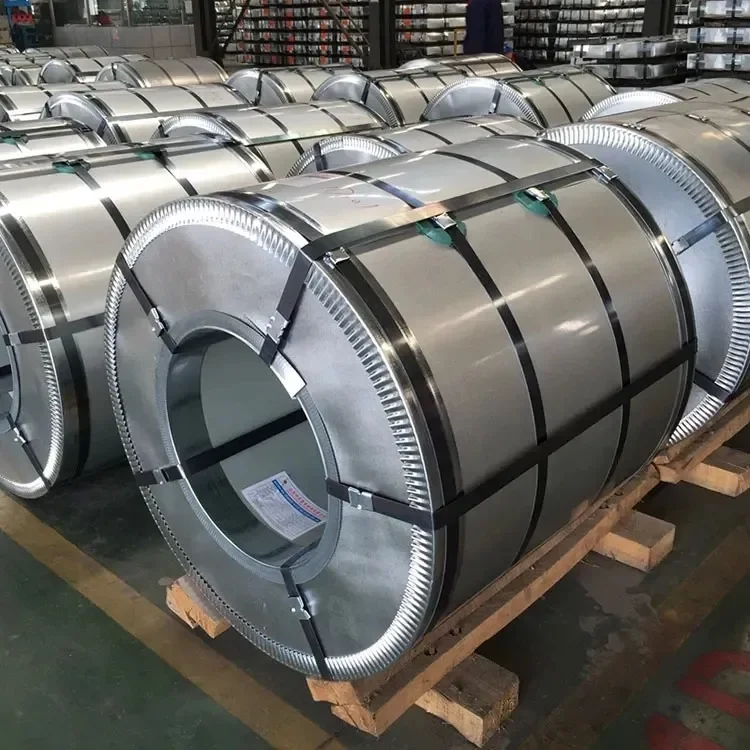
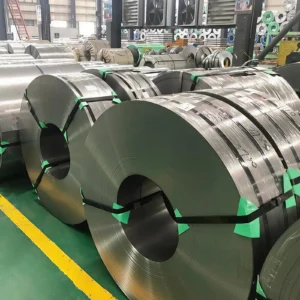
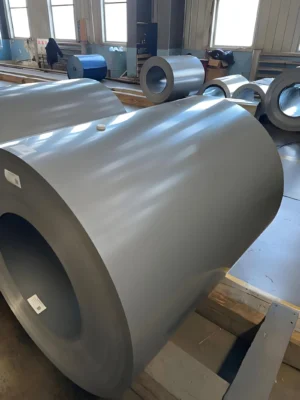
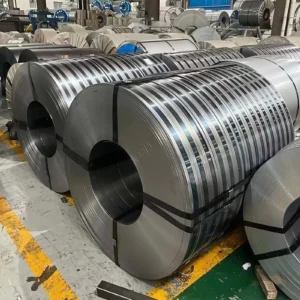
Compressor stators leave a large annular skeleton, and that scrap carries the same price as the finished core. Consequently, ordering 620 mm coil instead of trimming 1250 mm in-house often saves more than a grade upgrade.
Moreover, nesting two smaller stampings inside one strip raises utilisation by several points. Hence send your nest layout with the enquiry, not just the tonnage.
Thin-gauge non-oriented sheet explains the gauge argument in more depth. Hardness data, which governs die wear, appears in the hardness note.
Frequently Asked Questions
No, since iron loss is only about 20% of total loss at 55 kW.
M19 at 0.35–0.50 mm, depending on duty and cooling.
Not below 0.35 mm at 50 Hz, because cost and stacking factor worsen.
No, we supply slit coil only.
What We Do Not Do
- We do not build or retrofit compressors.
- We do not stamp or anneal laminations.
- We do not guarantee efficiency class outcomes.
Consequently, we supply coil and measured magnetic data, while your motor team owns the design.
Specify Your Order
- State motor rating, poles, and duty hours.
- Name the grade, or give the loss limit at 1.5 T.
- Give slit width from your nest layout, then confirm tonnage and port.
M19 Non Oriented Electrical Steel and M36 Non Oriented Electrical Steel both ship to your width, and quotes return within one working day.
- Email: vera.liang@ztwysteel.com
- Location: Xishan District, Wuxi, Jiangsu, China
- Supply range: CRNGO M19–M47 at 0.35–0.65 mm, CRGO M4/M5 at 0.23–0.35 mm
- Slitting: 20–1250 mm, ±0.05 mm, burr under 0.02 mm
- Documentation: MTC EN 10204 3.1, core loss per ASTM A343 / IEC 60404-2