

Advantages of Thin-Gauge Non-Oriented Silicon Steel
Thin gauge buys eddy loss with the square of thickness, so the gain depends on the frequency you run. Thin gauge non-oriented silicon steel at 0.20 mm cuts eddy loss to 16 percent of a 0.50 mm sheet. Jiangsu Zhongtong Weiye Special Steel Co., Ltd. slits non-oriented sheet down to 0.20 mm for builders who run fast.
The Short Answer
A thinner sheet lowers eddy loss, raises the stacking count, and costs more per tonne. The gain grows with frequency, since eddy loss follows f squared. At 50 Hz a 0.20 mm sheet pays back slowly, while at 400 Hz it pays at once. Hence the frequency decides the gauge.
The Fifty-Hertz Case
Assume a 0.50 mm sheet splits its loss at 60 percent hysteresis and 40 percent eddy. A 0.20 mm sheet then keeps hysteresis and cuts eddy to 16 percent, so total loss lands at 66 percent. A 0.35 mm sheet lands at 80 percent. That is a real gain, yet a modest one. Therefore, a 50 Hz motor gains a third at best.
The Four-Hundred-Hertz Case
At 400 Hz the eddy share rises to about 84 percent, since eddy loss grows with f squared. A 0.20 mm sheet then keeps 29 percent of that figure, while 0.35 mm keeps 57 percent. The same gauge change now removes 71 percent. Hence the high-frequency core is where thin gauge earns its premium.
The Kilohertz Case
Above 1 kHz the eddy share passes 90 percent, so the sheet becomes the whole design. A 0.10 mm foil and a 0.20 mm sheet differ by a factor of four in eddy loss. A ferrite may then beat steel on loss, yet it saturates low. Therefore, thin steel holds the high-flux niche.
Advantage One — Loss at Speed
A traction motor at 12,000 rpm runs its electrical frequency near 400 Hz or more. Thin gauge cuts that loss, so the efficiency map improves at the top of the range. A drive cycle spends much of its time there, so the gain is real. Hence the gauge choice shows up in the range figure.
Advantage Two — Temperature
Lost watts become heat in the stator, and heat shortens insulation life. A thinner sheet lowers the watt density, so the winding runs cooler, as the core sheet range allows. A cooler stator also allows a smaller frame for the same rating. Therefore, thin gauge buys thermal headroom.
Advantage Three — Power Density
A smaller frame at the same torque raises the power density, and that suits a traction or an aircraft application. Thin gauge also allows a higher flux density before the loss limit binds. A designer then shrinks the iron without losing efficiency. Hence the gauge supports a compact design.
Advantage Four — Fast Flux Changes
Thin sheets respond faster to a current step, since eddy currents shield the interior less. Servo axes then reach torque sooner, and a ripple loop stays stable. Thick sheets lag the command, so the loop fights itself. Therefore, thin gauge suits a servo or a spindle.
Cost One — Price Per Tonne
Thin gauge needs more rolling passes and more annealing capacity per tonne, so it costs more. A 0.20 mm sheet may carry a 20 to 40 percent premium over 0.35 mm. Buyers who run at 50 Hz rarely repay that. Hence the price gap follows the gauge, not the grade.
Cost Two — The Stacking Factor
A thinner sheet needs more coating layers for the same stack height, so the fill factor drops. A 0.20 mm sheet may fill 95 percent of a stack, while a 0.35 mm sheet fills 97 percent. The designer then loses iron area, and the loss gain shrinks by that share. Therefore, count the fill factor before the tonnage.
Cost Three — Twice the Laminations
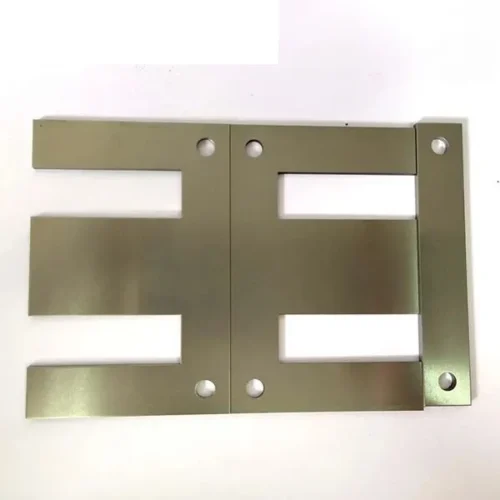
A 0.20 mm stack needs 2.5 times the laminations of a 0.50 mm stack at the same height. The press then runs longer, and the die wears sooner. Bonded stacks also need more glue per unit height. Hence the stamping cost rises with the count.
Cost Four — Burr Sensitivity
Thin sheets tolerate a smaller burr, since the edge takes a larger share of the section. A burr of 0.02 mm is a tenth of a 0.20 mm thickness, so it can short two laminations. Slitters must hold the edge tighter, and punches must keep a small clearance. Therefore, thin gauge raises the process bar.
The Handling Question
A 0.20 mm coil buckles easily, so a decoiler needs tension control and a straight feed line. A poorly set line ripples the strip, and a ripple becomes a rejected core. Such a coil weighs less per metre, so a run lasts shorter, and a slit coil book matters more. Hence the line setting counts as much as the grade.
Where Thin Gauge Fits
Traction motors, aircraft generators, servo axes, and high-frequency transformers all suit the thin range. Pump, fan, and grid transformer duties do not, since their frequency stays low. A small core at 400 Hz also fits, if the stack height allows the count. Therefore, four duties pay and three do not.
Where Buyers Get It Wrong
A buyer orders 0.20 mm for a 50 Hz pump and never repays the premium. Another ignores the stacking factor and finds the stack short of iron. A third keeps a wide burr and shorts laminations at the edge. Those three errors cover most of our returns.
What We Do Not Do
We do not melt or roll steel. We do not anneal a stamped core. Nor do we promise a loss figure without the test frequency.
Those limits keep the claim honest.
Specify Your Order
First, state the frequency and the flux. Second, name the thickness and the loss grade. Then give the width and the stack height, so the slit coil and the count match the press.
Related Reading
The grade naming note explains how a loss code is read, so a 35W470 sits beside a 20W1200. The applications note maps grades onto machines, since a traction core and a pump core need different gauges.
Frequently Asked Questions
Why does thin gauge cut loss? Eddy loss follows the square of thickness.
When does it pay? Above about 200 to 400 Hz, depending on the duty.
Does it cost more? Yes, by roughly 20 to 40 percent per tonne.
Does the fill factor fall? Yes, since more coatings sit in the same stack.
Which machine suits it best? A traction motor or a servo axis.
- Email: vera.liang@ztwysteel.com
- Location: Xishan District, Wuxi, Jiangsu, China
- Supply range: CRNGO 0.20–0.65 mm, slit to width
- Slitting: 20–1,250 mm, ±0.05 mm, burr under 0.02 mm
- Documentation: MTC EN 10204 3.1 with grade, thickness, loss and test frequency, 3.2 on request








 English