

Properties and Applications of Silicon Steel
One data sheet lists loss, flux density, thickness, and coating, and seven machines read that sheet in seven ways. Properties and applications of silicon steel pair one property at a time, since each machine fails on one constraint. Jiangsu Zhongtong Weiye Special Steel Co., Ltd. matches the grade to the machine, and the silicon steel sheet range covers both families.
The Short Answer
A distribution transformer lives by no-load loss, and an EV motor lives by loss at 400 Hz. Metering cores want linearity, while chokes want headroom against saturation. Hence one alloy family serves all of them, and the grade does the sorting.
The Property Set
Four numbers carry most of the decision. Specific loss at 1.5 or 1.7 T sets the heat. Flux density at 50 A/m sets the size. Thickness sets the eddy term and the stack. Coating sets the interlamination resistance, and silicon ties the first two together. Therefore, a buyer who reads loss alone misses half the sheet.
Machine One — Distribution Transformer
A 10 to 35 kV unit idles for decades at 50 Hz, so no-load loss drives the bill. Grain-oriented grades at 0.23 to 0.35 mm keep that figure low, and a 23P85 reads near 0.85 W/kg. A 0.1 W/kg saving pays back across 20 years, since the coil runs continuously. Hence thin oriented sheet owns this slot.
Machine Two — Large Power Transformer
Size adds a second constraint here, because magnetostriction makes a core hum. Low-loss grades with a controlled domain structure quiet that hum, while a step-lap joint holds the factor near 1.1. Cheap joints raise noise and loss at once. Therefore, grade and joint get bought as a pair.
Machine Three — Industrial Motor Stator
A 50 Hz stator needs a balance, since the stamping costs more than the steel. Non-oriented grades at 0.50 mm, near 4.70 W/kg at 1.5 T, give a workable loss at a workable price. Thin oriented sheet would cut loss and break the budget. Hence the mid-grade non-oriented sheet serves this slot.
Machine Four — EV Traction Motor
An EV motor spins fast, so the eddy term climbs with the square of frequency. Loss at 400 Hz then outweighs loss at 50 Hz by a wide margin. Non-oriented sheet at 0.20 to 0.27 mm keeps that term small, and the thin gauge fits a tight slot. Therefore, thin gauge plus high silicon defines this grade.
Machine Five — Appliance Motor
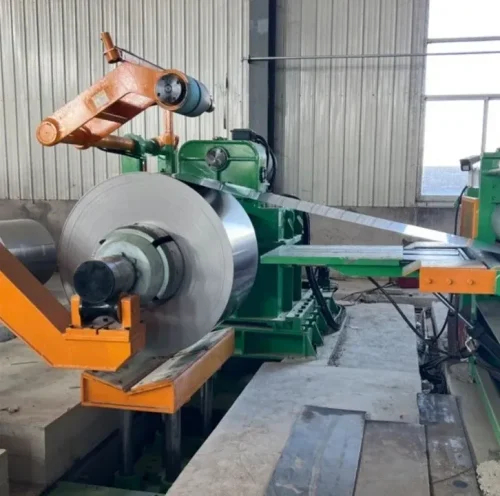
A fan or pump motor runs at low flux and cares about stamping speed. Mid-grade sheet at 0.50 mm punches cleanly, and the coating survives a fast die. High-silicon sheet would crack at the die, so the line slows. Hence formability outranks loss in this slot.
Machine Six — Metering Core
A current transformer must stay linear across a range, since a core that saturates early distorts the reading. Thin oriented sheet with low remanence holds the ratio, because the flux swing stays small. Thick non-oriented cores drift at the top of the range. Therefore, linearity sets this choice.
Machine Seven — Choke and Reactor
A choke carries direct current, so the core sits on a biased part of the curve. An air gap stores the energy, so the steel needs headroom rather than the lowest loss. Non-oriented grades at 0.35 to 0.50 mm do that job, while the gap does the rest. Hence the steel supports, and the gap decides.
What a Swap Costs
Non-oriented 0.50 mm in an EV stator lifts the 400 Hz loss by a wide margin. Oriented 0.23 mm in a fan motor cracks at the die. A metering grade in a distribution transformer raises the loss bill. Those swaps fail for three different reasons.
What the Coating Adds
C5 and C6 coatings keep the stack insulated, and a self-bonding film glues it. Bonded stacks skip the weld and the clamp, which helps a small motor. Coatings that fail at 180 °C limit a hot application. Therefore, the film enters late and matters anyway.
What Thickness Does to the Die
Thin sheet burrs less at a sharp die, yet it buckles more in a long slot. Thick sheet resists buckling, although it raises the punch load. Slit width tolerance then decides whether the stack fits. Hence the press and the coil get chosen together.
Where Buyers Get It Wrong
One buyer picks a grade by loss alone, then ignores the die. Another picks by price and ignores the frequency. A third swaps an oriented sheet into a motor and blames the steel for the crack. Those three errors cover most of our returns.
What We Do Not Do
We do not melt or roll steel. We do not design a core or a die. Nor do we promise a machine result from a sheet figure.
Those limits keep the answer honest.
Specify Your Order
First, name the machine and the frequency. Second, give the flux and the loss target. Then state the thickness, the width, and the coating, so the coil matches the die.
Related Reading
The applications note walks the same ground machine by machine. The grade naming note decodes the loss figure, which sets the first comparison.
Frequently Asked Questions
Which property matters most? It depends on the machine and the frequency.
Why thin sheet for an EV motor? Eddy loss falls with thickness at high frequency.
Why oriented sheet in a transformer? It cuts no-load loss along the roll.
Can one grade serve all seven? No, since each machine fails on one constraint.
Does coating matter for a motor? Yes, since it insulates the stack and survives the die.
- Email: vera.liang@ztwysteel.com
- Location: Xishan District, Wuxi, Jiangsu, China
- Supply range: CRGO 0.23–0.35 mm and CRNGO 0.35–0.65 mm
- Slitting: 20–1,250 mm, ±0.05 mm, burr under 0.02 mm
- Documentation: MTC EN 10204 3.1 with grade, thickness and loss figure, 3.2 on request







 English