
Mastering Silicon Steel: The Unfolding Journey of Long-Term Technical Mastery in Silicon Steel Manufacturing
Silicon steel manufacturing looks straightforward on paper, yet the gap between an ordinary mill and a premium one spans decades of accumulated know-how. In practice, two plants can run identical equipment and still differ by 15% in core loss. Jiangsu Zhongtong Weiye Special Steel Co., Ltd. buys from that top tier, so we see the difference on every certificate. Below, therefore, are the seven items where mastery actually lives.
Why Mastery Cannot Be Purchased
A licence transfers drawings, and it does not transfer tacit process knowledge. Consequently, new lines often reach 80% of target quality within two years. Reaching the last 20% takes five years or more, because that margin hides in variables nobody documents.
Moreover, customers certify material, not mills. Therefore, a new supplier must survive transformer makers’ qualification cycles before earning volume.
Seven Know-How Items That Take Years
Know-how 1 — the inhibitor recipe. Grain-oriented sheet needs AlN or MnS inhibitors to control secondary recrystallization. Adjusting the balance takes years, since a small drift ruins texture sharpness.
Know-how 2 — decarburisation control. Carbon must fall below roughly 30 ppm, and dew point governs the reaction. Hence operators tune humidity by season, not by a fixed setpoint.
Know-how 3 — reduction ratio and crown. Total cold reduction near 85–90% sets up the Goss texture, while roll crown controls gauge across the width. Both interact, so changing one forces a change in the other.
Know-how 4 — secondary recrystallization. Annealing near 1200 °C with a MgO separator grows the Goss grains. Consequently, temperature uniformity across the coil decides whether B8 reaches 1.88–1.90 T or stalls near 1.82 T.
Know-how 5 — coating cure. Insulation film must survive slitting, stacking, and impregnation. Therefore, cure profile matters more than film thickness, and adhesion failures surface only after varnish baking.
Know-how 6 — domain refinement. Laser or mechanical scribing narrows domain spacing, and loss then drops further. However, over-scribing raises stress and can hurt magnetostriction.
Know-how 7 — edge and shape quality. Camber, burr, and edge taper all reduce stamping yield. Hence finishing lines receive as much attention as the annealing line.
What Each Know-How Buys, in Product Terms
- Sharp texture yields B8 near 1.90 T, so cores shrink for the same rating.
- Clean steel lowers P1.7/50, so no-load loss falls measurably.
- Stable coating raises stacking factor, so build height stays predictable.
- Tight gauge control protects stacking factor across the campaign.
- Good edge quality cuts stamping scrap, often by several percent.
Together those gains explain why premium coil commands a price gap. In contrast, cheap coil usually fails on one of them, and the failure appears downstream.
Where New Mills Typically Slip
First, texture sharpness plateaus, since inhibitor tuning stays empirical for years. Second, coating adhesion fails under vacuum pressure impregnation, which only motor builders detect. Third, gauge drift appears late in long campaigns, because thermal crown compensation was never fully mapped.
Each failure is invisible at the mill gate, and each one surfaces at the customer’s press. Therefore, qualification includes trial coils, not certificates alone.
What This Means for Buyers
- Ask for B8 and P1.7/50 separately, since one can look good alone.
- Request coating adhesion data, not just coating type.
- Run trial coils through your own press before volume commitment.
- Track lot-to-lot loss drift, because consistency is the real product.
- Keep two qualified sources, since allocation tightens in peak quarters.
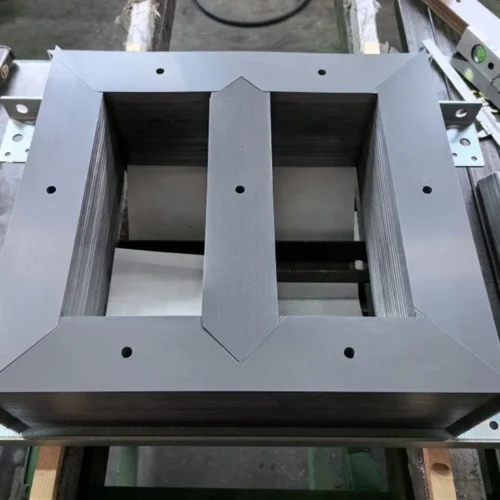
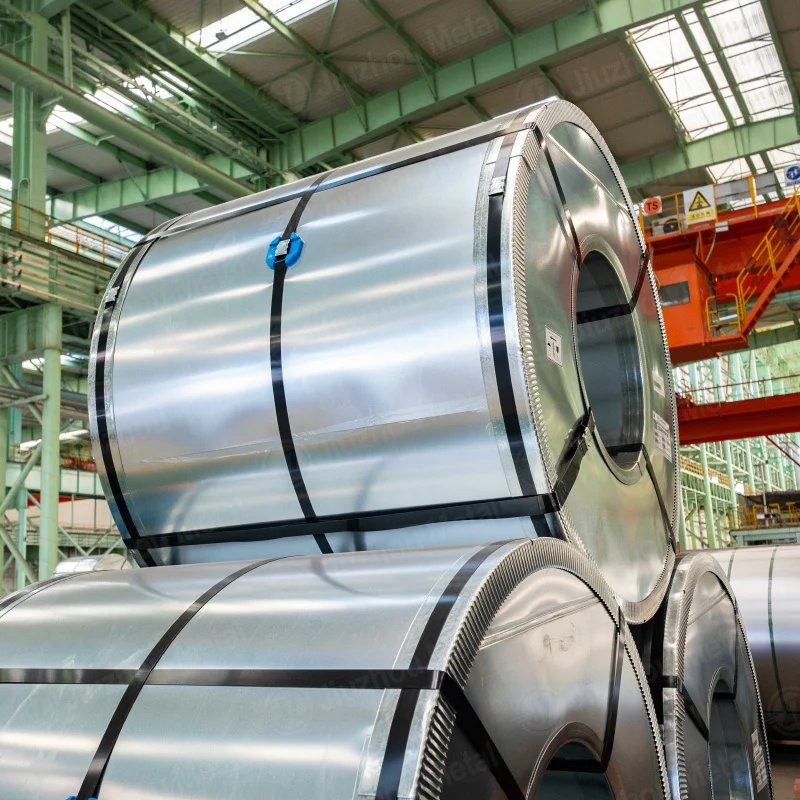
For transformer duty, M5 Grain Oriented Electrical Steel covers 0.30 mm cores at distribution scale. Motor builders generally take M19 Non Oriented Electrical Steel, while heavier frames use M36 Non Oriented Electrical Steel.
Background on process families sits in our cold-rolled oriented steel guide. Purchasing detail, meanwhile, appears in the grain-oriented coil guide.
Frequently Asked Questions
Five to eight years for oriented grades, since texture and coating learning overlap.
Sometimes on loss, rarely on consistency across a campaign.
Because induction sets core size, whereas thickness mainly affects eddy loss.
No, since over-treatment raises stress and can worsen magnetostriction.
Adhesion after impregnation plus flexibility tests, not film thickness alone.
What We Do Not Do
- We do not operate a rolling mill.
- We do not develop inhibitor recipes.
- We do not certify your finished core design.
Consequently, we source qualified coil and verify documents before shipment.
Specify Your Order
- State the equipment and operating flux.
- Name the grade, or give both loss and induction limits.
- Give gauge and slit width, then confirm tonnage and port.
We reply with stock, price, and test data within one working day.
- Email: vera.liang@ztwysteel.com
- Location: Xishan District, Wuxi, Jiangsu, China
- Supply range: CRGO M4/M5 at 0.23–0.35 mm, CRNGO M19–M47 at 0.35–0.65 mm
- Slitting tolerance: ±0.05 mm
- Documentation: MTC EN 10204 3.1, core loss and B8 data per ASTM A343 / IEC 60404-2, coating adhesion report




 English