

Silicon Steel Export Packing: Five Stages, Five Failure Points
Silicon steel export packing fails for one reason, because water forms inside a sealed container even when no rain falls. A coil leaves Wuxi dry, yet 30 days at sea can build a film of moisture on the steel. The damage shows up as edge rust rather than a soaked crate. So buyers often blame the mill rather than the voyage. Most of these cases trace back to rust causes that started before the container door closed.
This guide follows one coil through five stages, from the mill wrap to the destination warehouse. Each stage carries its own failure point. So the packing plan has to answer all five rather than the obvious one.
What Silicon Steel Export Packing Has to Survive
A voyage from Shanghai or Ningbo to Rotterdam takes 30 to 35 days. Meanwhile the run to Los Angeles takes 14 to 18 days. During that time the container crosses climate zones, so the internal temperature swings hard.

Condensation, Not Rain
At 30 °C, saturated air holds 30.4 g of water per cubic metre. A 40 ft container near 67 m³ therefore carries about 2 kg of water vapour. Cool the box to 20 °C, since saturated air then holds only 17.3 g/m³. So roughly 0.9 kg of that water condenses on the steel. That layer is what rusts a coil.
Why VCI Only Works in a Sealed Space
VCI film releases a vapour that forms a protective layer on the metal surface. The vapour escapes unless the wrap stays closed, so a torn film protects very little. Desiccant works the same way, because it only absorbs moisture in an enclosed volume. Both methods need the same condition, namely a sealed space around the coil.
Silicon Steel Export Packing: Five Stages, Five Failure Points
Stage one starts at the mill, while stage five ends in the buyer’s rack. Between them sit handling, loading and the sea passage. A weak link at any stage defeats the other four, so the plan must cover each one.
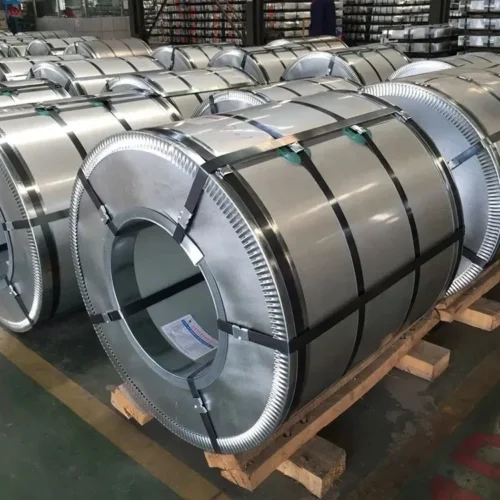
Stage One — Mill Wrap and Edge Protection
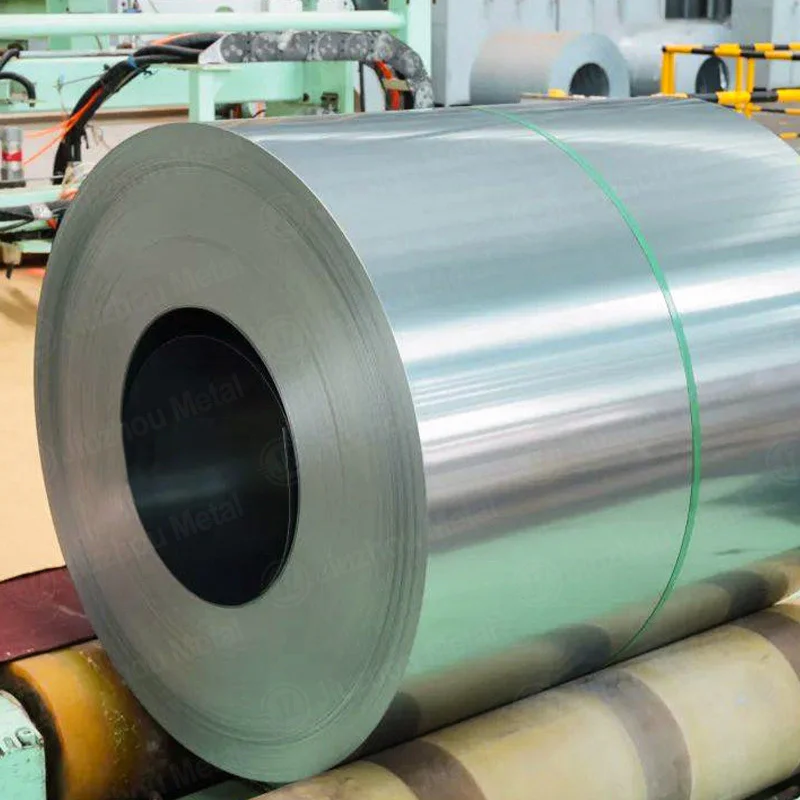
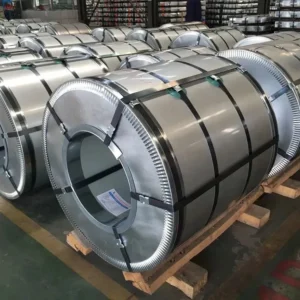
The mill wrap protects the surface, since a grain oriented electrical steel sheet rusts first at a cut edge. Coatings run 0.003 to 0.006 mm per side, so a scratch exposes bare metal within one touch. Edge protectors therefore matter more than the outer film. That is why silicon steel sheets need insulation that survives the voyage rather than the press alone.
Eye-to-Sky or Eye-to-Wall
An eye-to-sky coil stands on its side, so the wrap drains and the edges carry the load. An eye-to-wall coil lies flat, so the wrap can trap water against the steel. Most exporters ship eye-to-sky for that reason, since gravity helps rather than hurts. The choice shows on the packing list, so the buyer can check it before the container arrives.
Steel strapping holds the wrap in place, while 2 to 3 bands per coil keep the laps tight. A coil weighing 3 to 5 t needs bands at the one-third points rather than the middle alone. Run the silicon steel sheet weight calculation before you pick a band count. A 5 t coil loads straps harder than a 3 t coil, since each band carries more mass.
Stage Two — Inland Haul and Handling
The truck ride shakes a coil harder than the sea passage, because the road transmits sharp shocks. A 5 t coil on a flatbed can shift if the dunnage settles. So the driver checks the lashing before departure. Forklift forks dent a coil core unless the operator uses a spreader bar. A 508 mm core carries little crush strength, since the wall is thin.
Stage Three — Container Loading
Loading decides the protection level, because the box has a fixed volume and a fixed weight limit.
Weight Limits That Decide the Plan
A 20 ft container carries 25 to 28 t, while a 40 ft box carries 25 to 27 t. A 5 t coil therefore fills a 40 ft unit with about five coils. So the volume runs out while the weight is still short. That mismatch matters, since empty space invites movement. Most non oriented electrical steel shipments follow the same rule, because coil density sets the count.
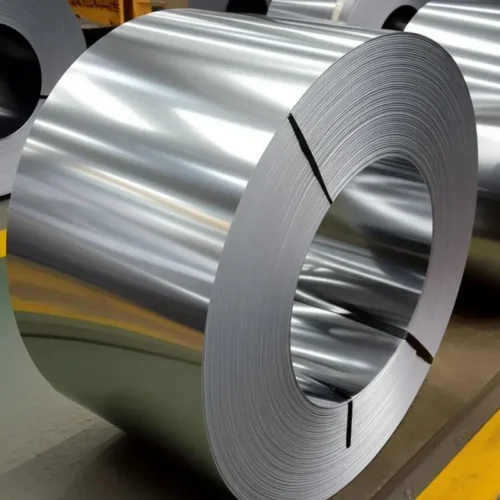
Dunnage and Void Fill
Air bags and timber dunnage fill the gap, so the coils cannot shift in a seaway. Poor void fill lets a coil roll against the door, and a 5 t mass breaks a wrap in seconds. Loading photos document the arrangement, while the bill of lading records the count. A trial lot below one container still follows the electrical steel coil MOQ rules. So the packing level never drops for a small order.
Stage Four — Thirty Days at Sea
The sea passage tests the whole plan, because the container breathes with each temperature swing. A coil wrapped in VCI film and packed with 2 to 4 kg of desiccant survives most routes. A bare coil does not, because nothing slows the moisture. Humidity inside the box should stay under 50 percent, since rust nearly stops below that line.
Stage Five — Discharge and Storage at Destination
Discharge reverses the loading logic, so the same care applies in the other direction. A coil that sits in a hot yard after arrival can rust within weeks. The buyer must open the wrap in a dry place, unless the yard stays cool. The receiver should check the edge and the wrap before signing, since a signed receipt weakens a later claim.
Documentation That Travels With the Coil
Four documents travel with the coil, and each supports a different claim. The MTC under EN 10204 3.1 states the grade, the thickness and the loss basis. The packing list states the wrap, the desiccant count and the strapping pattern. Loading photos show the arrangement inside the box. The mill label ties the coil to a heat number. So the silicon steel standards list in the certificate can be checked against the metal. A silicon steel mill grade label that stays on the coil settles most disputes before they start.
What Silicon Steel Export Packing Costs
Packing adds roughly 1 to 2 percent to the coil value. VCI film, desiccant and edge protectors are cheap items, because they weigh little. On a 3 t non-oriented coil at 1,000 USD per tonne, that means 30 to 60 USD. The coil itself is worth 3,000 USD. A rusted coil loses far more, since a downgraded coil may sell at half price or return at full cost.
The arithmetic favors protection, so the cheap option rarely is. Still, check the silicon steel sheets list for the packing level we hold in stock. Buyers who ask about electrical steel quotation speed usually get the packing line in the same reply. The two belong on one sheet, because the quote covers both.
What We Do Not Do
We do not ship a coil without edge protectors, nor do we load a container without a photo record. Nor do we promise a delivery date we cannot confirm with the carrier. Finally, we do not issue a certificate for a heat number we did not receive. Stock sits in Wuxi, while CRGO silicon steel coils leave with the mill label intact. Every coil ships from Jiangsu Zhongtong Weiye Special Steel Co., Ltd.
FAQ
No, because the two work on different problems. VCI film slows surface corrosion, while desiccant removes the water that drives it. Both together cost less than 1 percent of the coil value.
About five, since a 5 t coil reaches the weight limit near 25 t. A 20 ft box takes about five as well, because the weight limit binds before the volume.
Yes, because eye-to-sky coils travel well in a container with air bags and dunnage. A crate suits cut to size sheets rather than coils, so the two orders need different plans.
Six months in a dry store, since VCI film keeps working while the wrap stays sealed. Open the wrap in a humid yard and the clock jumps to weeks.
Usually 1 to 2 percent, because the film, desiccant and protectors cost little. Quotes state the packing level, so the buyer can compare like with like.
Request a Quotation
Send your coil weight, width, destination port and packing preference. Then we can confirm the container plan and the protection level before we quote. We answer packing enquiries within one working day, while quotes stay valid for two weeks. Write to vera.liang@ztwysteel.com.
- Email: vera.liang@ztwysteel.com
- Location: Xishan District, Wuxi, Jiangsu, China
- Packing: eye-to-sky horizontal coils, VCI film, desiccant, steel strapping
- Container load: 20 ft 25–28 t, 40 ft 25–27 t
- Marking: mill label, heat number and gross weight on every coil
- Documentation: MTC EN 10204 3.1, packing list, loading photos



 English