

Which Grade Fits a Distribution Transformer?
Most buyers start with a grade name and then ask whether it fits, although the order runs backwards. A distribution transformer grade is easier to choose backwards, because the loss guarantee fixes the answer before any code appears. Jiangsu Zhongtong Weiye Special Steel Co., Ltd. works that inversion below, using a grain oriented electrical steel sheet as the example.
The Short Answer
The 10 to 35 kV class takes 0.27 mm oriented strip in the 27QG120 grade, at 50 to 2,500 kVA. A tight guarantee instead moves the choice to 23RK085 at 0.23 mm. Cost-led tenders stay near 30Q120, since first cost rules there. Hence four steps settle the grade, and the steps run from the guarantee to the strip.
Start From the Guarantee, Not the Grade
A tender states an allowed no-load loss, and that figure carries the real requirement. Everything else follows from it, since the core has to meet the number. So the first question arrives in kilowatts, not in codes. A designer who begins with a code argues about labels, while a designer who begins with watts argues about cost.
Step One — Turn the Guarantee Into Watts per Kilo
Take a 1,000 kVA unit with a guarantee of 1.35 kW, and a core of 1.2 tonnes of CRGO sheet. Divide the loss by the mass and you get 1.125 W/kg across the whole core. That figure is an average, since the yoke runs at lower flux than the limb. Even so, it gives a usable target, and the target costs nothing to compute.
Step Two — Divide by the Building Factor
The core never reaches the strip’s tested figure, since cutting, stacking, and joints all cost loss. A building factor of 1.1 to 1.3 covers that gap, and 1.25 is a fair middle. Divide 1.125 W/kg by 1.25, so the strip must test near 0.90 W/kg. A grain oriented sheet never reaches its own figure once stacked. Therefore, the question becomes a number the catalogue answers.
Step Three — Read the Grade Table
Now compare candidates on that basis, while keeping the induction fixed at 1.7 T. The 23RK085 strip tests at 0.85 W/kg, which clears the 0.90 target. A 27RK095 grade tests at 0.95 W/kg, which misses it by a little. The 27QG120 and 30Q120 strips test at 1.20 W/kg, which miss by a third. Hence the arithmetic already rules two families out.
Step Four — Check the Other Two Limits
Two limits can override the loss figure, and both appear late in a project. Noise matters when the unit sits near housing, because magnetostriction sets the sound level. Build height matters when the window stays tight, since a thin sheet needs more sheets inside it. Therefore, a grade that passes step three can still fail on sound or on stack.
The Cost of the Better Strip
A step from 1.20 to 0.85 W/kg saves 0.35 W/kg, so the gain is 0.35 kW on every tonne. Capitalised at about €14 per watt, that gain is worth near €4,900 per tonne over life. A 1.2 tonne core therefore carries roughly €5,880 of value, and that dwarfs a grade premium. Hence a premium of a few hundred dollars per tonne rarely loses that argument.
When 0.30 mm Still Wins
A light-duty unit can still take 0.30 mm strip, since a cost-led tender pays for first cost alone. That choice lifts no-load loss although it lowers the invoice, and both parties know it. So the grade becomes a commercial decision after the engineering screen. Therefore, never assume the thinnest strip always wins the order.
What a Tonne Buys Here
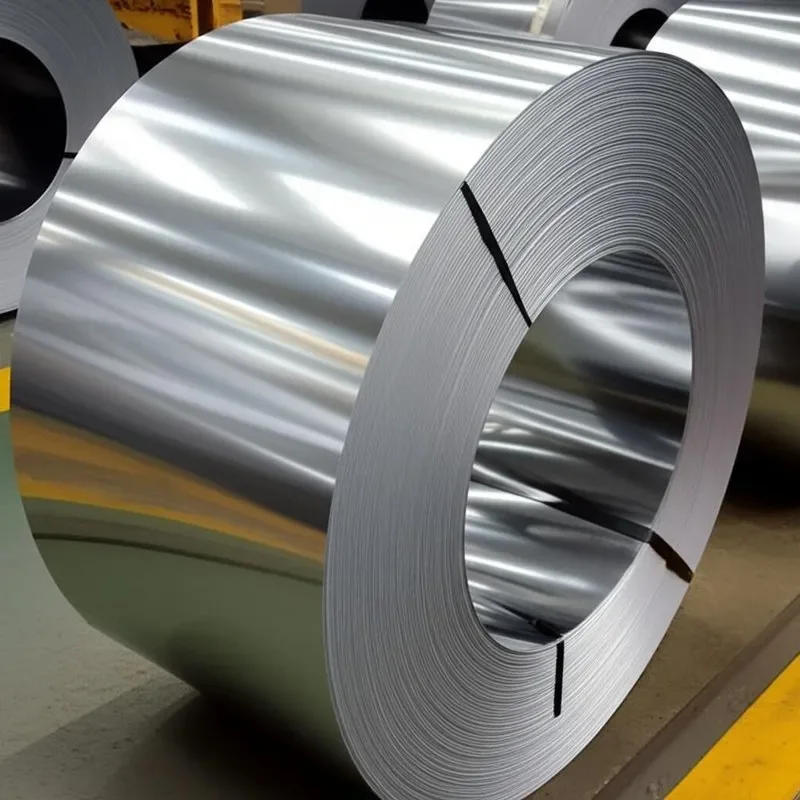
A 1.2 tonne core at 0.27 mm needs about 453 metres. A metre at 1,250 mm width weighs 2.649 kg at that density. At 0.23 mm the same mass stretches to 532 metres, since a metre then weighs only 2.257 kg. That difference matters at the slitting stage, because more metres means longer runs through the line. Hence weight planning and length planning are two jobs.
The Certificate Check
A grade name on a label proves nothing, until a certificate agrees. Ask for the tested loss at 1.7 T, the gauge, and the heat number, all on one document. An EN 10204 3.1 sheet carries all three, and 3.2 adds an independent witness, as the standard note explains. Therefore, the certificate is the step where a choice becomes a purchase.
What Goes Wrong
One buyer picks 27QG120 for a tight guarantee, then misses it by a third. Another buys 0.23 mm without checking the window, although the stack then stands too tall. A third compares 1.5 T and 1.7 T figures on one sheet, so the ranking comes out wrong. Those three errors arrive monthly.
What We Do Not Do
We do not melt or roll steel. We do not design the transformer, since the core belongs to the customer’s engineer. Nor do we promise a loss figure at a basis the mill never tested.
Those limits keep the answer honest, and they keep a tender defensible.
Specify Your Order
Give the kVA, the voltage class, the guaranteed loss, and the core mass, since four fields run the inversion. Add the noise limit when the site is sensitive. A CRGO coil then ships with its basis printed. A cut core arrives already stacked. That reply usually takes a day.
Related Reading
Our range note explains why 0.27 mm carries the volume. The grade guide maps every naming pattern. A hub page answers six basic questions.
Frequently Asked Questions
0.27 mm in the 27QG120 class, unless the guarantee is tight.
Only when the loss is capitalised, since a first-cost buyer sees no gain.
Because the core loses more than the strip tests, and the gap runs 1.1 to 1.3.
No, since the stack grows taller as the gauge falls.
A certificate with loss, gauge, and heat number.
- Email: vera.liang@ztwysteel.com
- Location: Xishan District, Wuxi, Jiangsu, China
- Supply range: CRGO and CRNGO 0.20–0.65 mm, four coating classes
- Slitting: 20–1,250 mm, ±0.05 mm, burr under 0.02 mm
- Documentation: MTC EN 10204 3.1 with grade, thickness and loss basis, 3.2 on request



 English