
What Is Hi-B Grain Oriented Silicon Steel
Hi-B is the trade shorthand for high magnetic induction grain oriented silicon steel, the top induction tier of oriented electrical steel. The name comes from the high flux density the material reaches at a given magnetising field: where a conventional oriented grade settles near 1.80 T at B8, Hi-B reaches 1.87 to 1.88 T and above. This page covers where the term came from, how grade codes carry it across standards, the B8 and loss bands by thickness, and supply forms. It is one branch of the grain-oriented electrical steel family.
Where the Name Hi-B Comes From
Hi-B began as a product name rather than a technical classification. Nippon Steel commercialised its high induction oriented steel under the ORIENTCORE HI-B mark, and the HI-B shorthand spread through the transformer industry until it became the everyday label for the whole high induction tier, whatever the mill.
“Hi-B” is now a category rather than one mill’s brand, supplied under several grade codes. Comparing offers means translating each code back to its B8 and P1.7/50 values rather than comparing the word.
The claim behind the name is measurable: Nippon Steel states its HI-B products run about 0.1 T higher at B10 than conventional grain oriented steel, on top of the B8 gain.
Reading the Grade Code: G, P, QG and QH
Grade codes carry the tier in one letter, and the letter differs by mill system:
| System | Conventional | High induction | Domain refined |
| Baowu / enterprise | G, as in B27G120 | P, as in B27P100 | R, as in B27R090 |
| GB/T 2521.2 | Q, as in 27Q120 | QG, as in 27QG100 | QH, as in 27QH085 |
| Nippon Steel | ORIENTCORE | ORIENTCORE HI-B | HI-B LS, HI-B PM |
| IEC designation | M120-27S | M100-27P5 | — |
So the same 0.27 mm high induction band appears as B27P100 at Baowu, 27QG100 in the GB system, 27ZH100 at Nippon Steel and 27JGH100 at JFE. Matching offers across mills means matching the numbers, not the letters. The orientation grade lineup sets out the full grade spread at each thickness.
The B8 Band, and the Gap Against Conventional Grades
B8 is the magnetic polarisation reached at a magnetising field of 800 A/m. On certificate values, the two tiers separate cleanly:
| Tier | Typical B8 minimum | Example Baowu grade (0.27 mm) | P1.7/50 |
| Conventional | 1.80 T | B27G120 | ≤1.20 W/kg |
| High induction (Hi-B) | 1.88 T | B27P100 | ≤1.00 W/kg |
At 0.27 mm the induction gap is about 0.08 T at B8, and the loss ceiling drops by about 0.20 W/kg between those two grades. At 0.23 mm the same pattern holds: B23G110 at 1.80 T and 1.10 W/kg against B23P090 at 1.87 T and 0.90 W/kg.
That is the number to test a supplier claim against: a coil offered as Hi-B whose certificate shows a B8 minimum of 1.80 T is conventional on paper. Reading P1.7/50 as the key transformer indicator covers how the loss figure is read alongside the induction one.
Typical Hi-B Grade Bands by Thickness
Baowu’s published high induction table, as a reference of how the band is laid out:
| Grade | Nominal thickness | P1.7/50 max | B8 min |
| B23P090 | 0.23 mm | 0.90 W/kg | 1.87 T |
| B23P095 | 0.23 mm | 0.95 W/kg | 1.87 T |
| B23P100 | 0.23 mm | 1.00 W/kg | 1.87 T |
| B27P095 | 0.27 mm | 0.95 W/kg | 1.88 T |
| B27P100 | 0.27 mm | 1.00 W/kg | 1.88 T |
| B27P110 | 0.27 mm | 1.10 W/kg | 1.88 T |
| B30P100 | 0.30 mm | 1.00 W/kg | 1.88 T |
Two things show up in the table. First, the induction minimum is set by thickness band rather than by loss band: 0.23 mm sits at 1.87 T and 0.27 mm and above at 1.88 T. Second, the loss and induction numbers move independently, so a lower loss grade at the same thickness does not automatically buy a higher B8.
Thicker Hi-B grades exist beyond this table, and every mill’s band boundaries differ slightly. Treat the table as a shape, then read the actual ceiling from the offer.
What the Higher B8 Buys in a Core
The reason to pay for Hi-B is that the higher induction lets the design run at a higher working flux density. Either the core section shrinks for the same rating, or the excitation current falls for the same geometry. Combined with the lower loss ceiling, this usually lands as a smaller or cooler core at the same efficiency class.
Where that pays off is continuous duty with no-load loss as a rated figure: distribution and power transformers, and reactors where the core runs at a steady flux. The design case for high magnetic induction works through the trade between core size and loss.
It does not pay off where the design is already constrained by the efficiency class rather than the core, or where the annual loss saving does not cover the premium. Hi-B costs more at the same gauge; the premium moves with grade band and market, so price it per lot.
Hi-B Against the Conventional Tier: the Process Difference
The gap is made in the mill. Conventional grades rely mainly on manganese sulphide to pin off-orientation grains during secondary recrystallisation; Hi-B uses aluminium nitride as the main inhibitor, which pins harder and lets a sharper Goss texture survive the high-temperature anneal. The rolling route differs too, with a single heavy reduction pass for Hi-B against a two-stage route for conventional grades.
The practical consequence is that thickness alone does not make the tiers interchangeable, and appearance does not distinguish them: a Hi-B and a conventional coil can look alike. How CGO and Hi-B differ in detail covers the process comparison and the on-paper checks.
Supply Forms
Hi-B ships in the same forms as other oriented grades:
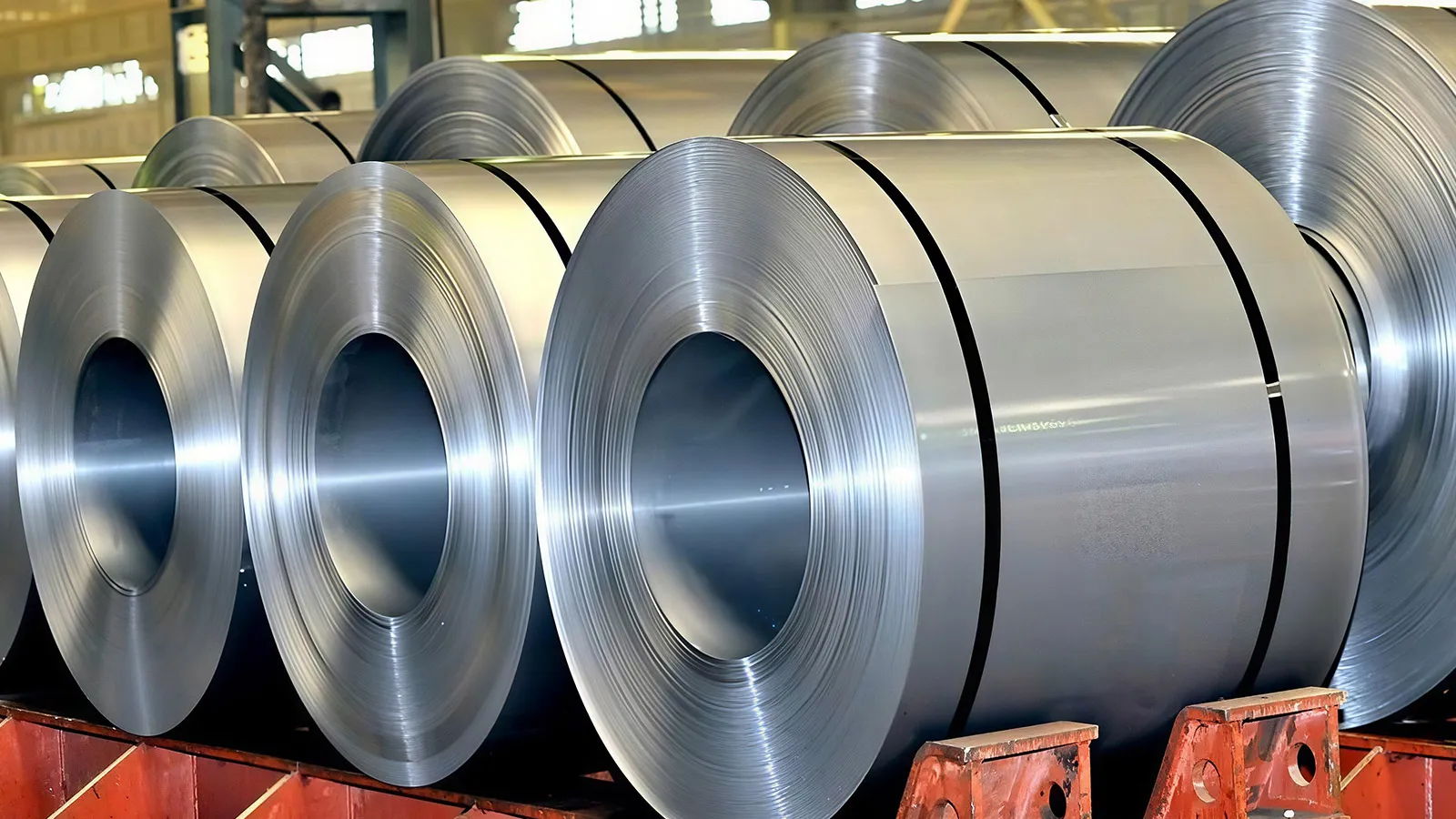
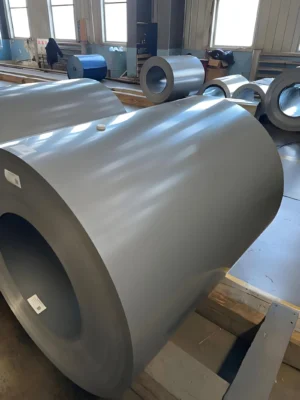
- Full-width cold rolled coil, within the mill’s producer width range.
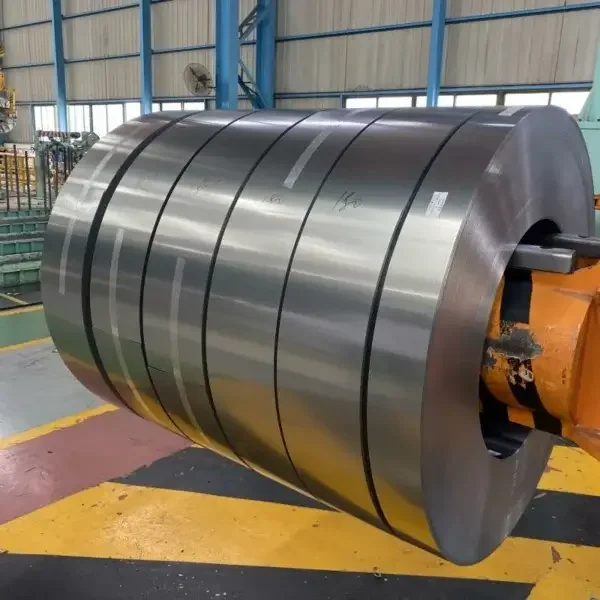
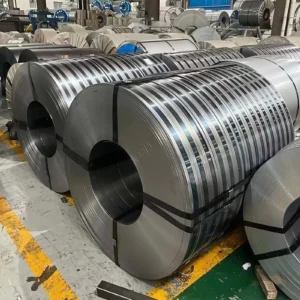
- Slit coil, cut along the rolling direction to the core strip width, so orientation stays aligned with the strip length.
- Cut sheets and laminations, processed to the core profile.
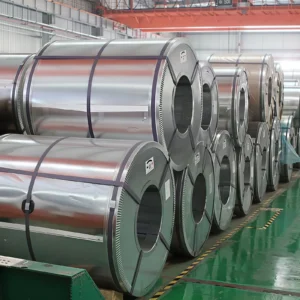
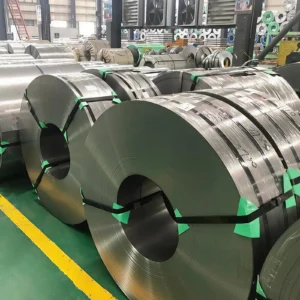
Coating class, interlamination resistance and stacking factor are ordered alongside the magnetic grade; they decide how the core stacks and how much active steel sits in the window. The high grade cold rolled coil range shows the supply formats for oriented material.
FAQ
Is Hi-B a brand or a grade? Both, historically. It started as Nippon Steel’s ORIENTCORE HI-B product name and became the industry shorthand for the high induction tier. Today several mills supply the tier under their own codes.
What B8 minimum should a Hi-B certificate show? 1.87 T at 0.23 mm and 1.88 T at 0.27 mm and above, following the typical Baowu band. A certificate showing 1.80 T is a conventional grade.
Does a lower loss grade always mean higher B8? No. Loss and induction minimums move separately. A grade can carry a lower P1.7/50 ceiling without a higher B8 minimum, so both figures have to be read.
Is the Hi-B premium a fixed percentage over conventional? No. It moves with grade band, thickness and market conditions, so it should be quoted per lot rather than carried as a constant.
Sourcing Hi-B for a transformer or reactor core? Send the rating, working flux density and efficiency class to vera.liang@ztwysteel.com, and we will come back with the grade band, thickness and certificate values that fit the design.



 English