

Enhancing Transformer Performance with Low Noise Silicon Steel: A Guide to Optimizing Operation Stability
Low noise silicon steel addresses the source of transformer hum, yet the noise a neighbour hears travels five paths before it reaches an ear. In practice, steel choice controls only the first link of that chain. Consequently, quiet installations combine material, joint design, clamping, and tank stiffness. Jiangsu Zhongtong Weiye Special Steel Co., Ltd. supplies oriented coil and states its magnetostriction plainly.
Where the Hum Comes From
Magnetostriction makes the core change length slightly as flux reverses, and that movement repeats at twice line frequency. Therefore, a 50 Hz unit hums at 100 Hz, with harmonics riding above it. Each cycle squeezes the laminations, and the stack answers with a faint tick that the tank amplifies.
Grain-oriented sheet keeps magnetostriction low, which is one reason transformers rarely use non-oriented grades.
Five Paths, One Decibel Budget
- Path 1 — the steel itself: sets the baseline, roughly 45–55 dB(A) at 1 m for distribution sizes.
- Path 2 — core joints: butt gaps add 2–4 dB, whereas step-lap joints recover most of it.
- Path 3 — clamping: loose stacks rattle and add 1–3 dB, since free edges vibrate.
- Path 4 — tank and mountings: stiffeners and isolation pads buy 3–6 dB, depending on design.
- Path 5 — the room: hard walls reflect sound, so a concrete cell can add 3–5 dB over a treated room.
Adding those contributions explains why identical cores perform differently on site.
The Flux Density Lever
Noise rises steeply near the knee, historically about 6–8 dB per 0.1 T above 1.5 T. Consequently, a designer who trims core size to save steel often pays in decibels and in loss.
Operating at 1.5 T rather than 1.6 T usually buys several dB, and that is cheaper than acoustic treatment.
What Steel Choice Actually Buys
- Oriented texture: lowers magnetostriction and raises permeability along the flux path.
- Thin gauge: reduces eddy loss, although coating share grows.
- Coating quality: prevents inter-laminar shorts, which otherwise create local buzzing.
- Stress relief: recovers quietness lost during slitting and punching.
- Consistent gauge: keeps stack pressure uniform, so no section rattles alone.
Each item is testable, therefore ask for test data rather than adjectives.
Why Stress Destroys Quiet
Punching strains the grain structure, and strained sheet magnetostricts more. Moreover, burr holds layers apart, so clamping pressure spreads unevenly. In addition, slitting camber forces the stack to bow, which loads one edge harder.
Hence annealing after punching often buys more decibels than a premium grade, since it removes the damage the press introduced.
DC Bias and Even Harmonics
Geomagnetic disturbance and nearby DC loads shift the operating point, and the core then produces even harmonics at 50 and 150 Hz. Consequently, occupants hear a rougher tone, and complaints follow. Designers counter it with flux margin, since no steel grade removes bias once present.
Therefore, specify headroom of about 0.1 T where the site sits near HVDC corridors.
What to Write in the Specification
- Grade, gauge, and loss basis.
- Maximum magnetostriction or an acoustic guarantee.
- Core joint type, step-lap rather than butt.
- Clamping pressure and its measurement method.
- Acoustic test standard and distance, typically sound pressure at 1 m.
Without item five, decibel claims cannot be compared at all.
Reading Real Numbers
A 1000 kVA distribution unit commonly measures 48–56 dB(A) at 1 m, while large power transformers reach 70–80 dB(A). Those figures depend on cooling plant too, since fans often dominate above 5 MVA.
Hence isolate core noise before blaming steel, because fan noise masks it entirely.
Background on loss mechanics sits in our transformer efficiency note, and saturation behaviour appears in the B50 explainer.
Frequently Asked Questions
Because magnetostriction repeats twice per 50 Hz cycle.
Slightly, mostly through lower loss and better stacking.
Slightly, mostly through lower loss and better stacking.
Yes, and it often beats a grade upgrade on cost per decibel.
As sound pressure level at a stated distance, sometimes with a guarantee.
What We Do Not Do
- We do not build, assemble, or test transformers.
- We do not guarantee acoustic outcomes.
- We do not anneal finished laminations.
Consequently, we supply coil with magnetic data, while your works own assembly.
Specify Your Order
- State rating, flux density, and noise target.
- Name the grade, or give the loss limit.
- Give gauge and slit width, then confirm tonnage and port.
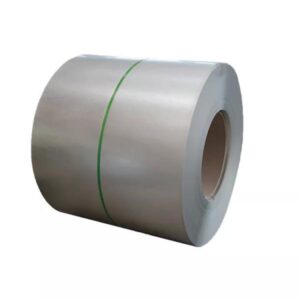
M5 Grain Oriented Electrical Steel covers 0.27–0.30 mm cores, and M4 Grain Oriented Electrical Steel serves slightly thicker builds. Quotes return within one working day.
- Email: vera.liang@ztwysteel.com
- Location: Xishan District, Wuxi, Jiangsu, China
- Supply range: CRGO M4/M5 at 0.23–0.35 mm, CRNGO M19–M47 at 0.35–0.65 mm
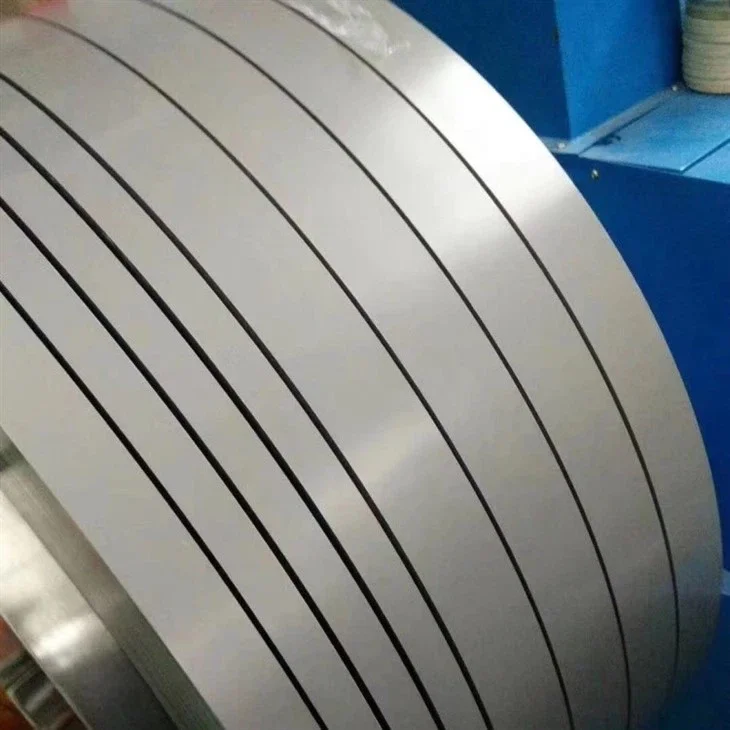
- Slitting: 20–1250 mm, ±0.05 mm, burr under 0.02 mm
- Documentation: MTC EN 10204 3.1, core loss per ASTM A343 / IEC 60404-2, magnetostriction on request






 English