

What is silicon steel and what is it used for?
What is silicon steel used for answers itself once you accept one fact: it exists to carry magnetic flux with as little heat as possible. In practice, iron does that job well, and 1–4.5% silicon makes it better by raising resistivity. Consequently, almost every transformer and motor core contains it. Jiangsu Zhongtong Weiye Special Steel Co., Ltd. supplies the flat-rolled form from Wuxi.
Three Numbers Sum It Up
- 3% — the silicon level in most commercial grades, which cuts eddy current loss sharply.
- 0.35 mm — a typical gauge, thin enough to limit eddy paths and thick enough to punch.
- 1.5 T — the induction at which loss is usually quoted, near but below saturation.
Those three values explain both the material and its price.
Two Families, One Sentence Each
Grain-oriented (GO) sheet grows grains aligned with the rolling direction, so it carries flux best along that axis. Hence it serves static cores such as transformers.
Non-oriented (NO) sheet keeps grains random, so it behaves evenly in all directions. Therefore, it serves rotating machines.
Where It Goes: The Use Map
Power transformers. Distribution and power units stack oriented sheet, because flux runs one way and no-load loss bills for decades. This single use absorbs the largest share of GO tonnage.
Industrial motors. Stators and rotors take non-oriented sheet at 0.35–0.50 mm. Efficiency classes such as IE3 and IE4 set the ceiling on acceptable loss.
Reactors and chokes. Filter and smoothing duties need a stable, gapped core, which a reactor core lamination supplies. Consequently, drive manufacturers buy these alongside motor steel.
Home appliances. Washer motors, fans, and compressors use compact cores, sometimes as a silicon steel coiled magnet ring for automatic washer motors. Here cost dominates, and M36–M47 grades fit.
Transport and renewables. Traction motors, wind generators, and chargers all need low loss at elevated frequency, so thin gauge enters the specification.
Small electronics. EI and UI laminations serve control transformers, instrument supplies, and audio gear.
What Silicon Steel Is Not
It is not stainless steel, since it rusts readily and depends on coating. Nor is it a structural material, because it bears little load. Moreover, it does not serve very high frequency well, where ferrites win.
Therefore, treat it as a magnetic material with a narrow, deep purpose.
How Grade Names Work
A name like 50W470 reads as 0.50 mm and 4.70 W/kg at 1.5 T and 50 Hz. Oriented names such as 27P120 read as 0.27 mm and 1.20 W/kg at 1.7 T. Hence the label states gauge and loss together.
That naming convention lets buyers compare offers without extra paperwork.
How It Is Made, in Five Steps
- Melt and refine steel, then adjust silicon and carbon.
- Cast slabs, then hot roll to a transfer gauge.
- Cold roll to final thickness, with annealing between passes.
- Anneal to develop texture or grain size, then apply insulation coating.
- Slit to width and test loss, induction, and coating.
Each step moves loss by a measurable amount, and step four decides most of it.
What First-Time Buyers Ask
- Which family do I need, GO or NO?
- Which gauge suits my frequency?
- Does the price include coating?
- What loss basis appears on the certificate?
- Can you slit to my width?
Answer those five, and the enquiry becomes quotable in one day.
Related Reading
Grade families are mapped in our silicon steel grades overview. Machine-by-machine context sits in the applications guide.
Frequently Asked Questions
Yes, since the two names describe one material.
50W470 for motors, and 27P120 to 30P120 for transformers.
Yes, with thinner gauge, often 0.20–0.27 mm.
Yes, with thinner gauge, often 0.20–0.27 mm.
Yes, although remelting downgrades it rather than restoring core grade.
What We Do Not Do
- We do not roll, anneal, or coat steel.
- We do not wind or assemble cores.
- We do not supply stainless or structural plate.
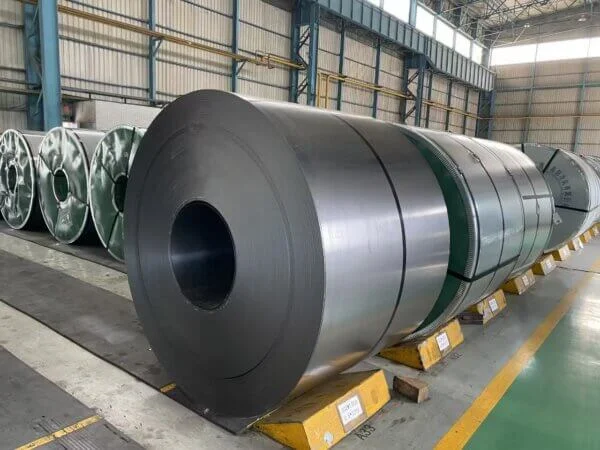
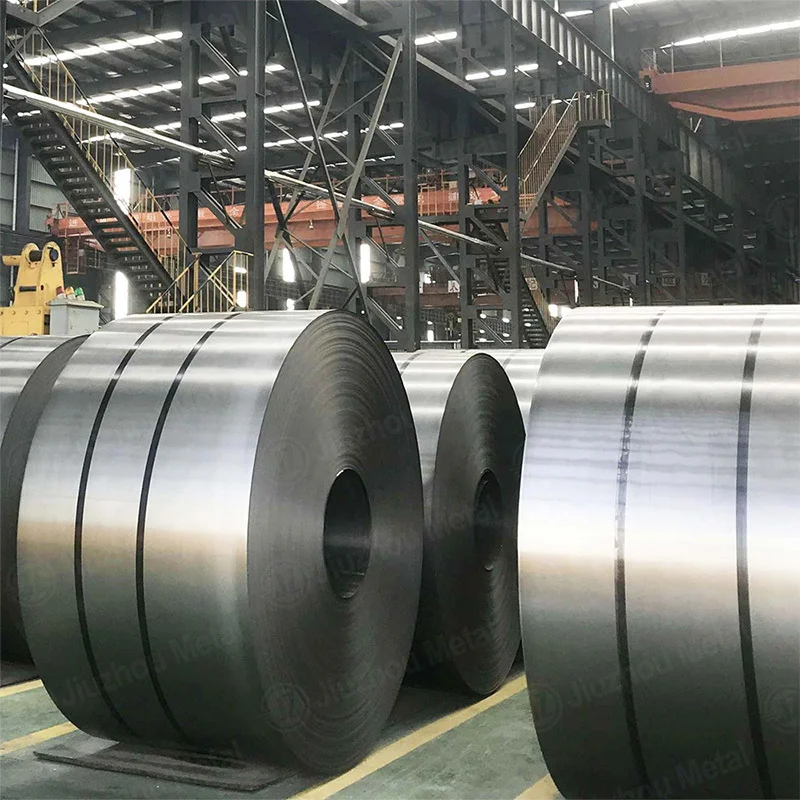
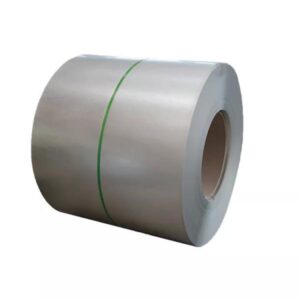
Consequently, we supply flat-rolled coil plus documentation.
Specify Your Order
- State the machine and flux direction.
- Name the grade, or give the loss limit.
- Give gauge and slit width, then confirm tonnage and port.
Quotes return within one working day, with loss data on your basis.
- Email: vera.liang@ztwysteel.com
- Location: Xishan District, Wuxi, Jiangsu, China
- Supply range: CRNGO M19–M47 at 0.35–0.65 mm, CRGO M4/M5 at 0.23–0.35 mm
- Slitting: 20–1250 mm, ±0.05 mm, burr under 0.02 mm
- Documentation: MTC EN 10204 3.1, core loss per ASTM A343 / IEC 60404-2





 English