
Applications of Alloy Steel Materials in Equipment: Compatibility and Performance
Picking the right alloy steel equipment comes down to one question: what destroys the part first? Abrasion, corrosion, heat, or fatigue? Each failure mode demands a different grade. Over-specifying wastes money; under-specifying causes early failure. Here is how engineers match alloy to duty.
When Abrasion Is the Failure Mode
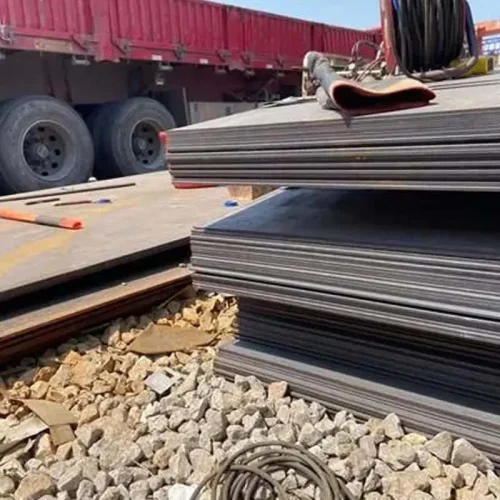
Mining chutes, cement liners, and excavator buckets see continuous rock wear. Carbon steel lasts months; wear plate lasts years. Consequently, equipment designers specify through-hardened wear plate measured in Brinell.
For general abrasion, 450HB Wear Resistant Steel Plate balances hardness and toughness. For high-impact rock handling, 600HB Wear Resistant Steel Plate stands up to direct drop loading. However, harder plate cracks under severe impact. Therefore, match the Brinell grade to the impact energy, not just the abrasion rate.
When Corrosion Is the Failure Mode
Refineries, chemical plants, and coastal equipment see acids, chlorides, and salt spray. Carbon steel and stainless steel fail in weeks. Instead, process engineers specify nickel-based alloys:
- Hastelloy C-276 Plate handles mixed oxidizing and reducing acids.
- Inconel 601 Plate resists high-temperature oxidation and sulfidation.
- Monel 400 excels in seawater and hydrofluoric acid service.
These alloys cost 5–10× carbon steel, yet they run 10–20 years where steel lasts months.
When Heat Is the Failure Mode
Turbines, boiler tubes, and furnace parts run at 500–1000°C. Ordinary steel loses strength and scales. Nickel superalloys retain creep strength and form a protective oxide scale. Furthermore, they resist carburizing and nitriding atmospheres. Inconel 601 and Hastelloy X are the standard choices for these high-temperature duties.
When Repeated Loading Is the Failure Mode
Tools and dies see cyclic stress and thermal shock. H13 hot-work steel resists heat checking; D2 cold-work steel resists abrasive wear. We supply D2 / SKD11 Mold Steel for long-run stamping dies and H13 for aluminum extrusion tooling. Choose the steel based on whether your die sees heat (H13) or abrasion (D2).
The Compatibility Checklist
Before ordering, ask four questions:
- What chemical or environment contacts the part?
- What temperature range does it see?
- What load and cycle frequency does it experience?
- What is the impact energy, if any?
These answers narrow the grade from 120 products to one or two. Furthermore, they prevent you from over-buying a Hastelloy grade for a wear application, or a wear plate for a corrosive application.
Source the Right Alloy for Your Equipment
Send us your service conditions—chemicals, temperature, load, and form. We will recommend the correct grade and quote with a mill certificate.
- Email: vera.liang@ztwysteel.com
- Location: Xishan District, Wuxi, Jiangsu, China
- Supply range: nickel alloys, wear plate, mold steel, electrical steel, copper & brass
- Documentation: MTC with chemistry, mechanical properties, and dimensions
We reply within one working day.






 English