EN 10107 Grain Oriented Silicon Steel: Decoding Grades
EN 10107 grain oriented silicon steel is the European grade system for fully processed Goss-textured strip, and each name packs three facts into one string: loss, thickness and class. Take M120-30S. It means 1.20 W/kg at 1.7 T and 50 Hz, 0.30 mm nominal thickness, conventional grade. Nothing else needs looking up.
The 2022 edition changed two things that matter in a real enquiry: it added a third class for domain refined material, and it put a 0.925 conversion factor between that class and the older tables. Miss either one and a European drawing compared against a Chinese certificate lands on the wrong grade.
What the Standard Covers
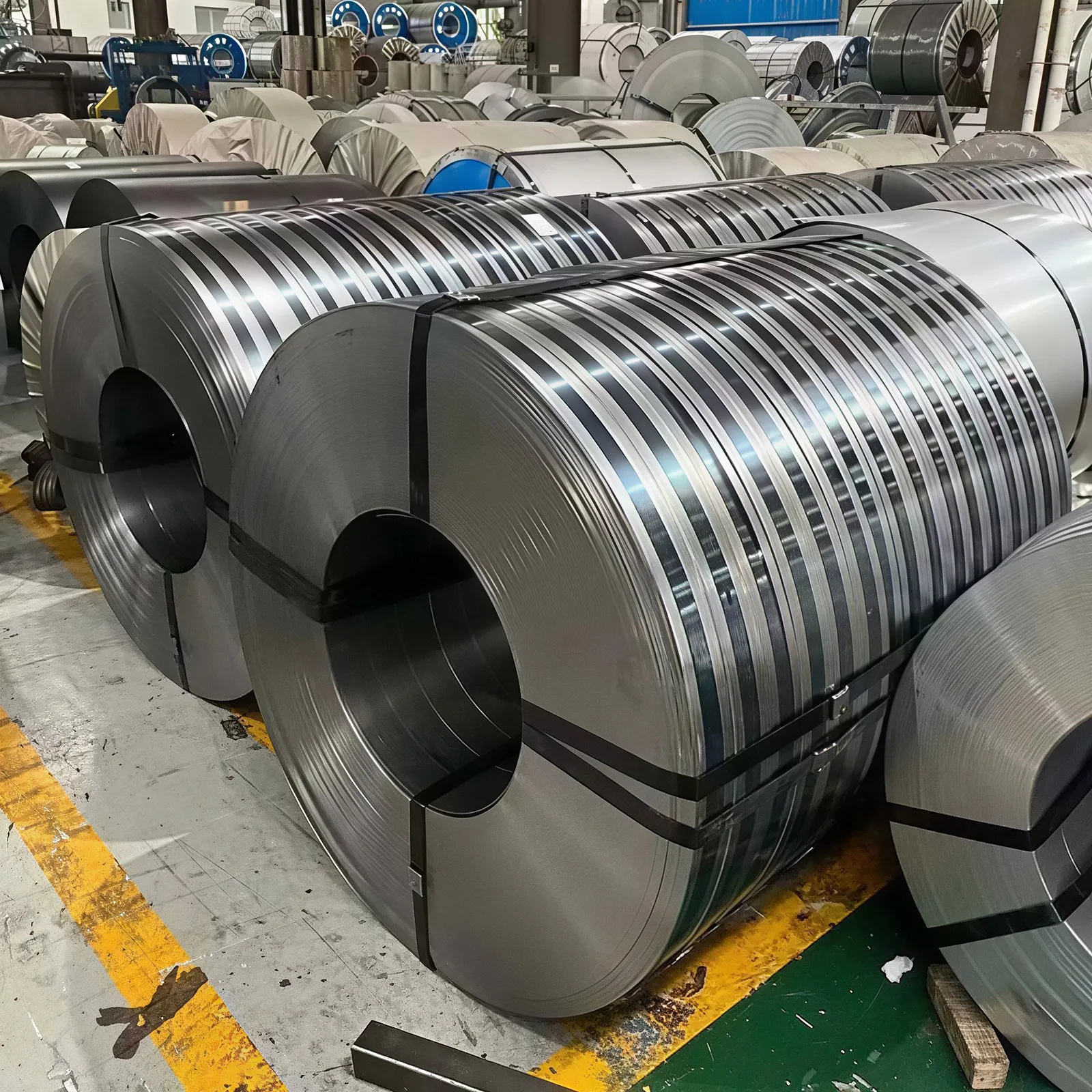
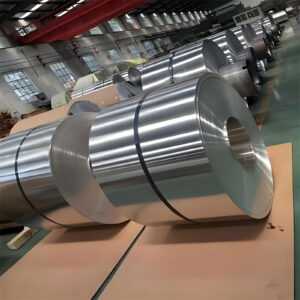
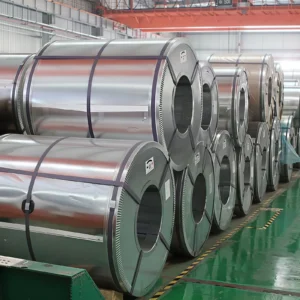
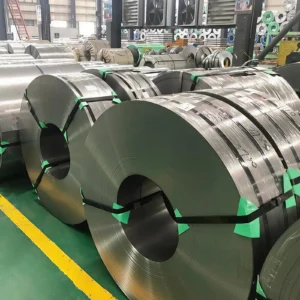
EN 10107:2022 replaced the 2014 edition and applies to grain-oriented strip and sheet in the final annealed condition, supplied as coils or sheets. It covers five nominal thicknesses: 0.20, 0.23, 0.27, 0.30 and 0.35 mm.
Three classes sit inside it, and they correspond to Class C22 of IEC 60404-1:
- S— conventional grain-oriented grades
- P— high permeability grades
- R— magnetic domain refined high permeability grades
The R class is new in 2022. It exists because most domain refinement methods do not survive stress-relief annealing after cutting, so the standard treats that material as a class of its own rather than a variant of the P table.
Decoding the Name
Every designation follows the same order: the letter M, then one hundred times the maximum specific total loss at 1.7 T and 50 Hz, then one hundred times the nominal thickness, then the class letter.
| Position | Meaning | Example |
| M | electrical steel | M |
| 120 | 1.20 W/kg max at 1.7 T, 50 Hz | 1.20 W/kg |
| 30 | 0.30 mm nominal | 0.30 mm |
| S | conventional class | conventional |
| Grade name | Loss at 1.7 T, 50 Hz | Nominal thickness | Class |
| M120-30S | 1.20 W/kg | 0.30 mm | conventional |
| M105-27S | 1.05 W/kg | 0.27 mm | conventional |
| M100-30P | 1.00 W/kg | 0.30 mm | high permeability |
| M080-23R | 0.80 W/kg | 0.23 mm | domain refined |
The last row follows the naming pattern rather than a specific catalogue grade, because R offerings differ by mill.
One trap sits in the loss reference. These figures are quoted at 1.7 T, not 1.5 T. A non-oriented grade such as 50W470 quotes 1.5 T. Put the two side by side and you are comparing two induction levels, not two materials. The oriented grade ladder keeps its figures at 1.7 T for this reason, and the Hi-B tier sits inside that same basis.
Where the 0.925 Factor Bites
This is the part most enquiries get wrong.
S and P grades take their loss values from the Epstein frame method, EN 60404-2. R grades cannot use that method: the Epstein sample needs annealing, and annealing wipes out the domain refinement. So the standard measures R grades with the single sheet tester of IEC 60404-3 instead.
The two methods do not agree: the standard states that SST loss values run larger than Epstein values at the same 1.7 T. Left alone, a better material would print a worse number than a lesser one. To keep the tables continuous, EN 10107 applies a conversion factor of Fc = 0.925 to SST loss values at 1.7 T.
Two consequences follow.
First, an EN R-grade table value is already converted. It sits on an Epstein-equivalent scale, so it can be read against an S or P grade without adjustment.
Second, the magnetic polarization is not converted. B at 800 A/m for R grades comes straight from the SST measurement, and the standard notes it tends to run a little lower than an Epstein figure. A 0.01 to 0.02 T gap between an R grade and a P grade of the same thickness is normal, not a defect.
Now the practical case. A Chinese mill issues a QH grade at 0.90 W/kg measured by the single sheet method under GB/T 13789, the same physical method. Feed that raw figure into the EN scale and it equals roughly 0.83 W/kg, because 0.90 × 0.925 ≈ 0.833. A buyer comparing the raw 0.90 against an EN table value of 0.90 concludes the Chinese material is a class behind. It is not; the two numbers sit on different scales.
Mapping EN Names to Chinese Names
The Chinese system shares the physical basis but reverses the letter order. In GB/T 2521.2 the thickness comes first, the class letter second, the loss figure last.
| EN 10107 class | EN letter | GB/T 2521.2 letter | Shared basis |
| conventional | S | Q | 1.7 T, 50 Hz, Epstein |
| high permeability | P | QG | 1.7 T, 50 Hz, Epstein |
| domain refined | R | QH | 1.7 T, 50 Hz, single sheet |
So M120-30S and 30Q120 describe the same specification: 0.30 mm, 1.20 W/kg. The names are mirrored, not different. Japanese and American designations follow their own logic, and this cross-standard matching guide covers those pairs.
Buying Notes
- Fully processed means final annealed.EN 10107 covers that condition only, so a drawing naming the standard requires final annealed stock, not semi-processed coil.
- Ask which method produced the certificate.Epstein and single sheet figures differ by roughly 8%. Two sheets of paper with the same number can describe different quality.
- Do not anneal an R grade.The refinement does not survive it, which is why the 2022 edition created the class. What laser scribing does to CRGO explains the mechanism.
- 60 Hz buyers get an informative annex, not a guarantee.The standard lists 60 Hz values as informative. Ask for measured 60 Hz data if that is your operating frequency.
- Geometric limits travel with the grade.Thickness tolerance, camber, edge wave and stacking factor sit in the same document, so a certificate quoting magnetic values only tells you half the story.
FAQ
What does M120-30S mean? M is electrical steel, 120 is one hundred times the maximum specific total loss of 1.20 W/kg at 1.7 T and 50 Hz, 30 is one hundred times the 0.30 mm nominal thickness, and S marks the conventional class. The name is the specification.
Is EN 10107 the same as GB/T 2521.2? No, though they share a physical basis. Both quote loss at 1.7 T and 50 Hz. EN 10107 adds a separate class for domain refined material and a conversion factor between test methods; GB/T 2521.2 handles the same material with its own letters.
Why does a European R grade look better than the Chinese single sheet figure for similar material? Because the European table value has already been scaled by 0.925 to sit on an Epstein-equivalent basis. The Chinese certificate carries the raw single sheet reading, which runs about 8% higher. Convert one to the other before comparing.
Can I stress-relief anneal EN 10107 material? S and P grades are routinely annealed after cutting. R grades are not: domain refinement is lost at normal stress-relief temperatures, and the loss returns toward the unrefined level. If the core goes through an anneal, specify S or P.
Which thickness fits a 50 Hz distribution core? 0.27 mm and 0.30 mm carry most of the volume, because they balance loss against stacking factor and cost. 0.23 mm earns its premium only where no-load loss dominates; 0.35 mm suits projects where first cost outweighs efficiency.
Vera Liang
Senior Application Engineer | Electrical Steel & Specialty Alloys
With 8+ years of field experience in silicon steel and high-performance alloy specification, Vera supports industrial clients in grade selection, magnetic property validation and corrosion-resistant material matching for motor, transformer and chemical engineering applications.
Sourcing a grade named on a European drawing? Send the grade name, working flux and annealing route to vera.liang@ztwysteel.com, and Jiangsu Zhongtong Weiye Special Steel Co., Ltd. will confirm the class letter, test method and certificate values before the order is fixed. Wuxi, Jiangsu, China.