
B35A300 Non-Oriented Silicon Steel Grade
B35A300 is a 0.35 mm conventional-type non-oriented silicon steel, with a maximum core loss of 3.00 W/kg at 1.5 T, 50 Hz and a minimum induction of 1.62 T, written in the Baowu grade notation. The code is fully readable once the naming rule is known, and the rule matters at the buying stage, because several grades share the same loss number under different letters. This page breaks the code down, lists the official property values, maps the grade to other mills’ designations, and covers the substitutions that go wrong.
B35A300 Silicon Steel Grade Code Breakdown
The naming rule for non-oriented steel runs in four blocks:
| Block | In B35A300 | Meaning |
| B | B | Mill prefix for Baosteel-produced material |
| 35 | 35 | Nominal thickness ×100, so 0.35 mm |
| A | A | Type series: A conventional, AH high induction, AR stress-relief annealing, AT high frequency low loss |
| 300 | 300 | Maximum P1.5/50 ×100, so 3.00 W/kg |
The same rule applied to oriented steel uses G, P and R for conventional, high induction and domain refined, so the letter after the thickness identifies the product family before you read the number.
A note on sourcing: Jiangsu Zhongtong Weiye is an independent steel processor in Wuxi, not a Baowu entity. Baowu is one of the mills we source from as a partner brand, so codes carrying the B prefix refer to material produced by that mill and supplied through us.
Official B35A300 Properties
| Property | Value |
| Nominal thickness | 0.35 mm |
| Density | 7.65 kg/dm³ |
| Maximum core loss P1.5/50 | 3.00 W/kg |
| Minimum induction B50 | 1.62 T |
| Minimum stacking factor | 95.0% |
Two details are worth pulling out. The stacking factor is published as a percentage, 95.0%, where the GB table writes the same limit as 0.95. And the induction minimum of 1.62 T is the figure that appears as J5000 for 35W300 in GB/T 2521.1, so the two designations describe material at the same point on the ladder.
Where these numbers come from, for anyone checking them at source: the mill publishes its grade table in the public electrical steel product catalogue, the national non-oriented standard is searchable in the GB/T 2521.1 listing on the national standards portal, and the enterprise standard behind the B-prefix codes is Q/BQB 480, published as a public PDF.
Induction Does Not Fall With Loss in the A Series
In the GB non-oriented table, lower loss generally comes with lower guaranteed induction, which pushes a high-flux design toward a higher-loss grade. The A series behaves differently: from B35A210 through B35A300, every grade carries the same 1.62 T minimum induction, because all of them are conventional A-series material.
That changes the selection logic inside the series. If the design is flux-limited rather than loss-limited, dropping to a cheaper higher-loss A-series grade does not cost induction, so the trade is purely loss against price. The induction figure only moves when you cross into another series, such as AH high induction.
Substitution Traps: A, AR, AH and the GB Grade
Three codes sit close enough to B35A300 to be quoted by mistake:
- Same 0.35 mm, same 3.00 W/kg ceiling, but AR is stress-relief annealing material. Its magnetic values are specified after a stress-relief anneal, commonly at 750 °C for two hours, so the delivered sheet does not carry those figures until it has been through that treatment.
- Also 0.35 mm and also 300 on the loss block, but AH is the high induction series, so induction and price differ even where the loss ceiling matches.
- GB 35W300.Close but not the same document. Both cap loss at 3.00 W/kg and both show 1.62 T induction, yet a certificate issued to GB/T 2521.1 and one issued to the enterprise standard are separate declarations.
The lesson is simple: read the letter block as carefully as the number block. A quote for “35A300 something” without the series letter is incomplete.
Cross-Mill Equivalents
The mill publishes a correspondence table, which is the practical way to match an offer from another supplier:
| Mill | Designation for the same band |
| Baosteel | B35A300 |
| Nippon Steel | 35H300 |
| JFE | 35JN300 |
| thyssenkrupp | M300-35A |
| POSCO | 35PN300 |
| NLMK | 2411 |
| AK Steel | M-22 / M-27 |
These mappings are grade-band equivalences, not certified identity. The delivered certificate values remain the deciding document, and a buyer comparing two mills should compare measured loss and induction rather than the letters.
Applications: Silicon Steel for Small Motors and Home Appliances
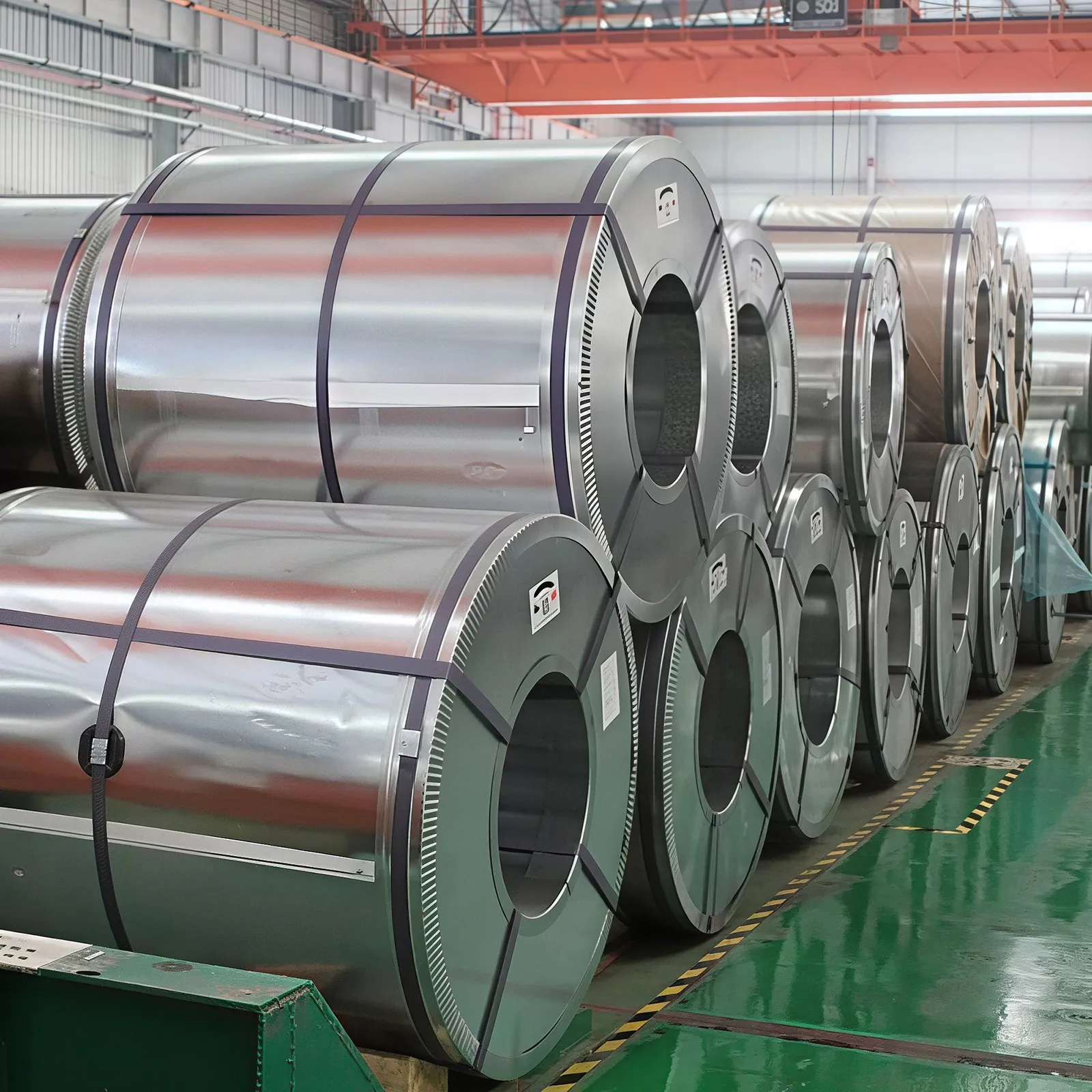
Conventional A-series 0.35 mm material is a workhorse for silicon steel for small motors: fan and pump motors, small compressor drives and general industrial units in the small to medium frame range, where the efficiency class is ordinary rather than tight. The thinner gauge against 0.50 mm cuts eddy-current loss at the same flux, which is why it shows up in faster-running small machines.
It is also a common silicon steel for home appliances choice: refrigerator and air-conditioner compressor motors, washing machine drives and small appliance motors built to a normal efficiency target. In these builds the loss ceiling is rarely the binding constraint, so the grade is normally selected on cost and punching behaviour rather than on the last 0.1 W/kg.
Where B35A300 is the wrong choice: tight efficiency classes that need the AH series or a lower loss number, high-frequency duty that needs the AT series or thinner gauge, and cores annealed after punching, where AR material is the intended product.
Buying Notes
Four items to confirm before the order is fixed:
- Series letter.A, AH, AR or AT, stated in full; this decides both the magnetic basis and the price.
- Certificate values, not the code.Ask for the lot’s measured P1.5/50 and induction rather than assuming the ceiling.
- Stacking factor basis.0% is a minimum; coating class and burr decide what the stack actually achieves.
- Density for weight calculations.65 kg/dm³ is the conventional figure used for quoting and core weight estimation.
FAQ
Is B35A300 the same as 35W300? No, they are different documents. Performance is close, both cap loss at 3.00 W/kg and both list 1.62 T induction, but one is declared to the enterprise standard and the other to GB/T 2521.1.
What does the A stand for? Conventional type. The series letters run A conventional, AH high induction, AR stress-relief annealing, AT high frequency low loss.
Is B35AR300 a drop-in replacement? No. Its magnetic values apply only after a stress-relief anneal, so substituting it into a design that is not annealed gives different results.
Does a lower loss A-series grade carry lower induction? No. Minimum induction stays at 1.62 T from B35A210 through B35A300, so the loss block can be chosen on its own inside the series.
Is Nippon Steel 35H300 an exact equivalent? No, it is the published band equivalent. Compare certificate values before treating the two as interchangeable.
Which grade replaces B35A300 at 0.50 mm? Look at B50A300-class material if the gauge can go thicker, or stay at 0.35 mm with a lower loss number if the target is efficiency rather than cost.
Related Silicon Steel Grades and Guides
- Hi-B grain oriented silicon steel— the unscribed tier this grade is built on
- Grain oriented silicon steel grades— the full ladder including the R bands
- GB/T 2521 silicon steel standard— how domain refined grades are classified
- High grade cold rolled oriented coil— supply forms for oriented material
Vera Liang
Senior Application Engineer | Electrical Steel & Specialty Alloys
With 8+ years of field experience in silicon steel and high-performance alloy specification, Vera supports industrial clients in grade selection, magnetic property validation and corrosion-resistant material matching for motor, transformer and chemical engineering applications.
Sourcing B35A300 or matching it to an equivalent grade? Send the required loss ceiling, induction and annealing condition to vera.liang@ztwysteel.com, and we will confirm the series letter, certificate values and available stock.





 English