

What is the difference between C11000 and C10200 copper?
The gap sits in one decimal place, since C10200 copper carries almost no oxygen while C11000 carries about 0.03%. Both conduct near 101% IACS, and both machine the same way. Jiangsu Zhongtong Weiye Special Steel Co., Ltd. quotes both grades as C11000/T2 copper plate, and it asks for the joining process before recommending one.
The Short Answer
C11000 is electrolytic tough pitch copper with roughly 0.02 to 0.04% oxygen. C10200 is oxygen-free copper, with oxygen under 0.001%. Conductivity matches to within a point, yet four processes behave differently. Hence the choice follows the furnace, not the meter.
The Chemistry
C11000 holds about 99.9% copper, and the balance includes that dissolved oxygen. C10200 holds 99.95% copper or better, with the oxygen removed by a carbon deoxidation step. Both stay free of phosphorus, which separates them from C12200. Therefore, one element alone sets the two apart.
Consequence One — Hydrogen Embrittlement
A brazed joint in a reducing atmosphere can trap hydrogen inside copper. In C11000 the hydrogen reacts with the oxide at grain boundaries, and steam forms under pressure. The joint then cracks along the boundary, sometimes days after cooling. C10200 carries no oxide to react, so the joint stays sound. Hence a furnace-brazed assembly needs the oxygen-free grade.
Consequence Two — Vacuum Service
A vacuum chamber needs a metal that releases little gas and holds a seal. C10200 suits that duty, since its oxide content stays low and its surface cleans predictably. Our C10200/TU1 copper pipe shows that grade in tube form. C11000 can pass a leak test and still fail later, as the oxide layer breaks down. Therefore, electronic and vacuum parts specify the OF grade.
Consequence Three — Welding
A weld in C11000 may show porosity, because the dissolved oxygen escapes as gas in the melt pool. C10200 welds with fewer pores, so a pressure joint holds. The filler choice matters less than the base gas content here. Hence a welded copper vessel favours the OF grade.
Consequence Four — Softening
Both grades anneal soft near 200 °C, and both lose cold work at that point. A welded vessel also feeds a C12200/TP2 copper pipe bundle, where the phosphorus grade takes over. C11000 softens a little lower, since the oxide particles pin the grains less firmly. A busbar that carries current and heat therefore needs a temper check on either grade. Thus softening does not separate them.
Where They Match
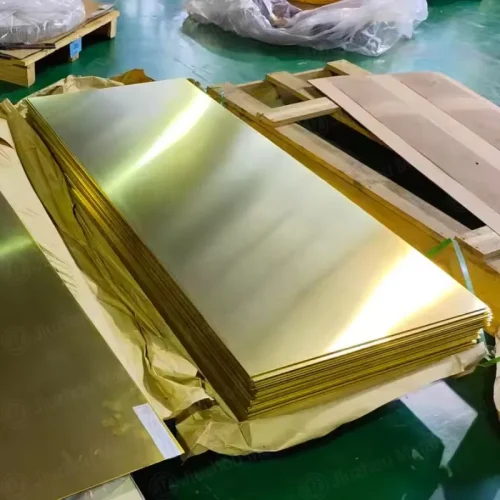
Conductivity stays near 101% IACS for both, and thermal conductivity follows the same pattern. Machining, polishing, and forming behave alike, since the structure stays the same. A plain busbar or a heat sink sees no difference at all. Therefore, price decides that order.
The Price Gap
C10200 costs more, since the deoxidation step adds a process and cuts yield. The premium runs wider on thin sheet, where the surface quality matters more. A buyer who brazes in air, rather than in a hydrogen furnace, gains little from it. Hence the premium buys a process, not a property.
Where C11000 Still Wins
A busbar, a terminal, a grounding plate, and a heat spreader all suit C11000. These parts solder in air, run at moderate temperature, and see no hydrogen. The grade also welds acceptably where porosity does not matter. Therefore, most electrical tonnage stays on ETP copper.
The Oxygen-Free Family
C10100 sits above C10200, at 99.99% copper with a tighter analysis for electronics. C10200 covers the general oxygen-free duty at a lower price. A buyer should not pay for C10100 where C10200 meets the spec. Hence three grades cover one ladder of purity.
The Certificate Line
Both grades follow ASTM B152 for plate and sheet, and the certificate names UNS C11000 or C10200. It also states the temper, such as O60 annealed or H02 half hard. The oxygen figure appears on some mill reports and not on others, so a buyer who needs it should ask. Therefore, the analysis line closes the argument.
Thickness and Form
Plate runs 0.5 to 50 mm, and sheet sits under 6 mm. Width follows the mill, and a cut length stays under 4 m at ±1 mm, which the cut-to-size note explains. Copper weighs about 8.9 t/m³, so a container fills at 25 to 28 t by weight. Hence the form rarely decides between these two grades.
Where Buyers Get It Wrong
A buyer specifies C11000 for a hydrogen-brazed radiator and finds cracks at the joint weeks later. Another pays for C10200 on a busbar that never enters a furnace. A third welds a C11000 tank and blames the filler for the porosity. Those three errors cover most of our returns.
What We Do Not Do
We do not melt or roll copper. We do not braze a joint or run a furnace cycle. Nor do we certify an oxygen level that the mill report does not show.
Those limits keep the advice honest.
Specify Your Order
First, name the joining process, whether air solder, hydrogen braze, or weld. Second, state the grade and the temper. Then give the thickness, so the mill route matches the part.
Related Reading
The grade naming note shows how a designation is built, so a UNS number reads against a trade name.
Frequently Asked Questions
Do the two conduct the same? Yes, both sit near 101% IACS.
Why does C11000 crack after brazing? Hydrogen meets the oxide and forms steam at the grain boundary.
Which grade suits a vacuum part? C10200, since it releases less gas and holds a seal.
Is C10200 worth the premium? Only where a furnace, a vacuum, or a weld demands it.
Which grade is softer? C11000 softens slightly lower, yet both anneal near 200 °C.
- Email: vera.liang@ztwysteel.com
- Location: Xishan District, Wuxi, Jiangsu, China
- Supply range: C11000 and C10200 plate 0.5–50 mm, sheet under 6 mm
- Cutting: length under 4 m, ±1 mm, squareness 1 mm per metre
- Documentation: MTC EN 10204 3.1 with UNS number, 3.2 on request







 English