

What Hastelloy alloy grades does Zhongtong Weiye supply?
Nine Hastelloy alloy grades sit in our range, so the choice narrows by acid type before price. We stock C-276 plate, B-2 bar, and C-22 coil. We source C-2000, B-3, C-4, G-30, G-35, and X to order. Jiangsu Zhongtong Weiye Special Steel Co., Ltd. names the UNS number on every certificate.
The Short Answer
The C family covers mixed acid duty, and the B family covers reducing acid. The G family covers phosphoric and nitric service, while X covers high-temperature strength. Hence nine grades split into four families by chemistry, not by price.
Two Axes Decide the Grade
Chromium fights oxidizing attack, and molybdenum fights reducing attack. A grade with more chromium suits nitric acid, since that acid supplies its own oxygen. A grade with more molybdenum suits hydrochloric acid, because that acid strips oxide films.
Where C-276 Sits
C-276 carries 14.5 to 16.5% chromium and 15 to 17% molybdenum, with 3 to 4.5% tungsten. Its pitting resistance number lands near 69, which places it high on both axes. Hence it handles chlorides and mixed acids at once, so most buyers start here.
Where C-22 Improves
C-22 lifts chromium to 20 to 22.5%, while it trims molybdenum to 12.5 to 14.5%. That shift favours oxidizing halogens and nitric mixes. Therefore, a plant with bleach or chlorate duty picks C-22 over C-276.
Where C-2000 Adds Copper
C-2000 keeps chromium near 23%, and it adds 1.3 to 1.9% copper. Copper widens sulphuric acid coverage, since that acid changes behaviour with concentration. Hence a sulphuric train often names C-2000.
Where the B Family Fits
B-2 holds 26 to 30% molybdenum with almost no chromium, so it resists hydrochloric acid at all strengths. B-3 keeps the same idea, yet it adds 1 to 3% chromium for ductility. Therefore, B-3 forms and welds with fewer cracks.
Where the G Family Fits
G-30 carries 28 to 31.5% chromium with 4 to 6% molybdenum, which suits phosphoric acid with fluorides. G-35 pushes chromium to 32 to 34%, since nitric acid with fluoride needs that ceiling. Hence fertiliser and pickling lines use both.
Where X Fits
X runs 20 to 23% chromium with 8 to 10% molybdenum, and it holds cobalt near 1%. It keeps strength at high temperature, so furnace parts and combustors use it. That duty differs from wet corrosion, because creep matters more than acid.
Where C-4 Fits
C-4 drops carbon and silicon, and it adds titanium to stabilise the structure. A welded vessel that cannot be solution-annealed after fabrication benefits from it. Hence C-4 suits field-welded tanks more than shop-built ones.
Where Welding Changes the Answer
A welded vessel leaves a heat-affected zone, since the weld cools fast. C-276 tolerates that zone, because its carbon stays below 0.01%. B-2 does not, so B-3 replaced it for welded work. Hence the fabrication method filters the list.
The Forms You Can Buy
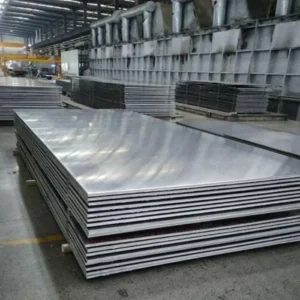
Plate runs 1 to 50 mm, bar runs 12 to 250 mm, and coil runs 0.5 to 3 mm. Tube covers seamless and welded, since both routes appear in ASTM B622 and B626. Hence the form often decides the mill, not the grade.
The Standards Behind Each Form
Plate follows ASTM B575, and bar follows B574, while seamless tube follows B622. Welded pipe follows B619, and welded tube follows B626. ASME adopts each text with an SB prefix, so pressure work cites SB575.
What the Certificate Shows
Each bundle carries an EN 10204 3.1 certificate with the UNS number, the heat, and the chemistry. A typical C-276 lot reports at least 690 MPa tensile and 283 MPa yield, with 40% elongation. Hence the numbers match the annealed condition.
Where Temperature Caps the Choice
C grades hold strength to about 540 °C in wet service, while dry furnace duty runs hotter. X keeps strength past 800 °C, since its cobalt and tungsten resist creep. Therefore, a hot wall and a wet wall need different families.
How Density Affects Freight
Nickel alloys sit near 8.9 to 9.2 t/m³, so a cubic metre weighs more than carbon steel. A 20-foot container therefore holds about 25 t of plate, not 28 t. Hence plan freight by weight, not by volume.
Where Buyers Get It Wrong
A buyer orders C-276 for nitric acid, where C-22 performs better and costs less. Another orders B-2 for a welded vessel, where B-3 avoids cracking. A third orders G-30 for chloride service, which needs a C grade. Those three swaps cause most complaints.
What We Do Not Do
We do not melt, roll, or heat-treat these alloys. We do not relabel a C grade as a B grade. Nor do we issue a certificate for material we did not buy from a mill.
Those limits keep the grade honest.
Specify Your Order
First, name the grade and the UNS number. Second, give the form, the size, and the quantity. Then state the acid and the temperature, so we can confirm the fit.
Our C-276 plate and sheet covers mixed acid duty. For hydrochloric service, B-2 bar fits better. Sulphuric trains usually take C-2000 tube and pipe.
Related Reading
Grade designations read best beside a silicon steel grade note, since both explain a naming system. Coil handling appears in the coil guide.
Frequently Asked Questions
Do you stock C-276 plate? We do, in 1 to 50 mm thickness.
Is B-3 better than B-2? For welded work it is, since B-3 cracks less.
Can you supply G-35 tube? We can, though the mill lead time runs long.
Which grade suits hydrochloric acid? B-2 or B-3, because both resist reducing attack.
Does the certificate name the UNS number? It does, and that number settles any grade dispute.
- Email: vera.liang@ztwysteel.com
- Location: Xishan District, Wuxi, Jiangsu, China
- Supply range: C-276 plate 1–50 mm, B-2 bar 12–250 mm, C-22 coil 0.5–3 mm
- Cutting: length under 4 m, ±1 mm, squareness 1 mm per metre
- Documentation: MTC EN 10204 3.1 with UNS number, 3.2 on request







 English