
What Are Silicon Steel Sheets and Their Common Types
A silicon steel sheet is a rolled iron-silicon strip cut to size, so the cut decides what you receive. Silicon steel sheets reach a plant in four states, and each state carries its own tolerance. Jiangsu Zhongtong Weiye Special Steel Co., Ltd. holds silicon steel sheets in coil and in cut length, so the state can be chosen before the order.
The Short Answer
The sheet is a cold-rolled electrical steel at 0.23 to 0.65 mm, with silicon between 0.5 and 3.2 percent. Three dimensions sort the common types: grain orientation, processing route, and thickness. Hence a type name is a triple, not a single word.
Dimension One — Grain Orientation
Grain-oriented sheet grows its crystals along the rolling direction, as the CRGO range shows, so loss drops along that axis. Non-oriented sheet keeps the grains random, so loss stays even in every direction. A transformer takes the first family, while a motor takes the second. Therefore, this dimension decides the machine, not the price.
Dimension Two — Processing Route
Fully processed sheet is annealed at the mill, and the customer stamps it as delivered. Semi-processed sheet ships lightly annealed, so the customer anneals the finished core. Mill-edge grade exists for a shop with its own line. Hence the route decides who owns the final grain.
Dimension Three — Thickness
Common gauges run at 0.23, 0.27, 0.30, 0.35, 0.50, and 0.65 mm, and each gauge serves a frequency band. A 0.23 mm sheet suits a high-frequency core, while a 0.65 mm sheet suits a low-speed, low-duty machine. Eddy loss follows the square of thickness, so the gauge carries real money in non-oriented grades. Therefore, the thickness step is the first design choice.
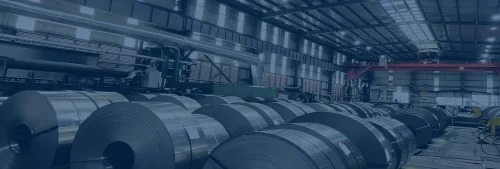
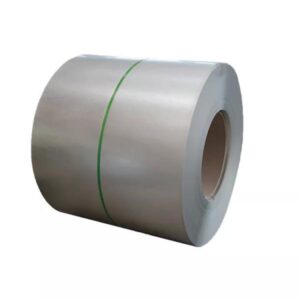
State One — The Mother Coil
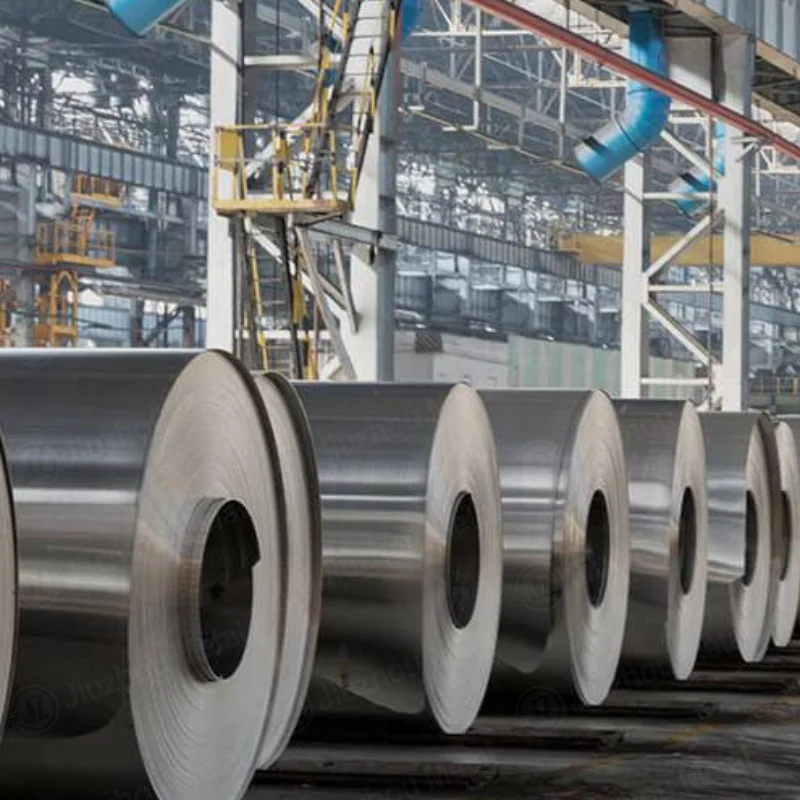
The mill ships a coil at 1,000 to 1,250 mm wide, and the inner core sits at 508 mm. A coil weighs 3 to 5 tonnes, and the surface carries the coating already. A buyer who stamps a wide blank can use this state directly, since no slitting is needed. Hence the mother coil is the cheapest per tonne.
State Two — The Slit Coil
A slitting line cuts the mother coil to the stamping width, and the width tolerance holds at 0.05 mm. The burr stays under 0.02 mm, since a taller burr can short two laminations. A slit coil keeps the length continuous, so a press feeds without a joint. Therefore, this state suits a progressive die.
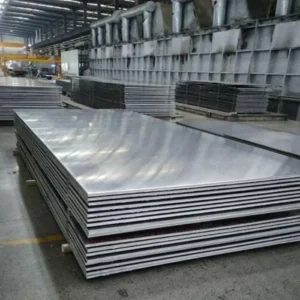
State Three — The Cut Sheet
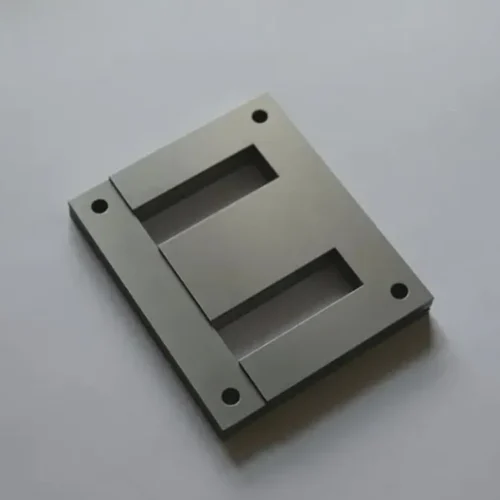
A cut-to-length line opens the coil into flat sheets, and the length tolerance holds near 1 mm. Squareness matters at the corner, since a sheared stack needs a true edge. A cut sheet suits a small batch or a manual stack. Hence this state trades length for handling.
State Four — The Lamination
A stamping press cuts the tooth and slot profile, and the blank becomes a lamination. At this state the burr limit tightens, and the inter-laminar coating must survive the punch. A buyer who orders laminations buys a finished part, not a sheet. Therefore, the fourth state sits outside our scope.
Weight Per Square Metre
Density sits at 7.85 tonnes per cubic metre, so a 0.35 mm sheet weighs 2.75 kg per square metre. A 0.50 mm sheet at 1,250 mm wide weighs 4.91 kg per running metre. Those two figures convert a coil weight into a piece count, so a quote can be checked. Hence the arithmetic is short and worth doing.
The Coating Options
An inorganic coating gives the highest inter-laminar resistance, and it suits a stacked transformer core. A semi-organic coating adds punchability and weldability, so a motor line prefers it. A self-bonding coating glues the stack without a weld, and it suits a small stator. Therefore, the coating follows the build method.
How a Type Name Reads
A code such as 50W470 states 0.50 mm and 4.70 W/kg, tested at 1.5 T and 50 Hz. A code such as 27Q110 states 0.27 mm and 11.0 W/kg at 1.7 T, which marks a grain-oriented grade. The letter separates the families, so W means non-oriented and Q means oriented. Hence the code carries three facts at once.
Comparing Two Offers
Line up the code, the thickness, the loss figure, the test condition, and the coating. A quote at 0.50 mm with a 13 W/kg figure is not the same product as one at 4.70 W/kg. Ask for the coil state as well, since a slit coil and a cut sheet differ in handling cost. Hence five lines expose a false comparison.
Where Buyers Get It Wrong
A buyer compares two sheets at different test inductions, so the loss figures never line up. Another orders a cut sheet for a progressive die and loses the continuous feed. A third ignores the burr limit and shorts a stack at the edge. Those three errors cover most of our returns.
What We Do Not Do
We do not melt or roll steel. We do not stamp a lamination. Nor do we anneal a finished core.
Those limits keep the answer honest.
Specify Your Order
First, name the family and the code. Second, state the thickness and the loss figure. Then give the width, the coil state, and the coating, so the material arrives ready for the press.
Related Reading
The grade naming note explains how a loss code is read, so a 27Q110 sits beside a 50W470. The cut-to-size note covers the slitting side, which decides whether a blank fits the press.
Frequently Asked Questions
What is a silicon steel sheet? A cold-rolled iron-silicon strip at 0.23 to 0.65 mm.
How many common types are there? Three dimensions cross into a dozen common grades.
What does 50W470 mean? 0.50 mm thick, 4.70 W/kg at 1.5 T and 50 Hz.
Which state suits a progressive die? A slit coil, since the length stays continuous.
Does the coating matter? Yes, since it sets inter-laminar resistance and punchability.
- Email: vera.liang@ztwysteel.com
- Location: Xishan District, Wuxi, Jiangsu, China
- Supply range: CRGO and CRNGO sheet, 0.23–0.65 mm, coil or cut length
- Slitting: 20–1,250 mm, ±0.05 mm, burr under 0.02 mm
- Documentation: MTC EN 10204 3.1 with grade, thickness and loss figure, 3.2 on request







 English