
Quais são os diferentes tipos de aço de silício?
Many procurement specialists and design engineers frequently ask, What are the different grades of aço ao silício? Aço ao silício, also named electrical steel, is categorized into multiple grades based on crystal grain structure, core loss, thickness and magnetic induction. Each grade serves unique electromagnetic scenarios. As a result, selecting the proper aço ao silício grade directly determines equipment efficiency, cost and long-term stability. If you pick the wrong grade, your transformers, motors or generators will suffer excessive heat, higher power waste and shortened service life.
Two Core Families: Grain-Oriented and Non-Grain-Oriented Silicon Steel
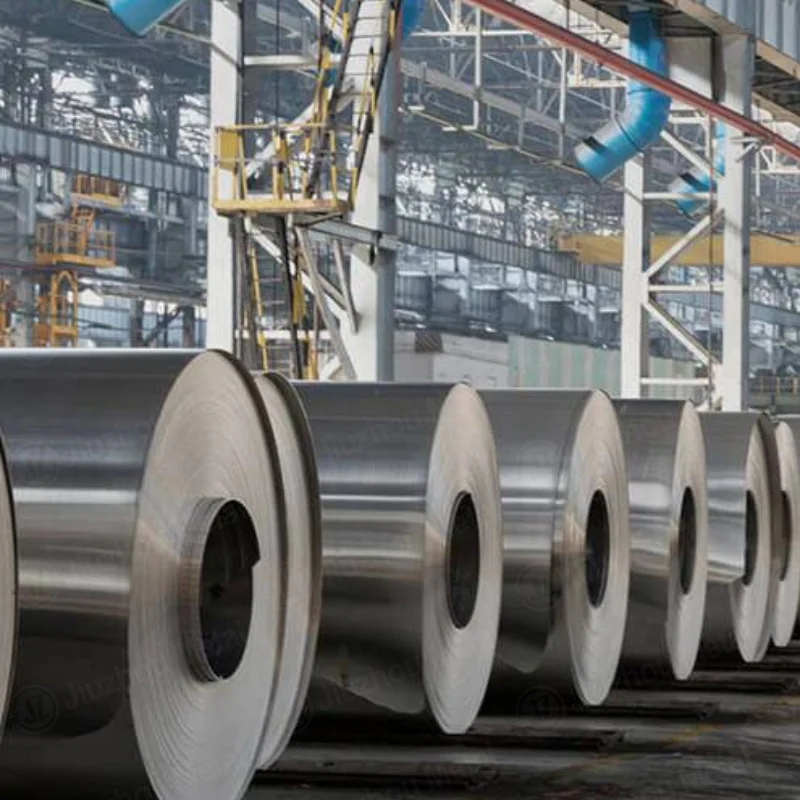
First of all, silicon steel grades fall into two major groups: grain-oriented (GO) silicon steel and non-grain-oriented (NGO) silicon steel. This is the most fundamental classification rule across global steel standards.
Grain-oriented silicon steel has neatly aligned crystal grains along its rolling direction. For this reason, it delivers ultra-low core loss and high magnetic permeability only in that single direction. It is built for static magnetic circuits, such as power transformer cores and large inductors. Furthermore, GO silicon steel can be subdivided into conventional grain-oriented steel (CGO), high permeability Hi-B grade, and domain-refined ultra-low loss grades. Hi-B grades show better magnetic performance than standard CGO grades, while domain-refined types achieve the lowest iron loss for ultra-high-efficiency grid transformers.
On the other hand, non-grain-oriented silicon steel features randomly arranged grains. Its magnetic performance stays consistent no matter which direction magnetic flux travels. Therefore, NGO silicon steel becomes the standard material for rotating machines. You will find these grades inside industrial motors, household appliance motors, EV traction motors and wind power generators. NGO grades also cover a wide spectrum, from general-purpose low-cost grades to premium thin-gauge grades designed for high-frequency new energy equipment.
How Silicon Steel Grades Are Defined and Marked
To understand what the different grades of silicon steel mean, you need to learn how manufacturers label these products. In most global standards, each grade code includes two key parameters: sheet thickness and guaranteed maximum core loss measured in W/kg. In addition, magnetic induction acts as another important reference index.
For example, under the Chinese GB standard, 50W470 means a thickness of 0.5 mm and a maximum core loss of 4.7 W/kg. Similarly, European EN grades use codes such as M270-35A, where 35 stands for 0.35 mm thickness and 270 refers to the maximum core loss value. Meanwhile, North American ASTM standards adopt classic M-series grades for both oriented and non-oriented silicon steel. Even though naming formats differ between JIS, ASTM, EN and GB, the grading logic remains the same. In short, lower core loss numbers always represent higher-grade, more energy-saving silicon steel.
Apart from loss and thickness, silicon content also affects grade classification. Most GO grades contain roughly 3.0% to 3.5% silicon. NGO grades cover a wider silicon range from 1% up to 3.5%. Higher silicon improves resistivity and reduces eddy current loss. However, too much silicon will make the steel brittle and harder to stamp or punch. For this reason, material makers balance silicon content carefully for each grade.
Common Non-Grain-Oriented Silicon Steel Grades and Applications
Next, let’s look at widely used NGO silicon steel grades. General-purpose NGO grades such as 50W600 or M600-50A work for low-demand household motors, small fans and low-power pumps. They offer acceptable performance at competitive material costs.
Mid-range NGO grades, like 50W470 and M470-50A, are popular for standard industrial motors and compressors. They strike a good balance between core loss and mechanical workability. In contrast, premium low-loss NGO grades such as 35W270 or M270-35A are preferred for high-efficiency IE4 and IE5 industrial motors.
Moreover, ultra-thin NGO grades with 0.20 mm or 0.25 mm thickness are developed specifically for EV traction motors and high-speed generators. At high operating frequencies, thinner laminations greatly cut eddy current loss. Nevertheless, these high-performance grades come with higher price tags and stricter processing requirements.
Common Grain-Oriented Silicon Steel Grades and Applications
In addition, grain-oriented silicon steel grades are tailored for static power equipment. Conventional CGO grades such as 30Q133 suit regular distribution transformers and low-voltage reactors. They provide stable performance and lower material cost for general grid projects.
Hi-B high-permeability GO grades, for instance 30P120, are widely adopted in large power transformers for national power grids. Compared with CGO grades, Hi-B silicon steel increases magnetic induction and reduces no-load loss significantly. Domain-refined GO grades like 23R080 represent the top tier. These ultra-low-loss grades are used for large-scale power transmission transformers where energy saving is the top priority.
It is worth noting that GO silicon steel is not suitable for rotating motors. Because its excellent magnetic property only works in one direction, rotating magnetic fields will create heavy loss if GO laminations are used inside motors.
Key Factors to Select the Right Silicon Steel Grade
When engineers compare the different grades of silicon steel, several factors must be evaluated. To begin with, confirm whether the magnetic field is static or rotating. Static flux paths require GO grades, while rotating flux needs NGO grades.
After that, check operating frequency. Low-frequency 50Hz or 60Hz power equipment can use standard 0.35 mm or 0.5 mm sheets. High-frequency motors need thinner premium NGO grades. In addition, you must balance efficiency targets and budget. Over-specifying ultra-low-loss grades leads to unnecessary cost increases. On the contrary, choosing low-end grades for high-efficiency projects causes excess energy waste.
Mechanical processing also influences grade selection. Some high-grade low-loss silicon steel becomes brittle after annealing. If your production involves heavy stamping and complex lamination shapes, you need to pick grades with good punchability.
Common Misconceptions About Silicon Steel Grades
Many buyers hold misunderstandings about silicon steel grading. Some believe a higher silicon percentage always means a better grade. In fact, grade ranking depends on core loss and magnetic performance, not silicon content alone.
Another common mistake is mixing GO and NGO grades. Even if a GO grade has excellent low-loss data, it will perform poorly when installed in rotating motor cores. Furthermore, different standards cannot be directly converted by name. A grade labeled M270 under EN standards is not completely identical to 35W270 under GB standards. Therefore, engineers should always refer to the official datasheet instead of simply matching grade names.
Conclusão
To sum up, the different grades of silicon steel are divided into grain-oriented and non-grain-oriented families. Within each family, grades are ranked mainly by core loss, thickness and magnetic induction. GO silicon steel grades serve static transformer cores, while NGO grades support rotating motors and generators.
Understanding these grades helps engineers and buyers make smart purchasing decisions. In conclusion, the best silicon steel grade is not always the highest-performance option. Instead, it is the grade that perfectly matches your working frequency, magnetic circuit design, processing requirements and project budget.






 English
  Japanese
  Korean
  French
  German
  Spanish
  Portuguese
  Russian
  Arabic
  Italian