
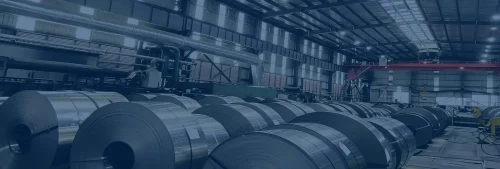
What Are Silicon Steel Sheets and Their Common Types
I. Basic Properties of Silicon Steel Sheets
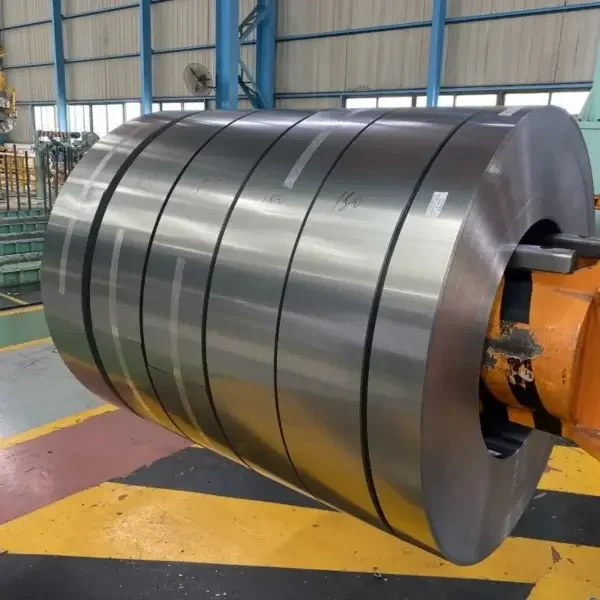
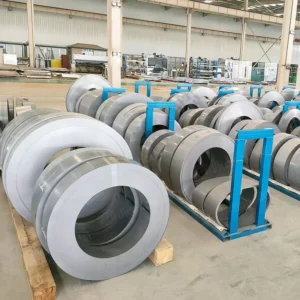
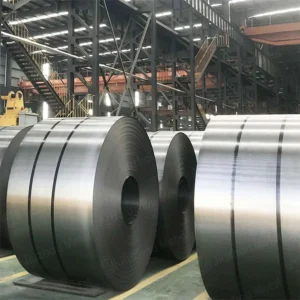
Silicon steel sheets are alloy steels with a silicon content of 2.5% to 4.5%. Their microstructures are specially treated to form ordered grain alignment. This unique structure delivers two core advantages under alternating magnetic fields: energy loss during magnetization is over 60% lower than that of ordinary steel, and saturation magnetic flux density ranges from 1.8 T to 2.0 T.
Engineers evaluate the quality of 실리콘강 sheets mainly via two key parameters: core loss (power loss per unit mass) and magnetic permeability (ease of magnetization). Lower core loss and higher magnetic permeability are always preferred.
Grain-oriented 실리콘강 sheets feature directionally aligned grains, similar to wood grain. Their magnetic performance along the rolling direction is far superior to that across the transverse direction. This material can cut energy loss by more than 30% when used for transformer cores, yet special attention must be paid to the blanking direction during processing.
Grains of non-oriented silicon steel sheets are randomly distributed like cobblestone pavements, delivering nearly identical magnetic properties in all directions. Though its maximum magnetic permeability is roughly 15% lower than that of grain-oriented grades, it avoids extra power loss caused by varying magnetic directions during the rotation of motor rotors.

II. Typical Application Scenarios
Laminated cores inside power transformers best showcase the strengths of grain-oriented silicon steel sheets. When the core is magnetized repeatedly by 50 Hz power-frequency current, its low core loss characteristic directly determines the transformer’s no-load loss. In contrast, drive motors for new energy vehicles mostly adopt non-oriented silicon steel sheets, as rotors operate at high speeds and the material must withstand alternating magnetic fields from all directions.
Selecting silicon steel sheets essentially requires balancing three factors: operating frequency defines the allowable loss threshold, the fluctuation frequency of magnetic field directions determines whether isotropic magnetic performance is required, and the budget dictates affordability for the higher processing costs of grain-oriented silicon steel sheets.





 English
  Japanese
  Korean
  French
  German
  Spanish
  Portuguese
  Russian
  Arabic
  Italian
  Turkish
  Dutch
Dutch  Polish
  Swedish
  Danish
  Norwegian
  Finnish
  Greek
Greek  Hungarian
  Czech
Czech  Romanian
  Bulgarian
  Slovenian
  Croatian
  Slovak
  Malay
Malay  Indonesian
  Thai
Thai  Vietnamese
  Myanmar
  Khmer
Khmer  Lao
Lao  Tagalog
  Hindi
Hindi  Bengali
  Urdu
Urdu  Nepali
  Sinhala
  Hebrew
  Ukrainian
  Serbian
  Icelandic
  Swahili