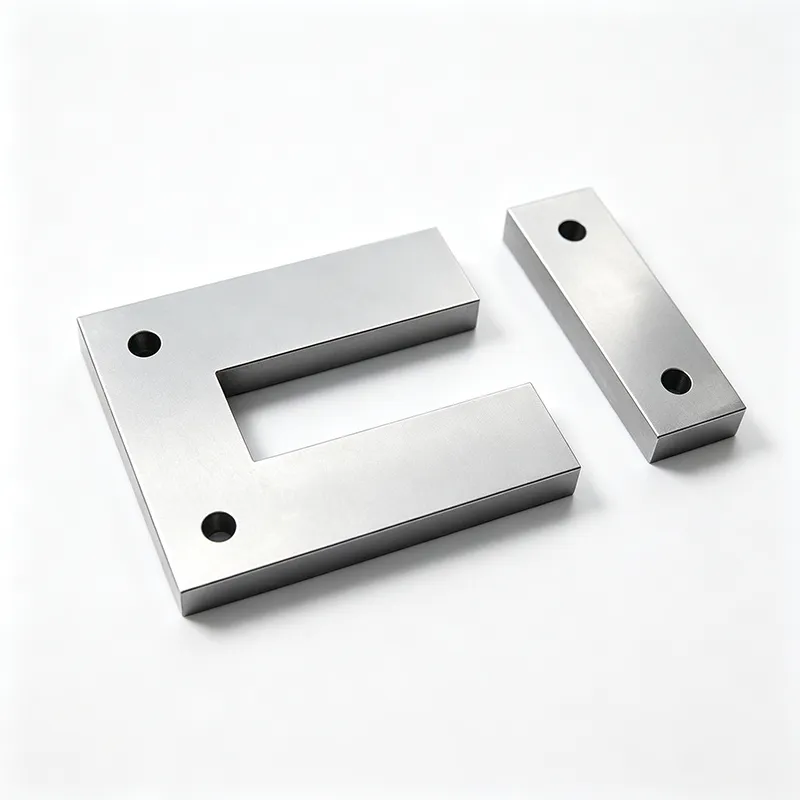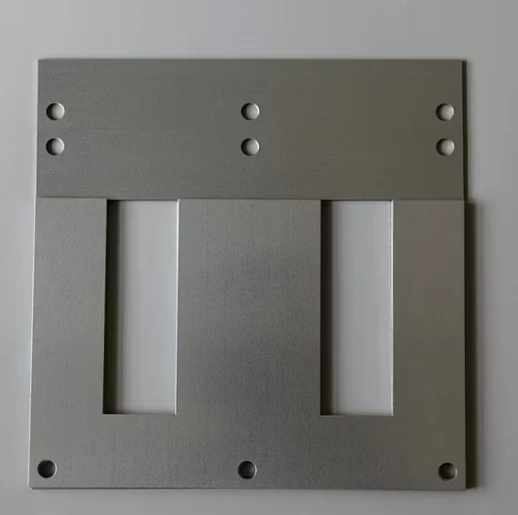
In 1900, R.A. Hadfield and others from the United Kingdom first discovered that Si-Fe alloy containing 4%Si has good magnetic properties. In 1903, Germany and the United States successfully produced hot-rolled silicon steel sheets containing 4.10-4.5%. In 1906, it was used to make motor and transformer cores instead of mild steel. In 1934, the American N.P. Goss used two cold rolling methods to produce (110)[001] cold-rolled silicon steel sheets containing 3%Si with preferential grain orientation. In 1968, Japan's Taguchi Satoru and others used comprehensive inhibitors of manganese sulfide and aluminum nitride and used a large reduction rate cold rolling method to make (110)[001] high magnetic induction oriented silicon steel sheet. The grain orientation of this material is more accurate, iron loss and magnetism are further improved. Over the years, the schematic curve of the decrease in iron loss value of silicon steel sheet is shown in Figure 1.
In 1949, the United States produced cold-rolled (110)[001] oriented silicon steel strips with thickness less than 0.1mm for use in the electronics industry. In 1957, the Federal Republic of Germany produced (100)[001] cubic oriented silicon steel sheets, which have high magnetic properties both in both longitudinal and transverse directions. However, due to the complexity of the process, they have not yet been officially produced. Figure 2 is a schematic diagram of the grain arrangement in (110) and (100) oriented silicon steel sheets. The magnetostriction of Si-Fe alloy containing 6.5%silicon is about zero, with high magnetic permeability, low iron loss, and the made transformer is noiseless. However, it is not widely used due to difficulty in processing. In the 1970s, liquid rapid cooling technology was used to produce 6.5%Si-Fe microcrystalline thin strips, and new varieties such as thinner oriented silicon steel sheets with (100) plane texture (no intergranular orientation) were developed.
| - | Flokkur | Silicon content, % | Nominal thickness, mm | - |
|---|---|---|---|---|
| Hot-rolled silicon steel sheet (No orientation) |
Hot rolled lowsilicon steel(Hot rolled motor steel) | 1.0–2.5 | 0.50 | - |
| hot rolling High silicon steel(Hot rolled transformer steel) | 3.0–4.5 | 0.35 and 0.50 | - | |
| Cold rolling electrical steel sheet | Non-oriented electrical steel (Cold-rolled motor steel) |
low-carbon electrical steel | ≤0.5 | 0.50 and 0.65 |
| kísilstál | >0.5–3.2 | 0.35 and 0.50 | - | - |
| Oriented silicon steel (Cold-rolled transformer steel) |
Plain oriented silicon steel | 2.9–3.3 | 0.20,0.23,0.27 | - |
| High magnetic sensationOriented silicon steel | 2.9–3.3 | 0.30 and 0.35 | - | - |
Silicon steel is mainly smelted in an oxygen converter (electric arc furnace can also be used), combined with vacuum treatment of molten steel and AOD technology (see refining inside the furnace), using hot molding or continuous casting. According to different uses, the silicon (0.5–4.5%) and aluminum (0.2–0.35%) contents are changed during smelting to meet different magnetic requirements.
The magnetism, surface quality, filling coefficient and punching properties of cold-rolled silicon steel sheets are better than those of hot-rolled silicon steel sheets, and they can be produced in rolls. Therefore, some countries have stopped producing hot-rolled silicon steel sheets since the 1960s. Zongtongweiye uses a method of rapid hot rolling at a low temperature of about 900℃ and stacking annealing under hydrogen protection to manufacture hot-rolled silicon steel sheets. The yield rate is high, and the surface quality and magnetic properties of the finished product are good.
The descaler and hydrochloric acid tank are used to remove oxides from the hot-rolled steel strip to prevent surface defects of the cold-rolled finished product.
In order to ensure the thickness and material for different purposes, the reduction ratio is set at 40%-90%, and advanced control equipment such as automatic thickness control and automatic shape control are implemented.
It is a process that softens the steel strip material that has been hardened in the cold stamping process. Through metal heating and rapid cooling, we produce steel for deep processing and high-tensile strength steel, and adopt booking (hood annealing) and continuous annealing methods.
When the silicon steel plate is processed into an iron core, in order to improve its processing performance and prevent eddy current loss equivalent to the thickness of the steel plate, continuous coating equipment is used to spray the insulating coating liquid on the upper and lower sides of the steel plate.
A notable feature of silicon steel sheet is its low loss and high magnetic permeability. This is due to the reduction of tiny magnetic domain wall losses between the oriented and non-oriented silicon steel sheets and the optimization of the size and shape of silicon grains. This low loss and high magnetic permeability enable the silicon steel sheet to reduce energy loss when current passes, and provide high-efficiency magnetic permeability.
Eddy current losses are generated in an alternating magnetic field, which lead to current consumption and heat generation. Silicon steel sheets reduce eddy current losses by introducing silicon particles into the material. Silicon's high resistivity reduces the intensity of eddy currents, thereby reducing heat and heat generation. This makes silicon steel sheets particularly suitable for equipment such as high-frequency transformers and motors.
The high saturation magnetic induction of silicon steel sheet enables it to withstand high magnetic flux density without saturation. By suppressing magnetic saturation, silicon steel sheets are able to reduce magnetic field fluctuations in transformers and motors, thereby reducing noise and mechanical vibration. This is very important for equipment that requires low noise and smooth operation.
The production process of silicon steel sheets is relatively environmentally friendly. Compared with ordinary steel, the manufacturing process of silicon steel sheet less energy consumption and resource consumption. In addition, its efficient energy conversion characteristics mean that in equipment using silicon steel sheets, less electrical energy is lost, making the entire power system more energy efficient.
Silicon steel sheet is used to make the iron core of the transformer. Their low losses and high magnetic permeability allow transformers to transmit and convert electrical energy efficiently.
As the core material of motors and generators, silicon steel sheets can provide efficient power conversion and output capabilities.
The excellent magnetic permeability of silicon steel sheet makes it an ideal material for magnetic sensor and magnetic field detector.
Silicon steel sheets play an important role in the drive system of electric vehicles, reducing energy loss and increasing battery life.

Jiangsu Zhongtongweiye Special Steel Co., Ltd. er faglegur og áreiðanlegur stálframleiðandi og útflytjandi staðsettur í Wuxi í Kína. Sérhæfir sig í að bjóða upp á kísilstál, nikkelblendstál, mótstál og önnur tengd stálvörur……
Um okkur

Hvaðsegðu
Höfundarréttur © Jiangsu Zhongtongweiye Special Steel Co., Ltd. Öll réttindi áskilin.
 English English
  Japanese
 Korean
 French
 German
 Spanish
 Portuguese
 Russian
 Arabic
 Italian
 Turkish
 Dutch
Dutch
 Polish
 Swedish
 Danish
 Norwegian
 Finnish
 Greek
Greek
 Hungarian
 Czech
Czech
 Romanian
 Bulgarian
 Slovenian
 Croatian
 Slovak
 Malay
Malay
 Indonesian
 Thai
Thai
 Vietnamese
 Myanmar
 Khmer
Khmer
 Lao
Lao
 Tagalog
 Hindi
Hindi
 Bengali
 Urdu
Urdu
 Nepali
 Sinhala
 Hebrew
 Ukrainian
 Serbian
 Icelandic
 Swahili