

Can copper plates be supplied with a conductivity test certificate?
Yes, and the paper usually arrives in two days with the plates. A conductivity test certificate states the grade, the temper, the reading in % IACS, the method, and the test temperature. Jiangsu Zhongtong Weiye Special Steel Co., Ltd. issues such a certificate with C11000/T2 copper plate, and it adds an independent witness on request.
The Short Answer
A 3.1 certificate carries the mill’s own conductivity reading, signed by its inspection department. A 3.2 certificate adds a third-party witness to the same test. Both print the method and the temperature, since a reading without those two lines means little. Hence the buyer should read four fields, not one.
What 100% IACS Means
The scale fixes 100% IACS at a resistivity of 1.7241 microhm-centimetre at 20 °C, or about 58 MS/m. A reading of 101% therefore means slightly better than that reference, not a mistake. C11000 typically lands near 100%, while C10200 reaches 101%. Therefore, the number compares a metal to a fixed standard, not to a rival supplier.
Method One — Eddy Current
An eddy-current meter reads conductivity from the surface without touching the metal, and ASTM E1004 governs it. The probe needs a flat area wider than its coil, so a narrow strip may not fit. A thickness below about 0.3 mm also bends the reading, since the field passes through the wall. Hence thin foil needs another method.
Method Two — Four-Terminal Resistance
A four-terminal bridge measures resistance across a measured length and section, then converts to conductivity. This method holds the tightest accuracy, so a dispute usually ends here. The specimen needs straight edges and a known thickness, which a machined coupon provides. Therefore, a lab test beats a handheld meter when the number matters.
Method Three — Derived from Resistance
A mill may derive conductivity from a resistance reading on a coil, using the measured weight and length. That route suits a large tonnage, since it needs no flat sample. The result still prints in % IACS, and the method line names the route. Hence three methods can appear on three certificates for one grade.
Why Temper Moves the Number
Cold work scatters electrons, so a hard temper reads one to three points lower than a soft one. Annealing restores the lattice, and the reading climbs back. A half-hard busbar therefore may read 98% while the same heat in O60 reads 100%. Thus the certificate should name the temper beside the reading.
Why Temperature Moves It
Resistance rises with heat, at roughly 0.4% per degree near room temperature. A reading taken at 30 °C therefore looks worse than one taken at 20 °C, without any metallurgical change. A good certificate states the test temperature, and a lab corrects to 20 °C. Hence the temperature line protects both sides.
What the Certificate Prints
The sheet names the grade and the UNS number, such as C11000. It states the temper, the heat number, the thickness, the reading in % IACS, the method, and the temperature. A 3.1 sheet carries the inspector’s signature, while 3.2 adds the witness. Therefore, six lines turn a number into evidence.
When a Buyer Needs 3.2
A utility, a rail project, and an export order to a regulated market often demand 3.2. The witness adds cost and a day or two, yet it settles a later dispute. A standard busbar order rarely needs it, since 3.1 already covers the claim. Hence the specification should say which one, not leave it open.
How to Write the Requirement
Put the minimum reading in the purchase order, such as 100% IACS minimum for T2. Name the method, eddy current or bridge, so the lab cannot drift. State the certificate type, 3.1 or 3.2. Then the mill tests against the same sentence the buyer wrote.
Grades Beyond T2
A deoxidized grade reads near 85%, and a brass reads near 28%, so the minimum must match the grade. C12000/TP1 copper plate therefore carries a lower floor than T2. C28000 H60 brass plate carries a much lower floor still. Hence a single 100% clause would fail two of the three.
Thickness and Sampling
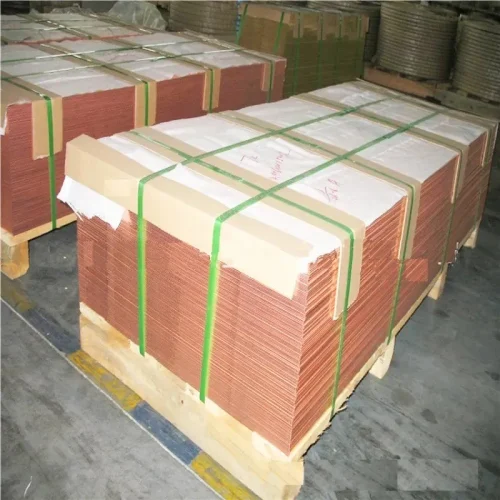
Plate runs 0.1 to 300 mm, and width 10 to 3,000 mm. A thick plate is tested at the surface, since the field cannot pass through 300 mm. A thin sheet is tested on a stack or by bridge, since a single foil reads low. Therefore, the sampling plan follows the gauge.
Where Buyers Get It Wrong
A buyer asks for 100% IACS on a brass plate and rejects a sound lot. Another compares two certificates taken at different temperatures and blames the mill. A third orders a 0.2 mm foil and expects an eddy-current reading. Those three errors cover most of our returns.
What We Do Not Do
We do not melt or roll copper. We do not run a conductivity test in house. Nor do we print a reading on a certificate that the mill did not test.
Those limits keep the paper honest.
Specify Your Order
First, name the grade and the temper. Second, state the minimum % IACS and the method. Then ask for 3.1 or 3.2, so the paper matches the project.
Related Reading
The grade naming note shows how a designation is built, so a UNS number reads against a GB number. Cut-length practice appears in the cut-to-size note, which matters when a test coupon must come from the same plate.
Frequently Asked Questions
Do you issue a conductivity certificate? Yes, 3.1 as standard and 3.2 on request.
Which method is used? Eddy current to ASTM E1004, or a four-terminal bridge for a tighter figure.
Why does my plate read 98%? A hard temper or a warm test temperature explains most of that gap.
Can a 0.1 mm foil be tested? Not by eddy current, so a bridge or a stacked sample is used.
Does brass carry the same floor? No, since brass reads near 28% IACS by nature.
- Email: vera.liang@ztwysteel.com
- Location: Xishan District, Wuxi, Jiangsu, China
- Supply range: copper plate 0.1–300 mm, width 10–3,000 mm, length 100–12,000 mm
- Cutting: length under 12 m, ±1 mm, squareness 1 mm per metre
- Documentation: MTC EN 10204 3.1 with % IACS, method and temperature, 3.2 on request







 English