
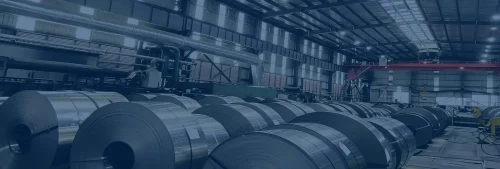
Why transformer steel needs grain orientation, what does grain orientation refer to
Why Transformer Steel Needs Grain Orientation

Transformer steel sits at the heart of every power grid. It carries magnetic flux with very low loss. Yet its performance depends on one hidden property. That property is grain orientation. Without it, transformers would waste huge amounts of energy.
What Grain Orientation Refers To
Grain orientation describes the atomic arrangement inside steel. Metals form crystals called grains. Each grain has a lattice structure. In ordinary steel, these grains point in random directions. Their magnetic properties differ along each axis. This randomness creates resistance to magnetic flux. In grain-oriented steel, however, most grains align along one axis. That axis is the rolling direction. As a result, the material becomes highly magnetic along that path. Manufacturers achieve this alignment through careful rolling and heat treatment. The process is slow and precise. Still, it yields a unique crystal texture.
The Physics Behind Magnetic Loss
Magnetic domains move when flux changes. In random grains, domain walls meet many obstacles. Each obstacle raises hysteresis loss. Hysteresis loss turns into heat. That heat wastes electricity. Grain orientation reduces these obstacles. Aligned grains let domain walls move freely. Consequently, hysteresis loss drops by a large margin. Eddy currents also fall because the steel can be made thinner. For a typical transformer, grain-oriented steel cuts core loss by up to seventy percent. That saving matters for utility companies. It also lowers carbon emissions over decades of service.
Why Random Orientation Fails
Non-oriented steel has many uses. Motors and generators often rely on it. But transformers operate differently. They see constant alternating flux. Even a small loss adds up hour after hour. Random grains force flux to zigzag. This zigzag path increases reluctance. Reluctance demands more magnetizing current. More current means more copper loss. The core also heats up faster. So the design must grow larger to manage heat. Such a design becomes heavy and costly. Grain orientation solves this problem at the material level.
How Grain Orientation Is Produced
Production starts with hot rolling. The steel then undergoes cold rolling. Cold rolling reduces thickness and builds texture. Next comes a decarburization anneal. This step removes carbon and prepares the surface. A magnesia coating follows. That coating prevents sticking during final annealing. The final anneal is the critical step. It allows secondary recrystallization. During this stage, grains with the right orientation grow large. Other grains shrink and disappear. The result is a sharp cube-on-edge texture. In this texture, the easy magnetization axis lies along the rolling direction. Every step must be controlled tightly. A small error can ruin the texture.
Practical Benefits for Transformer Design
Designers gain several advantages from grain-oriented steel. First, cores become smaller. A smaller core needs less copper wire. Second, efficiency rises under load. Third, temperature rise drops. That drop extends insulation life. Fourth, noise decreases because magnetostriction falls. Fifth, the transformer handles overloads better. These benefits compound across a fleet of units. A utility may own thousands of transformers. Even a one percent efficiency gain saves megawatt-hours each year. Over a thirty-year life, the savings pay for the premium steel many times over.
Limitations and Trade-Offs
Grain-oriented steel is not perfect. It costs more than non-oriented grades. It also performs poorly in directions other than rolling. So designers must align flux with the rolling direction. Cutting and bending can damage the texture. Stress from clamping raises loss again. Annealing after cutting can restore some properties. However, that adds cost and complexity. In addition, grain-oriented steel is brittle. It needs careful handling during assembly. These trade-offs explain why it appears mainly in transformers. Motors and generators still use non-oriented steel.
Conclusion: Value of Grain Orientation
Grain orientation refers to the alignment of crystal grains along one magnetic axis. Transformer steel needs this alignment to reduce hysteresis and eddy losses. Lower losses mean smaller cores, higher efficiency, and cooler operation. The production process is demanding, but the rewards are large. For grid operators, grain-oriented steel lowers fuel use and emissions. For manufacturers, it enables compact, reliable designs. In short, grain orientation turns ordinary iron into a high-performance magnetic material. That transformation keeps modern power systems efficient and stable.




 English
  Japanese
  Korean
  French
  German
  Spanish
  Portuguese
  Russian
  Arabic
  Italian
  Turkish
  Dutch
Dutch  Polish
  Swedish
  Danish
  Norwegian
  Finnish
  Greek
Greek  Hungarian
  Czech
Czech  Romanian
  Bulgarian
  Slovenian
  Croatian
  Slovak
  Malay
Malay  Indonesian
  Thai
Thai  Vietnamese
  Myanmar
  Khmer
Khmer  Lao
Lao  Tagalog
  Hindi
Hindi  Bengali
  Urdu
Urdu  Nepali
  Sinhala
  Hebrew
  Ukrainian
  Serbian
  Icelandic
  Swahili