
Grain Oriented Silicon Steel Grades: Thickness, Core Loss and Selection
19 November, 2026
News
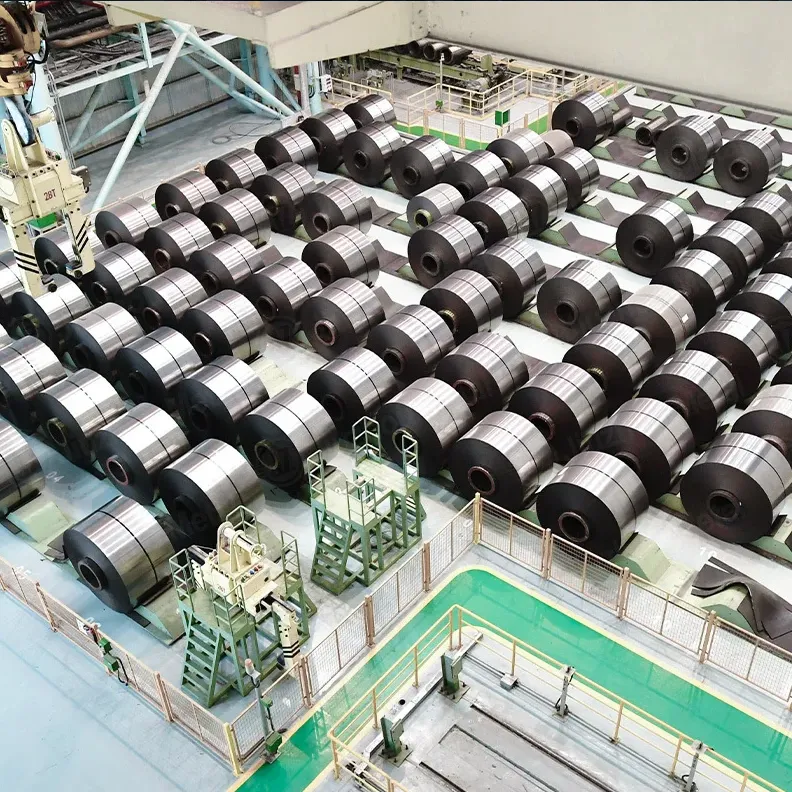
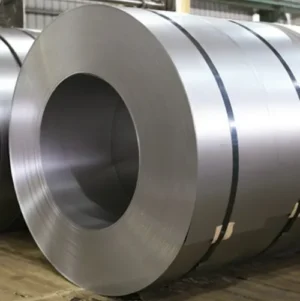
Grain oriented silicon steel (CRGO) is a cold-rolled electrical steel whose grains are aligned to the rolling direction. Standard grades run from 0.23 mm to 0.35 mm, with maximum core loss between 1.10 and 1.90 W/kg at 1.7 T and 50 Hz. A comparison of the three common thicknesses shows how that range maps onto real designs.
For 50 Hz distribution transformers, 0.27 mm and 0.30 mm grades cover most designs. Specify 0.23 mm only when no-load loss limits are tight or operating frequency exceeds 400 Hz. The 0.35 mm grades remain the cost-efficient choice for smaller cores and lower-duty units.
How to Read a CRGO Grade Name
Take 35Q155. The code carries three pieces of information:
- 35 — nominal thickness, 0.35 mm
- Q — grain oriented
- 155 — maximum core loss, 1.55 W/kg, measured at 1.7 T and 50 Hz
A lower trailing number means a lower-loss grade. Non-oriented grades use W instead of Q, and their loss figure is measured at 1.5 T, not 1.7 T. The two series therefore cannot be compared by the trailing number alone. CRNGO grade codes follow a different naming logic entirely.
Grade Comparison Table
|
Grade
|
Thickness (mm)
|
Max core loss, P1.7/50 (W/kg)
|
Typical B8 (T)
|
Typical application
|
|
23Q110
|
0.23
|
1.10
|
≥1.88
|
Large power transformers, high-efficiency cores
|
|
23Q120
|
0.23
|
1.20
|
≥1.87
|
Power transformers
|
|
27Q120
|
0.27
|
1.20
|
≥1.87
|
Distribution and power transformers
|
|
30Q120
|
0.30
|
1.20
|
≥1.86
|
Distribution transformers, 50 Hz
|
|
30Q130
|
0.30
|
1.30
|
1.80–1.84
|
Standard distribution transformers
|
|
35Q155
|
0.35
|
1.55
|
1.80–1.84
|
Small transformers, ballasts, reactors
|
|
35Q190
|
0.35
|
1.90
|
1.78–1.82
|
Low-duty cores, general electrical use
|
Values above are specification limits under GB/T 2521, measured at P1.7/50. B8 figures are indicative and may vary between mills. Each shipment carries a mill test certificate issued by the producing mill.
Selection by Application
Distribution transformers, 50 Hz. 30Q120 and 27Q120 are the working grades. Going to 23Q110 buys roughly 8 to 10 percent lower core loss but adds cost and reduces lamination stiffness, so it pays off only when the efficiency class or no-load loss cap demands it.
Power transformers. 27Q120 and 23Q110, usually Hi-B, because core weight is large and every 0.01 W/kg multiplies across tonnes of steel.
Small cores, ballasts and reactors. 35Q155 or 35Q190. The thicker sheet stamps and stacks more easily, and the loss penalty is small at low flux densities.
Frequency above 400 Hz. Eddy current loss rises with the square of frequency, so thin gauge at 0.23 mm is the sensible choice regardless of cost.
Three Common Misreadings
“Thinner is always better.” Below about 0.27 mm, the gain in 50 Hz core loss is modest while cost, punching wear and lamination count all rise. Thin gauge earns its price at high frequency or under strict loss caps, not in ordinary distribution transformers.
“The Q number is a quality ranking.” It is a loss limit at a fixed measuring condition, nothing more. A 30Q130 from one mill and a 30Q130 from another may differ in surface coating, flatness and B8 while sharing the same loss ceiling.
“CRGO can replace CRNGO in motors.” It cannot. Grain orientation gives excellent permeability along the rolling direction and poor permeability across it, which is why CRGO belongs in static flux paths such as transformer cores, not in rotating machines. For motors, the non-oriented series is the appropriate family.
How This Data Was Compiled
The grade names and loss limits follow GB/T 2521; equivalents across Chinese, Japanese and American standards are mapped separately. B8 ranges reflect typical values for conventional and high-induction grades received at our Wuxi processing facility. Figures are specification limits, not measured averages. Selection notes reflect orders handled for transformer and reactor manufacturers in Europe, Southeast Asia and the Middle East.
Frequently Asked Questions
Is 30Q120 better than 30Q130? Yes on loss: 1.20 versus 1.30 W/kg at P1.7/50. Whether it is worth the price depends on your no-load loss cap and the core weight. On a 500 kg core the difference is about 50 W of no-load loss.
Can 0.23 mm be used in a 50 Hz transformer? It can, and it is common in high-efficiency units. The gain over 0.27 mm is around 8 percent core loss, so confirm the efficiency target justifies the price gap.
What is the difference between CGO and Hi-B? CGO is conventional grain oriented steel with B8 around 1.80 to 1.84 T. Hi-B adds a higher magnetic induction, typically 1.88 T or above, which allows a smaller core for the same rating.
What thickness tolerance applies? GB/T 2521 sets the tolerance band. Commercial supply in 0.23 to 0.35 mm gauge is commonly within plus or minus 0.02 mm. Ask for the actual lot report rather than relying on the nominal figure.
For the broader material picture, the silicon steel overview covers non-oriented grades, coatings and coil formats.
Jiangsu Zhongtong Weiye Special Steel Co., Ltd. Wuxi, Jiangsu, China vera.liang@ztwysteel.com
Send your transformer rating, operating frequency and loss limit, and we will reply with a grade recommendation and the matching mill certificate within one working day.



 English