

What is the maximum service temperature of Hastelloy C-276?
It depends on what fails first, so the answer is not one number. The maximum service temperature of C-276 starts near 150 °C in wet acid. In clean dry air it reaches 1,040 °C. Both ends matter, and each one has its own mechanism. Jiangsu Zhongtong Weiye Special Steel Co., Ltd. sells the plate, and it asks for the medium before it quotes.
Why One Number Fails
Three mechanisms take turns as the ceiling, and each one owns a temperature band. Wet corrosion owns the low end, creep owns the middle, and oxidation owns the top. Hence the answer changes with the atmosphere, not with the alloy alone.
Band 1 — Up to 150 °C
Here the acid does the damage, and strength does not matter. C-276 handles chloride and sulphate mixes near their boiling points, so a 90 °C reactor is routine. Above 150 °C, few aqueous duties exist, since pressure then sets the design.
Band 2 — 150 to 400 °C
Chloride stress cracking starts to matter in this band, and C-276 resists it better than stainless steel. Wet chloride at 200 °C still attacks a weld toe, since the affected zone holds residual stress. Hence welded parts deserve a stress relief, even though the alloy resists cracking.
Band 3 — 400 to 600 °C
Creep enters the design here, because the metal starts to stretch under load. Pressure equipment codes cap C-276 near this band, and the exact cap sits in the code tables. A vessel wall at 550 °C therefore needs a creep check, not a corrosion allowance. Hence designers shift to a code value rather than a mill data sheet.
Band 4 — 600 to 800 °C
Long holds in this band precipitate brittle phases, since molybdenum and chromium combine slowly. Toughness falls, and a weld with high restraint may crack on cooling. A short cycle does little harm, while a thousand-hour hold does real harm. Therefore, intermittent duty survives where continuous duty does not.
Band 5 — 800 to 1,040 °C
Oxidation sets the ceiling in this band, because the alloy leans on a chromium oxide scale. The scale stays adherent in clean air, yet sulphur or chloride in the gas breaks it. Spalling then exposes fresh metal, and the loss accelerates. Hence 1,040 °C holds only for clean oxidizing gas.
Band 6 — Above 1,040 °C
The oxide scale stops protecting, since chromium cannot repair it fast enough. Strength also falls behind nickel-chromium grades such as X. A furnace part at 1,100 °C therefore needs X or a ceramic, not C-276.
What the Number Means for a Quote
Our price needs a temperature, since the test plan changes with the duty. Corrosion coupons travel with wet orders, while creep data travels with hot ones. Neither adds much cost, yet both prevent a claim.
The Continuous and Intermittent Split
Continuous service allows a higher ceiling than cycling, since a stable scale survives longer. Each thermal cycle cracks the scale, and the crack becomes a pit. A batch furnace therefore caps lower than a steady kiln. Hence duty cycle belongs in the question.
What the Certificate Does Not Tell You
A mill certificate reports chemistry and tensile at room temperature, and it says nothing about creep. Oxidation resistance also stays outside the certificate scope. Therefore, a high-temperature job needs a code table and a test, not a certificate alone.
How We Answer the Question
We ask three things, namely the medium, the highest wall temperature, and whether the part carries pressure. Wet duty then points to a corrosion review, and dry duty points to an oxidation review. A pressure part points to the code cap. Hence the quote follows the mechanism.
Where C-276 Still Wins
A waste incinerator scrubber runs wet at 80 °C and dry at 600 °C in the same unit. C-276 covers both ends, while a stainless grade fails at the wet end. Hence a mixed unit often keeps one alloy throughout.
The Welding Caveat
A 600 °C hold ages a weld faster than the parent plate, since segregation starts in the bead. A post-weld anneal restores the structure, yet it must reach 1,120 °C. Without that anneal, the weld becomes the short-life point. Therefore, high-temperature welds need the full cycle.
What We Do Not Do
We do not publish a service temperature we cannot defend. We do not certify creep life. Nor do we sell C-276 for a 1,100 °C furnace duty, since X covers that band.
Those limits keep the number honest.
Specify Your Order
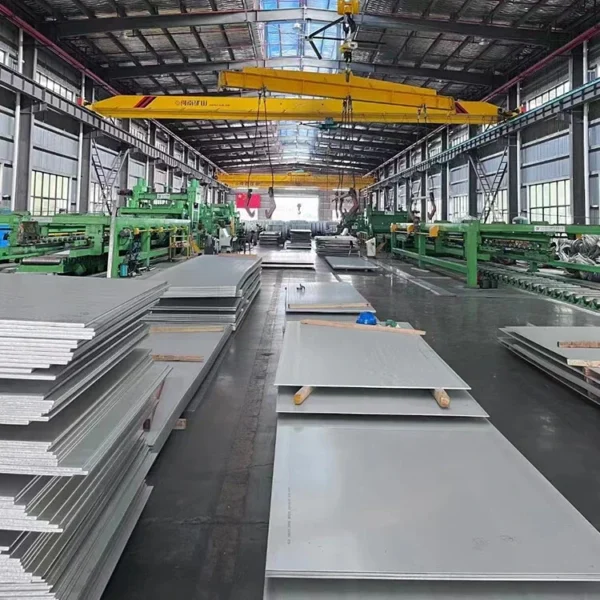
First, state the medium and the wall temperature. Second, say whether the part holds pressure. Then give the form and the size, so the plate matches the duty.
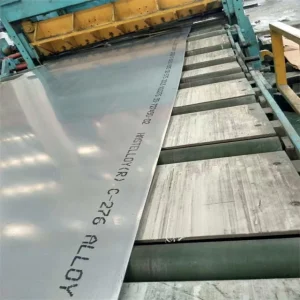
C-276 plate and sheet covers the wet and mid bands. For furnace duty above 1,000 °C, Hastelloy X plate and sheet fits better. For oxidizing acid, C-22 coil and strip fits better.
Related Reading
Grade naming systems read best in the silicon steel grade note, since both explain how a number encodes a spec. Cut-length practice appears in the cut-to-size note.
Frequently Asked Questions
Is 1,040 °C the true limit? Only in clean dry air, since sulphur or chloride lowers it.
What caps the temperature in acid service? The boiling point and the pressure rating, not the alloy.
Does C-276 creep at 500 °C? Slowly, so a pressure part needs a code check.
Can I use it in a furnace at 1,100 °C? Not safely, since the scale spalls and strength drops.
Does a weld lower the ceiling? It can, since segregation ages the bead faster.
- Email: vera.liang@ztwysteel.com
- Location: Xishan District, Wuxi, Jiangsu, China
- Supply range: C-276 plate 1–50 mm, X plate 1–50 mm, C-22 coil 0.5–3 mm
- Cutting: length under 4 m, ±1 mm, squareness 1 mm per metre
- Documentation: MTC EN 10204 3.1 with UNS number, 3.2 on request





 English