

What is grain-oriented electrical steel (GOES) used for?
Grain-oriented electrical steel exists for one geometry: flux that runs in a single direction, along the rolling axis. Therefore, it serves transformer cores first, and almost every other use is a variation on that theme. Where flux turns or rotates, the material loses its advantage quickly. Jiangsu Zhongtong Weiye Special Steel Co., Ltd. supplies it at 0.23–0.35 mm.
One Rule Decides Every Use
Goss texture aligns easy magnetization along the rolling direction. Consequently, loss along that axis falls far below the cross direction. Every design decision follows from that asymmetry, and every misuse follows from ignoring it.
Use 1 — Power Transformer Cores
Core-form and shell-form power transformers use oriented sheet in grades from 23P85 to 30P120. Flux runs along each limb, so the texture works as intended. Moreover, no-load loss bills continuously, which justifies the premium.
Joints remain the weak point, since flux must cross a gap at each corner.
Use 2 — Distribution Transformers
Distribution units use the same family at 0.27–0.35 mm, usually at moderate loss classes. Volume drives the choice, so buyers accept a slightly higher W/kg. Consequently, this segment consumes the largest oriented tonnage.
Dry-type units follow the same logic, although their insulation class shapes the build.
Use 3 — Wound and Cut Cores
Wound cores, also called cut cores, bend the strip around a mandrel and then anneal it. Flux still runs along the strip, so orientation survives the bend. Therefore, small and medium transformers often prefer this shape, because it removes corner joints entirely.
Toroidal cores take the same idea further, since a toroid has no joint at all.
Use 4 — Reactors and Chokes
Reactors need a controlled gap, yet their flux still runs longitudinally through the limb. Hence oriented sheet suits them, provided the gap fringing is managed. A reactor core lamination shows the gapped format we supply.
Fringing flux at the gap adds loss, so the gap width matters as much as the grade.
Use 5 — Instrument and Current Transformers
Instrument transformers demand accuracy rather than bulk, so they use thin oriented sheet at small sizes. Low loss keeps phase error predictable, which is the actual specification. Therefore, precision buyers often choose the thinnest grade they can afford.
Where GOES Loses
Rotating machines are the clearest case, because flux rotates through every angle. High-frequency duty is the second, since thin conventional sheet still loses at kilohertz. Three-dimensional flux paths are the third, because a T-joint forces flux across the grain.
Using oriented steel in those places wastes money without a benefit.
Why Thin Gauge Helps a Transformer
Eddy loss falls with the square of thickness, so 0.23 mm beats 0.30 mm clearly. However, thinner sheet costs more per ton and stacks with a lower factor. Therefore, choose gauge against the loss target rather than against fashion. Domain-refined grades add laser scribing, which cuts loss again at a price.
Why Joint Design Eats Half the Gain
A butt-lap joint loses more than a mitered joint, since flux must jump a gap. Step-lap joints reduce that penalty further by spreading the gap across several sheets. Consequently, two cores built from one grade can differ by several percent in no-load loss.
Therefore, ask about joint design before arguing about grade.
What Buyers Get Wrong
Buyers often order a grade and forget the joint, yet the joint decides the result. Others choose thick sheet for a large core, because thick sheet feels stronger. Some assume oriented steel suits any transformer, although small EI cores waste it. Consequently, ask what the flux path does before naming a grade.
What Grade Fits What Use
- Large power transformers: 23P85 to 27P110, thin and low loss.
- Distribution units: 27P110 to 30P120, balanced cost.
- Wound cores: 23P85 to 27P100, thin for easy bending.
- Reactors: 27P110 to 30P120, gauge chosen for the gap.
- Instrument cores: thinnest available, for accuracy.
Each row trades loss against cost and formability.
A Note on Standards
EN 10107 defines oriented grades, and ASTM A876 covers the same family. Both express loss at 1.7 T and 50 Hz, so figures compare directly. Japan uses JIS C2552, which encodes gauge and loss with its own letters. Hence convert by loss value, never by code resemblance.
Related Reading
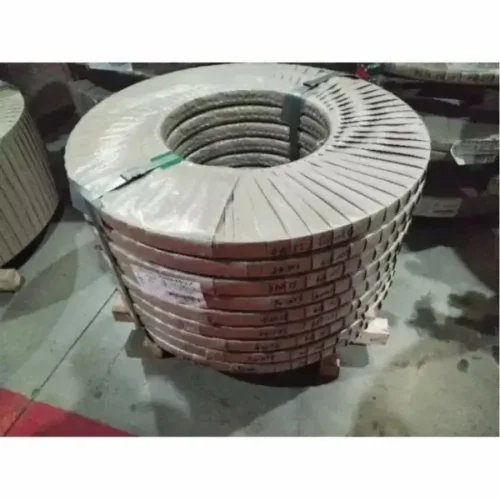
Coil formats and handling appear in the oriented coil guide. Process background sits in the cold-rolled oriented steel guide.
Frequently Asked Questions
Rarely, since motor flux rotates rather than runs one way.
Only at modest frequency, because conventional gauge still loses.
P marks oriented grades, and the trailing number gives loss at 1.7 T.
Yes, since bending does not destroy the texture.
Yes, since CRGO abbreviates cold-rolled grain-oriented.
What We Do Not Do
We do not wind or anneal cores. We do not stamp laminations. Nor do we supply oriented sheet below 0.20 mm.
Those limits keep the offer accurate.
Specify Your Order
First, state the flux path and the rating. Second, name the grade or the loss limit. Then give the gauge and slit width, so we can match stock.
M5 Grain Oriented Electrical Steel covers 0.27–0.30 mm cores, and quotes return within one working day.
- Email: vera.liang@ztwysteel.com
- Location: Xishan District, Wuxi, Jiangsu, China
- Supply range: CRGO M4/M5 at 0.23–0.35 mm, CRNGO M19–M47 at 0.35–0.65 mm
- Slitting: 20–1250 mm, ±0.05 mm, burr under 0.02 mm
- Documentation: MTC EN 10204 3.1, loss data per ASTM A343 / IEC 60404-2







 English