
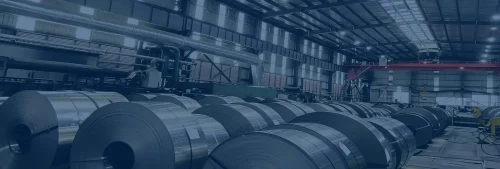
Inside Silicon Steel R&D
ستمبر 14, 2026
بلاگ
I. The Need for Continuous Silicon Steel Research & Development
As the core functional material of the power industry, سیلیکون اسٹیل’s magnetic permeability and core loss directly govern the energy efficiency of transformers, motors and other electrical equipment. Amid tightening global energy efficiency standards, conventional سیلیکون اسٹیل faces three major challenges:
- Severe eddy current loss: Heat generated by magnetic domain reversal under high-frequency operating conditions can reduce equipment efficiency by up to 15%.
- Thickness limitation bottleneck: The current manufacturing technology pushes material thickness close to its physical limit at 0.18 mm.
- Cost dilemma: Heavy reliance on imported high-grade grain-oriented سیلیکون اسٹیل urgently needs to be resolved.

II. Three Core R&D Breakthrough Directions
Modern silicon steel research is analogous to constructing “magnetic high-speed channels” at the micro scale:
- Texture control technology Special rolling and annealing processes are adopted to form the ideal {110}<001> grain orientation, which boosts magnetic flux density by 30%.
- Coating innovation High-temperature resistant insulating coatings are developed to maintain inter-lamination resistance above 50 Ω·cm².
- Thin strip continuous casting breakthrough Direct production of ultra-thin 0.1 mm strips skipping the hot rolling stage cuts manufacturing energy consumption by 40%.
III. Overlooked Barriers in Application Innovation
These easily neglected R&D details exert decisive impacts on final performance:
- Stress sensitivity Internal stress induced by blanking and shearing can degrade core loss by 20%, necessitating the development of stress-relief annealing processes.
- Service aging Magnetic properties may degrade by 8% after transformers operate for 10 years; novel AlN inhibitors slow down such performance decay.
- Cross-industry applications Drive motors for new energy vehicles demand silicon steel compatible with both high-frequency (800 Hz) and low-temperature (-40 ℃) operating environments.





 English
  Japanese
  Korean
  French
  German
  Spanish
  Portuguese
  Russian
  Arabic
  Italian
  Turkish
  Dutch
Dutch  Polish
  Swedish
  Danish
  Norwegian
  Finnish
  Greek
Greek  Hungarian
  Czech
Czech  Romanian
  Bulgarian
  Slovenian
  Croatian
  Slovak
  Malay
Malay  Indonesian
  Thai
Thai  Vietnamese
  Myanmar
  Khmer
Khmer  Lao
Lao  Tagalog
  Hindi
Hindi  Bengali
  Urdu
Urdu  Nepali
  Sinhala
  Hebrew
  Ukrainian
  Serbian
  Icelandic
  Swahili