

Key Influencing Factors of Silicon Steel Resistivity and Application Selection
The resistivity of silicijevo jeklo sheets generally ranges from 45 to 60 μΩ·cm, with exact values determined by silicon content and manufacturing processes. A thorough grasp of this parameter is critical for material selection and performance optimization. This paper systematically analyzes its influencing factors and corresponding matching solutions.
I. Correlation Between Silicon Content and Resistivity
Silicon content acts as the core factor governing silicijevo jeklo resistivity, exerting effects in two major aspects:
- High-silicijevo jeklo (silicon content above 3%) achieves resistivity of 50–60 μΩ·cm, which effectively suppresses eddy current loss yet raises processing difficulty.
- Low-silicon steel (silicon content 1%–2%) delivers resistivity around 45–50 μΩ·cm, better suited for stamping and forming applications.
🔍 Core Difference: Every 1% increase in silicon content lifts resistivity by approximately 5–8 μΩ·cm, while magnetic permeability declines accordingly.
Heat treatment modifies grain structures to adjust resistivity. Annealing eliminates internal residual stress in cold-rolled silicon steel and stabilizes its resistivity. When annealed at 800–850 °C in dedicated silicon steel annealing furnaces, enlarged grain size reduces resistivity by 3%–5%.
💡 Process Tip: Excessively high annealing temperatures trigger surface oxidation of silicon steel, which conversely pushes resistivity upward.
II. Performance Analysis of Cold-Rolled Silicon Steel
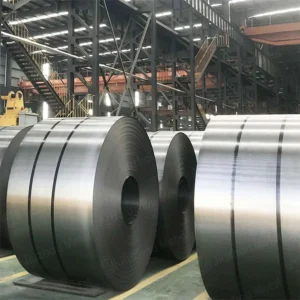
Cold-rolled silicon steel obtains oriented grain structures via rolling processes, featuring the following characteristics:
- Stable resistivity within 47–52 μΩ·cm
- Thickness tolerance up to ±0.02 mm, ideal for laminated motor core fabrication
- Insulating coating treatment cuts eddy current loss by 15%–20%
✅ Preferred Applications: Stator cores of small and medium-sized motors, high-frequency transformers and other loss-sensitive equipment.
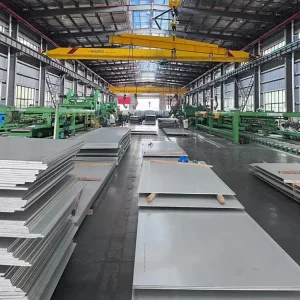
Hot-rolled silicon steel features randomly distributed grain orientations. With sheet thickness ranging 1.5–3.5 mm, its resistivity is normally maintained at 50–55 μΩ·cm. This material fits large power transformer cores and delivers prominent cost advantages in low-frequency high-power operating conditions.
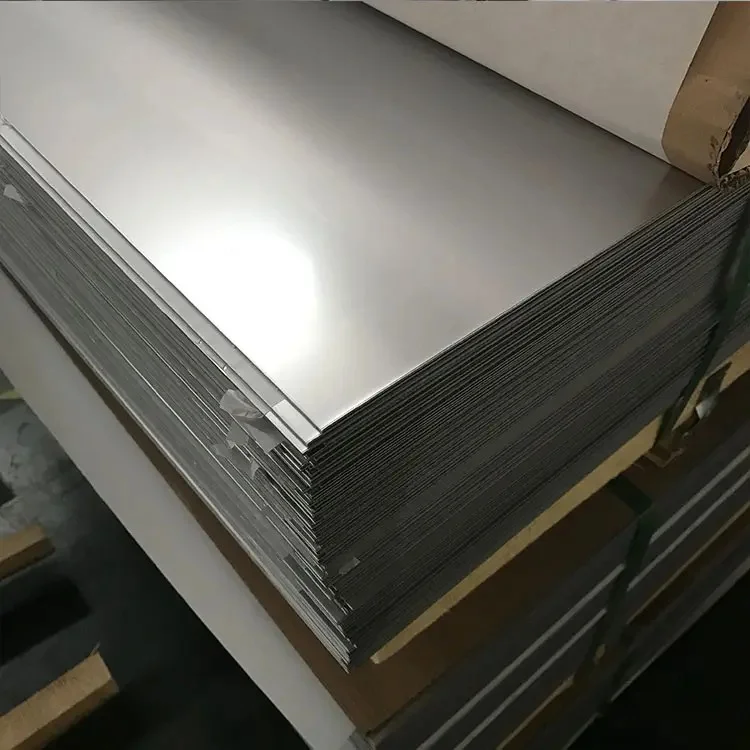
III. Impacts of Machining Processes
Mechanical working alters the microstructures of silicon steel:
- During shearing with silicon steel cutters, grain deformation at cutting edges raises local resistivity by 5%–8%.
- Setting the clearance of stamping die cutting edges to 5%–8% of sheet thickness minimizes magnetic property degradation.
⚠️ Reminder: Low-temperature annealing at 200–300 °C is recommended post-machining to restore electromagnetic performance.
Surface treatment offsets performance losses caused by processing. The 2–5 μm insulating film formed by silicon steel insulating coatings preserves bulk resistivity while restraining inter-lamination eddy currents. In humid environments, silicon steel anti-rust agents prevent resistivity fluctuations induced by surface oxidation.
IV. Performance Testing Solutions
Specialized silicon steel testing equipment is required for accurate resistivity measurement, with mainstream test methods listed below:
- Four-point probe method for bulk resistivity measurement
- Eddy current testing to evaluate coating uniformity
- Hysteresis loop tester for comprehensive loss characteristic assessment
📌 Testing Specifications: Clean specimen surfaces fully before testing; ambient temperature shall be controlled at 23±2 °C.
When selecting silicon steel sheets, clarify the specific resistivity requirements of target applications first, then comprehensively evaluate silicon content, machining procedures and surface treatment schemes. Matching supporting production equipment ensures full utilization of the material’s intrinsic properties.





 English
  Japanese
  Korean
  French
  German
  Spanish
  Portuguese
  Russian
  Arabic
  Italian
  Turkish
  Dutch
Dutch  Polish
  Swedish
  Danish
  Norwegian
  Finnish
  Greek
Greek  Hungarian
  Czech
Czech  Romanian
  Bulgarian
  Slovenian
  Croatian
  Slovak
  Malay
Malay  Indonesian
  Thai
Thai  Vietnamese
  Myanmar
  Khmer
Khmer  Lao
Lao  Tagalog
  Hindi
Hindi  Bengali
  Urdu
Urdu  Nepali
  Sinhala
  Hebrew
  Ukrainian
  Serbian
  Icelandic
  Swahili