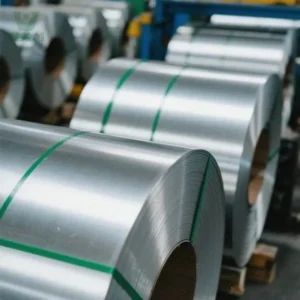
Commonly referred to as electrical steel in the industry, silicon steel is an irreplaceable soft magnetic alloy for power, electronics and national defense industries. It is manufactured by adding 0.5%–4.5% silicon to pure iron. Though it appears as thin steel sheets, it directly determines the voltage conversion efficiency of transformers and energy-saving performance of motors. Without silicon steel, power grids would suffer massive energy loss, and transformers would generate excessive waste heat like giant heaters.
Why Silicon Is Added to Pure Iron
Pure iron boasts excellent magnetic permeability yet suffers from low resistivity. When exposed to alternating magnetic fields, eddy currents form inside iron cores and produce heat, causing severe energy waste. Adding silicon fundamentally raises material resistivity: each 1% rise in silicon content significantly suppresses eddy current loss. Additionally, silicon lowers magnetostriction, cutting operational noise for power equipment.
Two Core Types: Grain-Oriented & Non-Grain-Oriented Silicon Steel
The market offers two mainstream silicon steel grades with distinct internal crystal structures and application scenarios.
1. Cold-Rolled Grain-Oriented Silicon Steel (CRGO)
CRGO features neatly aligned grain structures via precision cold rolling and annealing to form uniform Goss texture. It delivers ultra-high unidirectional magnetic permeability and minimal core loss, making it ideal for transformers with fixed magnetic field directions.
High magnetic induction Hi-B silicon steel is the premium choice for high-end transformers, greatly boosting energy efficiency ratings.
2. Cold-Rolled Non-Grain-Oriented Silicon Steel (CRNGO)
Randomly distributed grains enable consistent magnetic performance across all directions, perfectly matching rotating magnetic fields in motors. It is widely adopted in household appliance motors and industrial drive motors.
Driven by new energy vehicles, high-frequency low-loss CRNGO has become a key R&D focus to cope with ultra-high motor rotating speeds.
Full Production Workflow: Smelting to Finished Cold-Rolled Sheets
Silicon steel manufacturing is regarded as a sophisticated craft in the metallurgical sector. Tiny process deviations will drastically degrade magnetic performance, requiring strict full-process control.
- Ultra-Low Carbon Smelting & Continuous Casting
Silicon steel demands carbon content below 0.005%, as carbon carbides hinder magnetic domain movement and raise hysteresis loss. RH vacuum degassing removes impurities like carbon, oxygen and sulfur, while continuous casting ensures uniform chemical composition across slabs.
- Hot Rolling & Normalization
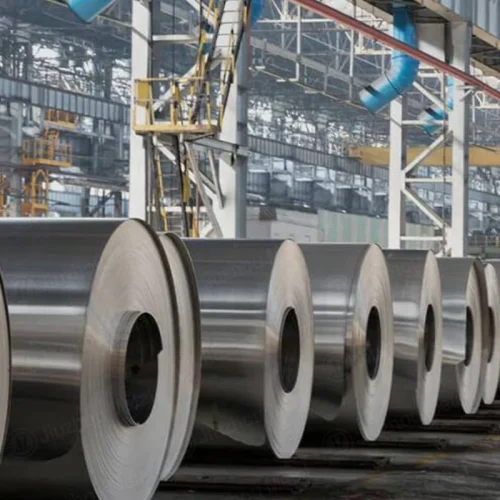
Heated slabs are hot-rolled into thick steel coils. CRGO undergoes additional normalization to homogenize internal microstructure for subsequent grain orientation control.
- Precision Cold Rolling
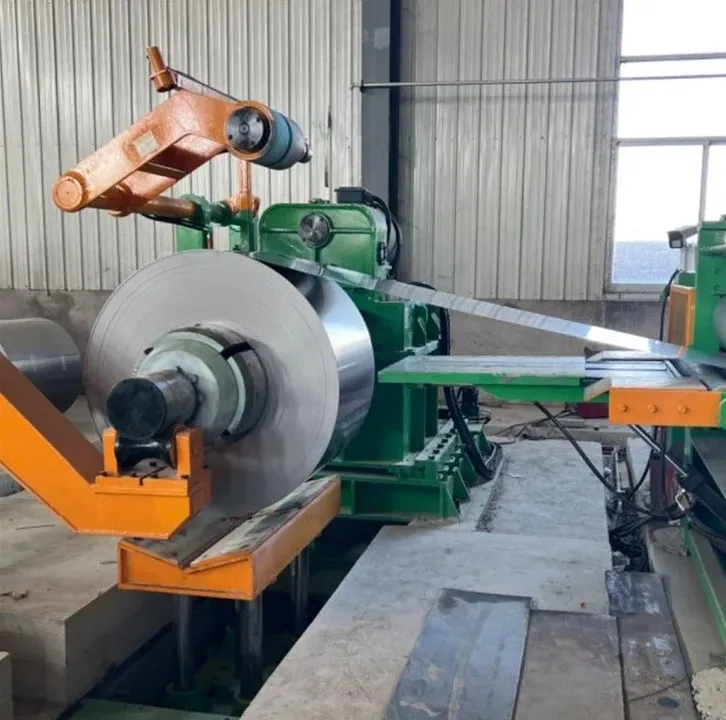
High-reduction cold rolling generates deformation energy to facilitate later recrystallization. CRGO is processed via 20-high rolling mills into ultra-thin gauges (0.23mm, 0.27mm, 0.18mm). Thinner sheets reduce eddy current loss but raise rolling difficulty exponentially.
- High-Temperature Annealing & Insulating Coating
Controlled-atmosphere annealing eliminates internal stress and regulates grain size. For CRGO, magnesium oxide barrier coating reacts at high temperatures to form magnesium silicate, providing surface tension and insulation. A final insulating coating prevents inter-lamination short circuits.
Key Performance Indicators for Silicon Steel Selection
Engineers evaluate silicon steel mainly through two core metrics:
- Core Loss (P, W/kg)
Energy consumption per unit weight under specified magnetic flux density and frequency. Lower values mean higher energy efficiency. For instance, P15/50 stands for core loss at 1.5T magnetic induction and 50Hz frequency.
- Magnetic Induction (B)
Magnetization capacity of the material. Higher B values generate stronger magnetic flux under identical excitation, enabling smaller, lighter transformers and motors.
Industry Applications & Future Development Trends
Global energy transition reshapes market demand for high-performance silicon steel.
New Energy Vehicle Drive Motors
Traditional motors run at 50Hz, while EV motors operate at 400–1000Hz ultra-high frequencies. This drives demand for ultra-thin (0.15–0.2mm) high-frequency low-loss silicon steel, a fiercely competitive R&D field for leading steel manufacturers in China and other countries.
UHV Power Transmission Infrastructure
China’s large-scale UHV grid projects impose strict standards on CRGO. Premium Hi-B grain-oriented silicon steel is essential to cut long-distance transmission losses, underpinning national energy security.
Carbon Neutrality & Energy Conservation Goals
High-efficiency silicon steel slashes power equipment carbon emissions. A mere 1% efficiency improvement for global transformers saves power equivalent to dozens of large thermal power plants. Developing ultra-low-loss, high-magnetic-induction electrical steel has become an industry-wide priority.
Zaključek
Silicon steel is far more than ordinary steel — it is a high-value functional magnetic material. Hidden inside transformer oil tanks and motor casings, it quietly undertakes energy conversion and transmission. From early mass production to today’s nanoscale microstructure control, silicon steel’s technological advancement mirrors humanity’s pursuit of clean, efficient power utilization. Mastering its magnetic characteristics and process limits lays the foundation for designing next-generation high-efficiency power equipment.





 English
  Japanese
  Korean
  French
  German
  Spanish
  Portuguese
  Russian
  Arabic
  Italian
  Turkish
  Dutch
Dutch  Polish
  Swedish
  Danish
  Norwegian
  Finnish
  Greek
Greek  Hungarian
  Czech
Czech  Romanian
  Bulgarian
  Slovenian
  Croatian
  Slovak
  Malay
Malay  Indonesian
  Thai
Thai  Vietnamese
  Myanmar
  Khmer
Khmer  Lao
Lao  Tagalog
  Hindi
Hindi  Bengali
  Urdu
Urdu  Nepali
  Sinhala
  Hebrew
  Ukrainian
  Serbian
  Icelandic
  Swahili