
Is Silicon Steel a Pure Substance?
Сентябрь 14, 2026
Блог
I. Definition and Characteristics of Pure Substances
Pure substances can be described as “single-component substances” in chemistry, consisting of only one constituent, such as distilled water or pure iron. They feature fixed melting and boiling points with strictly consistent component ratios. Silicon steel, however, is an alloy composite of iron and silicon with silicon content ranging from 1% to 4.5%. This variable proportion directly proves it is not a pure substance.
II. Alloy Nature of Silicon Steel
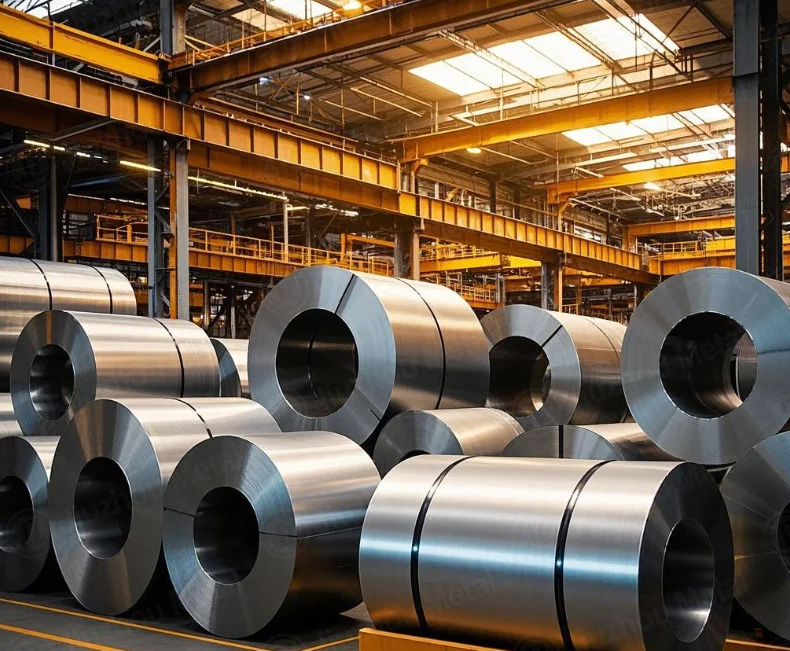
- Composition structure: Similar to nuts mixed evenly in chocolate, silicon atoms are uniformly dispersed throughout the iron matrix in кремниевая сталь.
- Performance variation: Each 1% increase in silicon content raises electrical resistivity by roughly 60% and cuts hysteresis loss by 20%.
- Microstructure: Silicon atoms embed into the interstices of iron crystal lattices, forming a solid solution, a typical alloy structure.
III. Unique Industrial Value Derived From Its Impure Composition
The non-pure nature of кремниевая сталь is exactly what makes it irreplaceable:
- Transformer cores made of 3% silicon steel reduce eddy current loss by 80% compared with pure iron.
- Non-oriented silicon steel used for motor rotors delivers magnetic permeability three times that of pure iron.
- 6.5% silicon steel sheets applied in high-frequency electrical appliances generate only one-tenth of the high-frequency loss of pure iron.





 English
  Japanese
  Korean
  French
  German
  Spanish
  Portuguese
  Russian
  Arabic
  Italian
  Turkish
  Dutch
Dutch  Polish
  Swedish
  Danish
  Norwegian
  Finnish
  Greek
Greek  Hungarian
  Czech
Czech  Romanian
  Bulgarian
  Slovenian
  Croatian
  Slovak
  Malay
Malay  Indonesian
  Thai
Thai  Vietnamese
  Myanmar
  Khmer
Khmer  Lao
Lao  Tagalog
  Hindi
Hindi  Bengali
  Urdu
Urdu  Nepali
  Sinhala
  Hebrew
  Ukrainian
  Serbian
  Icelandic
  Swahili