

Production Process of Grain-Oriented Silicon Steel
The production process of grain-oriented oțel siliconic mainly covers smelting, hot rolling, cold rolling, annealing and coating. Magnetic performance is improved by precise control of grain orientation, and this process determines the material’s service performance in electromagnetic equipment such as transformers.
I. Production Process Procedures
1. Smelting
Smelting is the initial working stage, which requires strict control over silicon content and impurity ratios. The silicon content is maintained at approximately 3%; excessively high silicon impairs subsequent machinability, while insufficient silicon leads to poor magnetic properties. Harmful elements including sulfur and phosphorus are minimized to guarantee molten steel purity. The primary difficulty of this stage lies in compositional homogeneity. Even if laboratory sampling tests pass, segregation may still occur during actual casting. Vacuum degassing and electromagnetic stirring technologies are widely adopted at present to mitigate this issue.
2. Hot Rolling
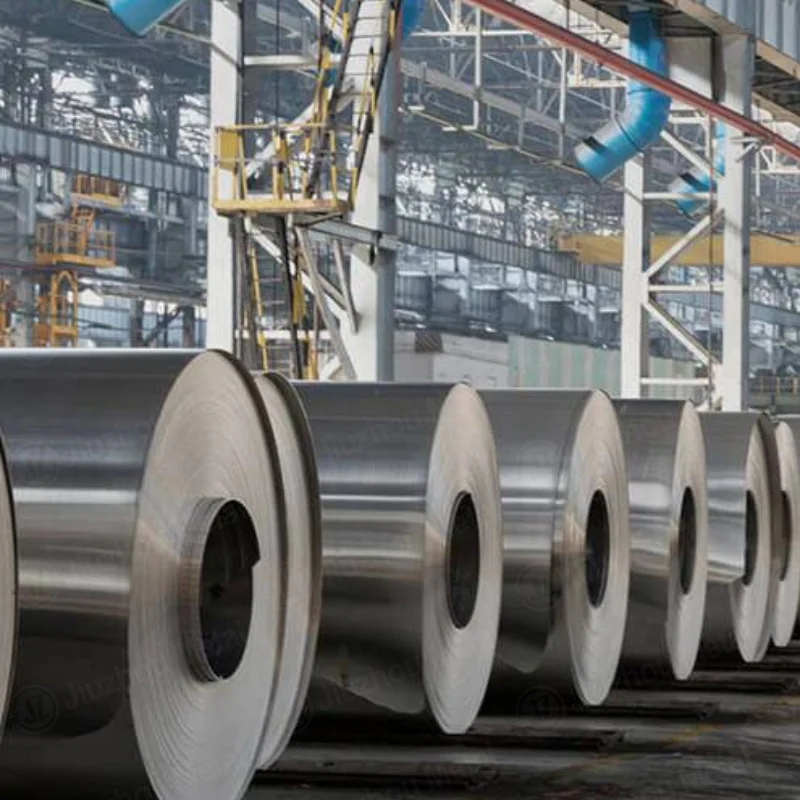
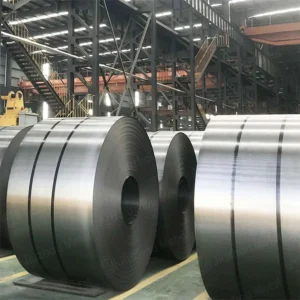
Steel slabs are heated to around 1200 °C and rolled into 2–3 mm thick coils. Austenite grains rearrange at high temperatures to form primary {110} texture, which lays the foundation for generating Goss texture in subsequent processes. Temperature regulation is critical: overheating triggers oversized grains, whereas insufficient temperature drastically increases deformation resistance. Most modern production lines adopt segmented rolling temperature control, limiting the temperature difference between strip head and tail within 30 °C.
3. Cold Rolling & Annealing
Multi-pass cold rolling combined with intermediate annealing reduces strip thickness to 0.23–0.35 mm. Each rolling pass adopts a reduction rate of roughly 50%; excessive reduction will disrupt the texture structure. Annealing serves as the core procedure: decarburization annealing thoroughly eliminates carbon, and secondary recrystallization annealing uses inhibitors such as MnS and AlN to drive Goss texture grains to swallow grains with other orientations. The final finished product achieves a Goss texture proportion exceeding 80%.

II. Application and Material Selection
Magnetic anisotropy makes grain-oriented oțel siliconic ideal for transformer cores. Apart from thickness, two core indicators shall be prioritized during selection: magnetic induction B8 (magnetic induction under magnetic field strength of 800 A/m) and core loss P1.7/50 (specific loss per unit mass at 1.7 T and 50 Hz). Magnetic performance of the same grade may fluctuate by around 5% across different batches. Incoming inspection is recommended for core equipment.
Every link of grain-oriented oțel siliconic production, from composition control to texture optimization, targets superior magnetic performance. Such sophisticated precision control explains why its price is two to three times higher than non-oriented silicon steel.





 English
  Japanese
  Korean
  French
  German
  Spanish
  Portuguese
  Russian
  Arabic
  Italian
  Turkish
  Dutch
Dutch  Polish
  Swedish
  Danish
  Norwegian
  Finnish
  Greek
Greek  Hungarian
  Czech
Czech  Romanian
  Bulgarian
  Slovenian
  Croatian
  Slovak
  Malay
Malay  Indonesian
  Thai
Thai  Vietnamese
  Myanmar
  Khmer
Khmer  Lao
Lao  Tagalog
  Hindi
Hindi  Bengali
  Urdu
Urdu  Nepali
  Sinhala
  Hebrew
  Ukrainian
  Serbian
  Icelandic
  Swahili