
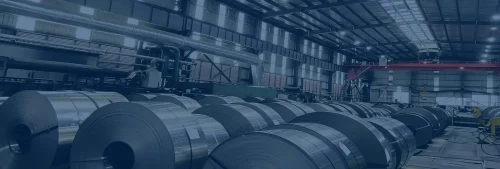
Density of Silicon Steel
The density of aço ao silício generally ranges from 7.65 to 7.75 g/cm³, with the exact value determined by silicon content and manufacturing processes.
I. Standard Density Values of Silicon Steel
Silicon content is the dominant factor governing aço ao silício density. Silicon has a lower atomic mass than iron, so density decreases slightly as silicon content rises. For conventional non-oriented aço ao silício with 1%–3.5% silicon, its density fluctuates within the 7.65–7.75 g/cm³ range.
It should be noted that this range is only empirical. Actual density is also affected by the content of other alloying elements and impurities.
Processing technology creates minor density variations. Cold-rolled silicon steel features more consistent grain orientation, resulting in a density 0.01–0.02 g/cm³ higher than hot-rolled silicon steel. This discrepancy is usually negligible for most practical applications, except for special scenarios with ultra-high magnetic performance requirements.

II. Application and Material Selection of Silicon Steel
Silicon steel is primarily used to fabricate iron cores for transformers and motors. Although density affects material weight and volume, magnetic indicators such as magnetic permeability and core loss take higher priority during grade selection.
For weight-sensitive applications, high-silicon silicon steel is an option; it delivers superior magnetic performance despite marginally lower density. For space-constrained equipment, materials with slightly higher density and greater magnetic flux density are often preferred.
Density is merely one of many selection criteria for silicon steel. It is recommended to first define the magnetic performance requirements of the working condition, then make comprehensive judgements based on silicon content and processing techniques.




 English
  Japanese
  Korean
  French
  German
  Spanish
  Portuguese
  Russian
  Arabic
  Italian
  Turkish
  Dutch
Dutch  Polish
  Swedish
  Danish
  Norwegian
  Finnish
  Greek
Greek  Hungarian
  Czech
Czech  Romanian
  Bulgarian
  Slovenian
  Croatian
  Slovak
  Malay
Malay  Indonesian
  Thai
Thai  Vietnamese
  Myanmar
  Khmer
Khmer  Lao
Lao  Tagalog
  Hindi
Hindi  Bengali
  Urdu
Urdu  Nepali
  Sinhala
  Hebrew
  Ukrainian
  Serbian
  Icelandic
  Swahili