
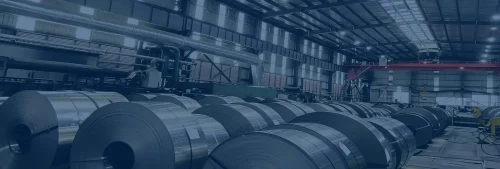
Analysis of Silicon Steel Density & Material Selection Application Guide
The density of aço ao silício sheets generally ranges from 7.65 to 7.75 g/cm³, with minor fluctuations determined by manufacturing processes and material categories. Mastery of this parameter is critical for electromagnetic equipment design and material selection.
I. Factors Affecting Silicon Steel Density
Density discrepancies between cold-rolled and hot-rolled aço ao silício stem mainly from fabrication techniques:
- Multi-pass cold rolling densifies grain structures, yielding densities close to the upper limit of 7.75 g/cm³.
- High-temperature deformation during hot rolling retains more micro voids, resulting in densities mostly between 7.65 and 7.70 g/cm³.
Density gaps between grain-oriented and non-oriented aço ao silício also merit attention:
- Grain-oriented silicon steel undergoes specialized annealing to form Goss texture, delivering slightly higher density (roughly 7.72–7.75 g/cm³).
- Randomly arranged grains in non-oriented silicon steel lead to a wider density fluctuation band (7.65–7.73 g/cm³).
Density variations in such electrical steel sheets exert a direct impact on magnetic permeability and core loss performance.
II. Application Scenarios for Silicon Steel
Silicon Steel for Transformers
A balance between density and magnetic performance must be struck for transformer-grade silicon steel:
- High-density grain-oriented silicon steel boosts magnetic flux density, ideal for high-power transformer cores.
- Thin-gauge laminated silicon steel suppresses eddy current loss via stacked structure. These materials are commonly produced in 0.23–0.35 mm thickness and coated with dedicated insulating film.
Silicon Steel for Motors
Key criteria for motor silicon steel selection:
- Non-oriented silicon steel adapts well to rotating magnetic fields.
- Wide-width silicon steel is prioritized for medium-frequency applications.
- High-density grades improve magnetic circuit efficiency of stators and rotors.
💡 Key Judgment Rule: Higher motor rotational speed imposes stricter tolerance requirements on thickness uniformity of silicon steel sheets.
High-Magnetic-Induction Silicon Steel
With density exceeding 7.74 g/cm³, high-induction silicon steel delivers superior performance in specialized fields:
- New energy vehicle drive motors demand elevated magnetic flux density.
- Precision instruments require consistent, stable magnetic properties.
- High-frequency transformers achieve reduced hysteresis loss. Such materials usually undergo customized heat treatment in silicon steel annealing furnaces.
III. Silicon Steel Processing Equipment
Post-processing machinery directly shapes the final material performance:
- Temperature profiles of annealing furnaces govern grain orientation quality.
- Insulation coating machines determine the stacking factor of laminations.
- Machining die precision controls burr height after blanking.
✅ Reliable Workflow: Confirm silicon steel strip specifications first, then calibrate matching processing equipment parameters accordingly.
Quality control and storage management are equally vital:
- Silicon steel testing equipment measures actual density and magnetic indicators.
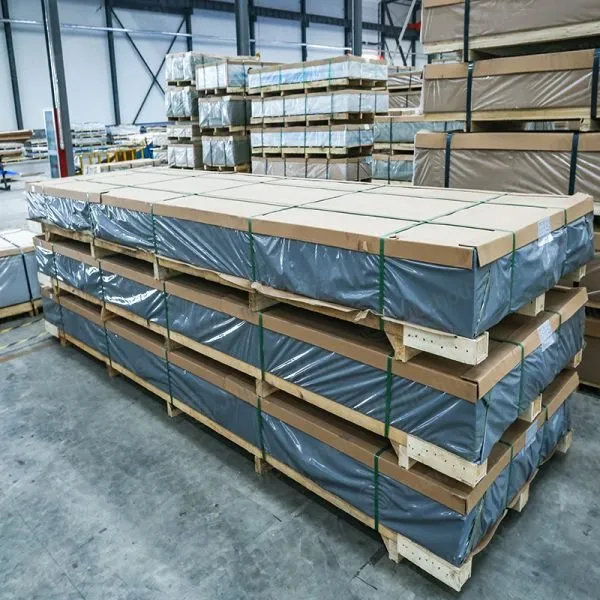
- Special packaging materials provide moisture and rust resistance.
- Insulating varnish treatment enhances inter-lamination insulation. Auxiliary equipment above plays an indispensable role in guaranteeing factory-outgoing silicon steel quality.
IV. Storage & Transportation Solutions
Guidelines for storing silicon steel coils and strips:
- Vertical storage prevents deformation induced by inter-layer compression.
- Constant-humidity environments inhibit surface oxidation.
- Magnetic-shielded packaging minimizes magnetic performance degradation.
Material handling equipment selected based on silicon steel characteristics:
- Electromagnetic suction cups suit bulk transfer of silicon steel plates.
- Air-cushion devices protect the surface of silicon steel bars.
- Custom fixtures avoid deformation of stamped silicon steel laminations.
Density is merely one fundamental index when selecting silicon steel sheets. The optimal solution shall be determined through comprehensive evaluation of magnetic performance, machining requirements and cost constraints.







 English
  Japanese
  Korean
  French
  German
  Spanish
  Portuguese
  Russian
  Arabic
  Italian
  Turkish
  Dutch
Dutch  Polish
  Swedish
  Danish
  Norwegian
  Finnish
  Greek
Greek  Hungarian
  Czech
Czech  Romanian
  Bulgarian
  Slovenian
  Croatian
  Slovak
  Malay
Malay  Indonesian
  Thai
Thai  Vietnamese
  Myanmar
  Khmer
Khmer  Lao
Lao  Tagalog
  Hindi
Hindi  Bengali
  Urdu
Urdu  Nepali
  Sinhala
  Hebrew
  Ukrainian
  Serbian
  Icelandic
  Swahili