

Can Silicon Steel Sheets Be Attracted by Magnets?
A magnet pulls a silicon steel sheet hard, and the sheet forgets the magnet once it leaves. Is silicon steel magnetic splits into three separate questions, and each has its own answer. Jiangsu Zhongtong Weiye Special Steel Co., Ltd. ships silicon steel sheets that pass that test at the receiving dock, since every coil is ferromagnetic by design.
The Short Answer
The sheet is ferromagnetic, so a magnet attracts it strongly at any silicon level used in electrical grades. It is also soft magnetic, so it holds almost nothing after the field leaves. Hence it is easy to magnetise and easy to release, which is the whole point of a core.
Question One — Can It Be Magnetised?
Iron atoms carry a magnetic moment, and silicon does not remove that. A 3 percent alloy keeps a saturation near 2.0 T, against 2.15 T for pure iron. The domains align under a small field, so a weak magnet already shows a pull. Therefore, attraction survives the alloying.
Question Two — How Hard Is the Pull?
The pull depends on the flux the sheet can carry, and a 2.0 T saturation is high. A thin sheet saturates sooner in the through-thickness direction, since the section is small. A stack of ten sheets then pulls harder than one sheet, since the iron mass rises. Hence the stack, not the grade, sets the force.
Question Three — What Stays Behind?
A soft magnetic sheet releases most of its flux when the field leaves, so a paper clip falls away. Some residual remains, and a punched edge keeps more, since strain pins the domains. Stress-relief annealing then clears that residue. Therefore, the sheet is not a permanent magnet.
The Bench Test — Number One
Hold a neodymium magnet an inch from a sheet, and the sheet jumps, since the permeability is high. Type 304 stainless shows nothing, since that alloy is austenitic. Aluminium shows nothing either. Hence the magnet test separates silicon steel from the two common look-alikes.
The Bench Test — Number Two
Touch the sheet with a screwdriver after the magnet leaves, and no pull appears on a clean annealed sheet. Test a punched lamination edge instead, and a light pull may show, since the shear zone holds strain. A second anneal removes that pull. Therefore, the second test measures strain, not grade.
The Bench Test — Number Three
Heat the sheet past its Curie point and the attraction vanishes, since the domains lose order. A 3 percent alloy loses order near 740 to 770 °C, and pure iron near 770 °C. A core never runs near that point, so service temperature keeps it magnetic. Hence the heat test confirms the family rather than the grade.
Why Orientation Changes the Pull
A grain-oriented sheet magnetises easily along the rolling direction, so a magnet pulls harder along the roll. Across the roll the pull drops, since that direction resists the domains. A non-oriented sheet pulls about the same in both directions. Therefore, a pull test can hint at orientation.
Why Thickness Changes the Pull
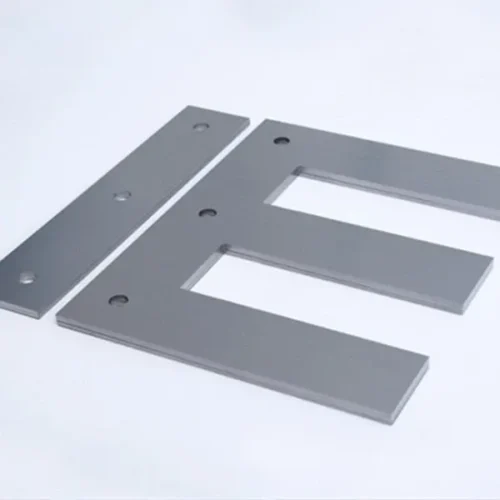
A 0.23 mm sheet carries less iron under the same footprint, so the pull falls against a 0.65 mm sheet. Stacks recover the pull, since the mass returns. Buyers who test a single thin sheet may misread the result. Hence test a stack at the thickness you use.
What the Attraction Does in Production
A magnetised lamination sticks to a die, a conveyor, or another lamination, and a stack then jams. A demagnetiser before assembly clears the residue, and a stress-relief anneal does the same. Loose iron dust also clings to a magnetised sheet and marks the surface. Therefore, handling needs a demag step on a tight line.
The Contamination Question
A magnet dragged over a sheet collects iron dust, and that dust becomes an inclusion in a core. Clean sheets show little dust, while a badly stored coil shows a dark line. A wipe test on the coil edge reveals the storage condition. Hence the magnet doubles as a cleanliness check.
The Confusion With Stainless
Type 304 holds no ferrite in the annealed state, so a magnet ignores it. A cold-drawn 304 forms some martensite, and a magnet then pulls weakly. Silicon steel pulls hard in every state, so the two never confuse a trained hand. Therefore, the stainless comparison is a useful control.
Where Buyers Get It Wrong
A buyer judges a sheet by the magnet test alone and accepts a wrong thickness. Another assumes a soft magnetic sheet cannot stay magnetised and skips the demag step. A third tests a single thin sheet and calls the grade weak. Those three errors cover most of our returns.
What We Do Not Do
We do not melt or roll steel. We do not demagnetise a finished core. Nor do we certify a grade from a magnet test.
Those limits keep the answer honest.
Specify Your Order
First, name the grade and the thickness. Second, state the coating and the width. Then give the stack height, so the slit coil matches the die and the demag step.
Related Reading
The grade naming note explains how a loss code is read, so a 50W470 sits beside a 23P85. The applications note maps grades onto machines, since a transformer and a motor load the sheet differently.
Frequently Asked Questions
Do magnets attract silicon steel? Yes, the sheet is ferromagnetic.
Does it stay magnetised? Almost nothing remains once the field leaves.
Does silicon reduce the pull? Only slightly, since saturation falls from 2.15 to 2.0 T.
At what temperature does it stop? Near 740 to 770 °C, well above any core duty.
Is it attracted like stainless? No, annealed 304 shows no pull at all.
- Email: vera.liang@ztwysteel.com
- Location: Xishan District, Wuxi, Jiangsu, China
- Supply range: CRGO and CRNGO 0.23–0.65 mm, slit to width
- Slitting: 20–1,250 mm, ±0.05 mm, burr under 0.02 mm
- Documentation: MTC EN 10204 3.1 with grade, thickness and loss figure, 3.2 on request






 English