

Are Sheets Electrically Conductive?
A buyer writes “conductive” and means “insulated”, and the two words point at different layers of one core. Is silicon steel conductive answers yes at the metal, while the insulation lives in the coating. Jiangsu Zhongtong Weiye Special Steel Co., Ltd. ships silicon steel sheet with a coating class on the certificate, since that film does more work than the alloy.
The Short Answer
The sheet conducts, and a 0.23 mm strip of 100 mm width shows about 20 milliohms per metre. The coating between sheets blocks the current that would cross the stack. Hence a core needs both a conductor and an insulator, and the two sit in different places.
Circuit One — Inside the Sheet
Iron conducts well, and 3 percent silicon raises resistivity about five times, from 9.7 to 47 microhm-centimetres. That gain cuts the eddy loss inside a single sheet, since the current meets more resistance there. A 0.23 mm strip at 100 mm width then measures near 0.020 ohm per metre. Therefore, the alloy slows the current, and it never stops it.
Circuit Two — Between the Sheets
Bare sheets conduct from the top lamination to the bottom, so a stack acts as one thick conductor. Coating of a few microns breaks that path, and the interlamination resistance then rises by orders of magnitude. C6 and C5 classes differ in that figure, so the class matters at a hot joint. Hence the second circuit is the one a buyer should specify.
Circuit Three — From Core to Frame
A CRGO core sits in a frame, and a bolt through the stack can short the laminations at the ends. An insulating bush and a coated bolt keep that path open, while a careless assembly closes it. A clamp that touches bare edges does the same. Therefore, the third circuit is mechanical, not metallurgical.
What Breaks Each Circuit
Break the first and the sheet becomes an insulator, which no electrical steel does. Losing the second lets the eddy loss climb, since the stack conducts as a block. Losing the third lets a circulating current run through the frame. Hence three failures look different on a test bench.
Why Thickness Matters More Than Conductivity
Eddy loss falls with the square of the thickness, so 0.50 to 0.35 mm cuts that term by about half. A resistivity gain of five times cuts it to a fifth. The geometry wins, and the coating then adds the rest. Therefore, a thin sheet outperforms a thick one at the same alloy.
The Frequency Effect
Eddy loss grows with the square of frequency. A 400 Hz machine feels the coating more than a 50 Hz transformer, since that term dominates. Thin sheet and tight coating therefore matter most at high speed. Cores at 50 Hz tolerate a coarser coating, since the eddy term stays small. Hence the application sets the tolerance.
What the Coating Adds
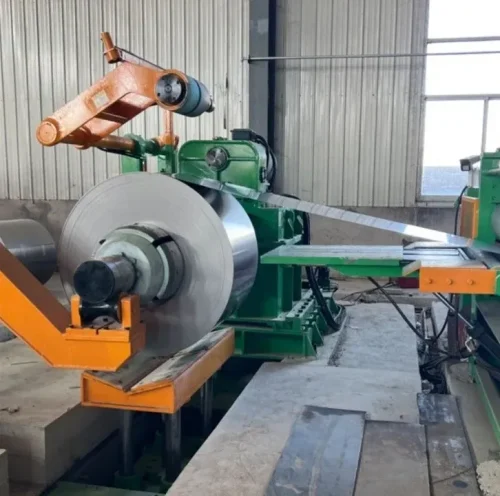
Tension coatings survive a slit and a wind, while organic coatings survive a varnish cure. A self-bonding coating replaces the interlamination insulation, since it glues the stack. Flaking coatings leave a bare patch, and that patch carries the current. Hence the class belongs on the purchase order.
Measuring the Answer
Four-point probes read sheet resistance on a single strip, and that value should land near the alloy figure. A Franklin test reads interlamination resistance on a stack, and that number depends on the coating class. Megohmmeters read the core-to-frame path. Therefore, three instruments answer three questions.
The Temperature Question
Resistivity rises with heat, so a hot core conducts a little worse than a cold one. The coating may degrade faster, since an organic film has a service ceiling. A core at 180 °C then keeps its alloy and loses its insulation. Hence heat hurts the second circuit first.
Where the Confusion Comes From
A datasheet quotes resistivity, and a buyer reads it as insulation. Suppliers quote a coating class, and a buyer reads it as conductivity. A rewinder removes the coating to weld, and a buyer inherits a shorted stack. Those three mix-ups explain most of the questions we get.
Where Buyers Get It Wrong
A buyer orders bare sheet and expects a low-loss core. Another specifies a coating class without a temperature. A third bolts a stack without a bush and blames the steel for the loss. Those three errors cover most of our returns.
What We Do Not Do
We do not melt or roll steel. We do not apply a coating class we cannot certify. Nor do we insulate a finished core.
Those limits keep the answer honest.
Specify Your Order
First, state the grade and the thickness. Second, name the coating class and the service temperature. Then confirm the assembly insulation, so the third circuit stays open.
Related Reading
The grade naming note explains how a loss code is read, so a 23P85 sits beside a 50W470. The thin gauge note covers the thickness effect, which sets the first circuit.
Frequently Asked Questions
Do silicon steel sheets conduct? Yes, at about 47 microhm-centimetres.
Is the coating an insulator? Yes, and its class sets the stack resistance.
Why not use a thick sheet? Eddy loss grows with the square of thickness.
Can a bolt short a core? Yes, so an insulating bush is needed.
Does heat change the answer? Resistivity rises, and the coating may degrade.
- Email: vera.liang@ztwysteel.com
- Location: Xishan District, Wuxi, Jiangsu, China
- Supply range: CRGO and CRNGO 0.23–0.65 mm, C5 or C6 coating
- Slitting: 20–1,250 mm, ±0.05 mm, burr under 0.02 mm
- Documentation: MTC EN 10204 3.1 with coating class and loss figure, 3.2 on request







 English